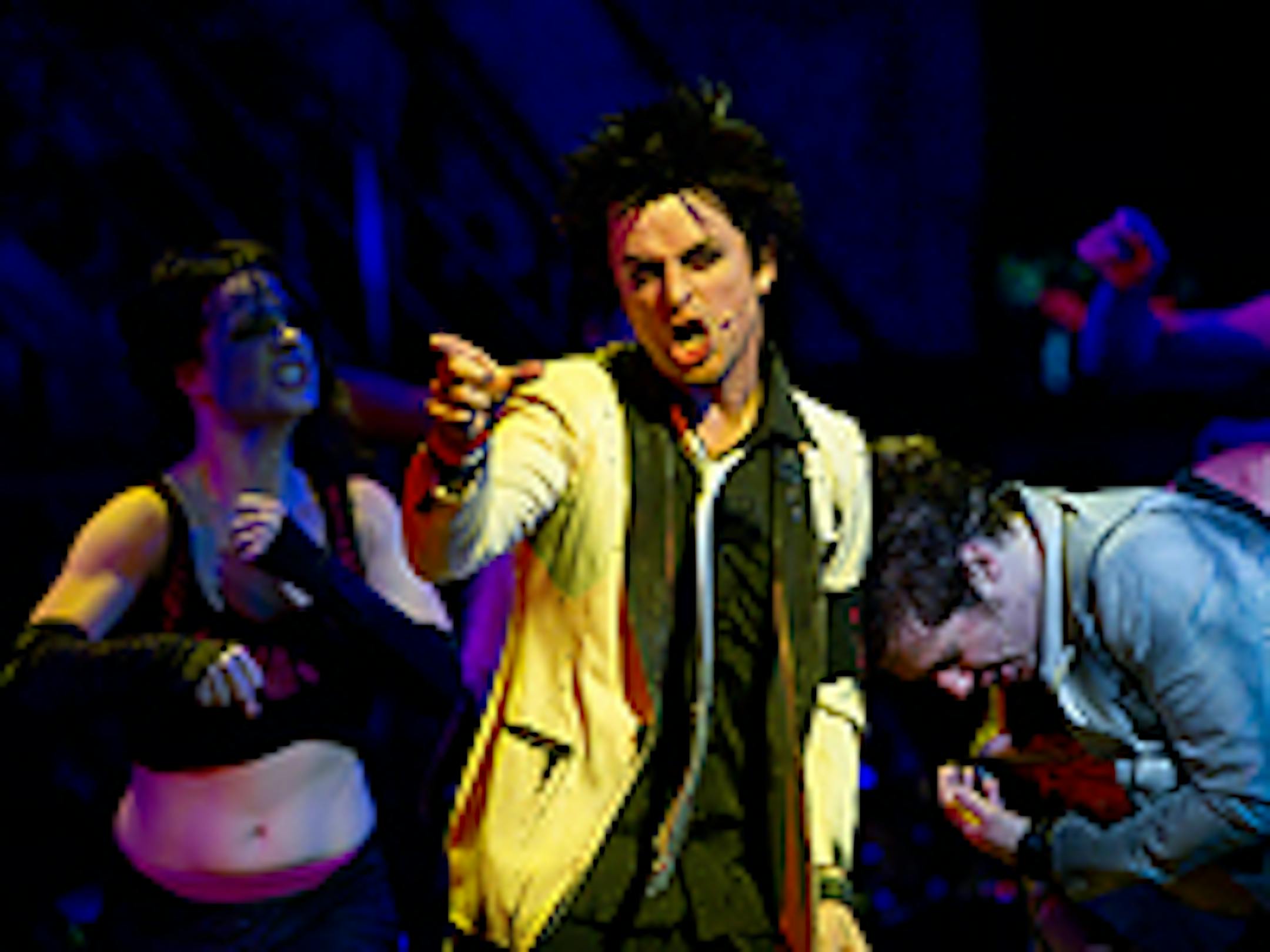
You've seen the billboards: Green Day's "American Idiot" is playing at the Orpheum next week. Wait, what? An "American Idiot" musical? Isn't that a punk rock album? Is the musical actually any good? Does Green Day even know about this? Read on for the answers to all these questions, and more. Ø
Act I: A Punk-Rock Epic
Green Day made its name in the 1990s as punk classicists, precipitating a punk revival with indelible singles like "Longview" and "Basket Case." By the next decade, though, frontman Billie Joe Armstrong and the band were thinking bigger.
Critics had noted the band's increasing lyrical and musical ambition on "Nimrod" (1997) and "Warning" (2000). In the 2003 sessions for an album initially known as "Cigarettes and Valentines," the band wove together multi-part suites that ultimately cohered into a full-fledged concept album tracking the picaresque journey of a "Jesus of Suburbia."
The resulting album, "American Idiot" (2004), became a huge comeback for Green Day after the commercial and critical slump of "Warning." The album went to No. 1 in the United States and 18 other countries, spawned hit singles (including the title track, "Boulevard of Broken Dreams," "Holiday" and "Wake Me Up When September Ends") and won a Grammy for best rock album.
"'American Idiot' really spoke to me," remembers Broadway composer Tom Kitt. "I hadn't heard an album like that in a long time, with thematic qualities from start to finish. It felt like a very important album."
Those themes -- restlessness, alienation, a search for meaning -- had been the stuff of rock concept albums since the Who's seminal "Tommy" (1969), but they were newly resonant in post-9/11 America. To many listeners, the album was begging to be taken to the next stage.
Act II: On Broadway
Director Michael Mayer, who scored a huge Broadway hit with the 2006 rock musical "Spring Awakening," initially thought "American Idiot" was such an obvious candidate for a stage adaptation that one had to be in the works already. When he discovered that such was not the case, he approached Green Day and found them receptive to the idea. Kitt was brought on board to adapt the album -- which is sung entirely by Armstrong -- into a full-fledged musical with a cast of 19 singers.
"There was a point where we were deciding whether we were going to move forward or not," remembers Kitt, "and for that first workshop I came for the last song on the album, 'Whatsername.'"