
Command shakeup sharpens debate on Minnesota home front

The shakeup in the Afghan war hasn't clarified the turmoil for either side of the issue.

June 25, 2010 at 3:58PM
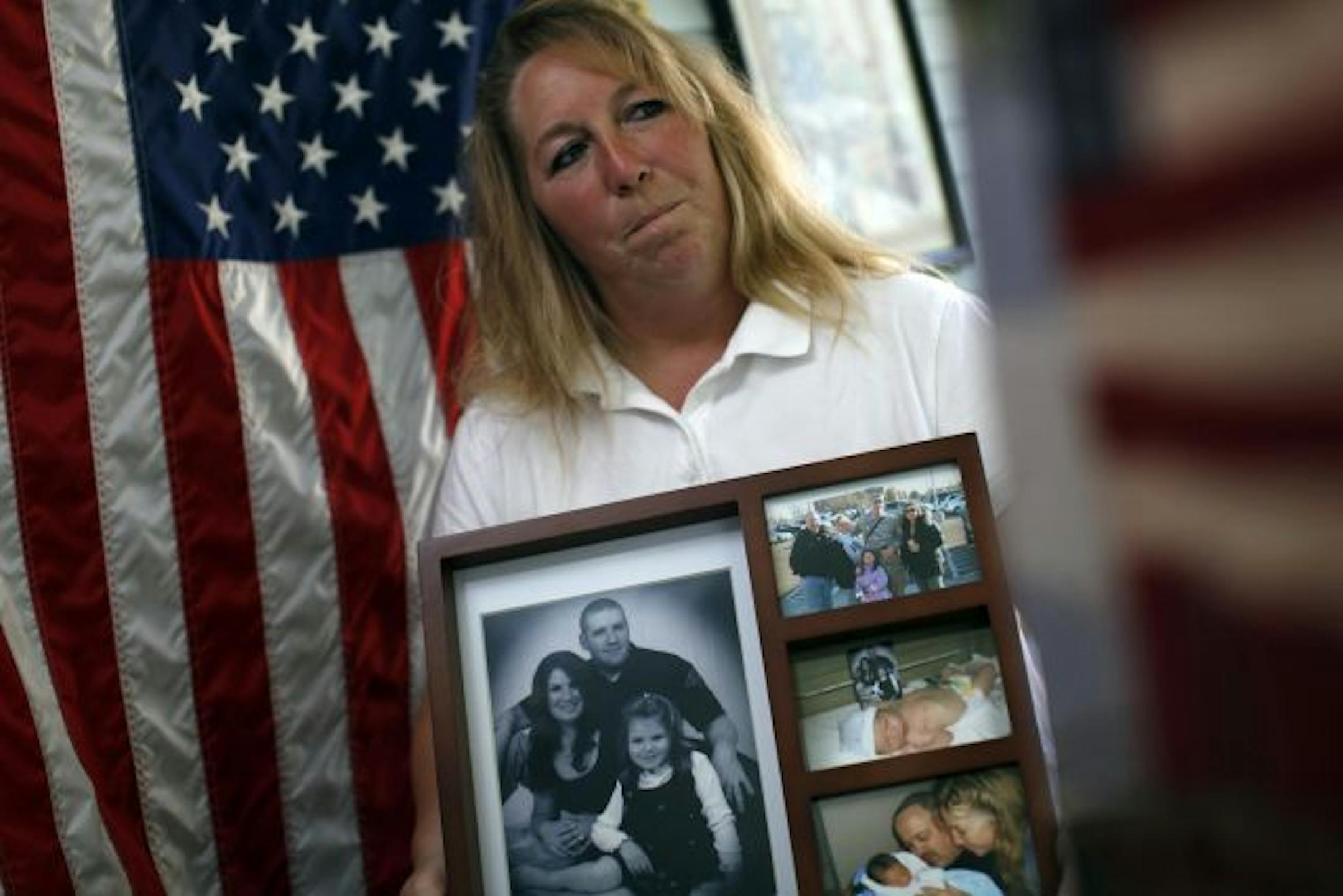
Teresa Ash of St. Paul holds a collection of photographs of her son�s Jake England with his wife Abby their daughter Madelyn and son Collin.
Teresa Ash of St. Paul holds a collection of photographs of her son�s Jake England with his wife Abby their daughter Madelyn and son Collin. (Star Tribune/The Minnesota Star Tribune)

President Obama tried to silence high-level disputes over the nation's Afghanistan war policy with the sacking of Gen. Stanley McChrystal this week, but on the home front in Minnesota, the flare-up in Washington only deepened opposing views of the war.

Those with direct ties to the military and the sacrifices made in Afghanistan want to stay the course. Those long dubious about the effort say the McChrystal episode is yet more evidence that the United States should end what has become the longest foreign war in its history.

For Don Goodnature the disagreement is painful, but understandable. His son, Army Chief Warrant Officer Corey Goodnature, was the first Minnesota soldier killed in Afghanistan. The war has gone on so long that Corey's son Shea is now an Army soldier deployed in the same country where his father died at 35 when his helicopter crashed during an attempt to rescue a team of stricken Navy SEALS.

That was nearly five years ago. Now Don Goodnature, of the tiny southeastern Minnesota town of Clarks Grove, worries for his grandson's life. But he doesn't want the United States to leave Afghanistan and his son's sacrifice behind.

"For us, losing a son there, it means a little bit more," he said. "To see them pull out would really be a waste. We also see the big picture. It's something that's just about impossible to win."

For longtime peace activist Marie Braun of Minneapolis, McChrystal's intemperate comments are the latest example of a muddied U.S. policy in Afghanistan and another reason to end the bloodshed on both sides.

"My hope is that this will mean the beginning of pulling the troops out," she said. "The longer we stay, the more innocent people are going to be killed, the more soldiers will be killed and it will be all for naught. Let this country determine what they want to do for themselves."

Growing impatience

The latest development in the struggle came Wednesday when Obama replaced McChrystal as the commander of U.S. and NATO forces in Afghanistan. The president acted in response to derogatory comments McChrystal and his aides made to Rolling Stone magazine about Obama's senior civilian advisers, including Vice President Joe Biden.

Impatience with the war is growing in the United States and among its allies in the effort. Defense Secretary Robert Gates warned earlier this month that public opinion in the United States and Great Britain would no longer tolerate the loss of their soldiers in Afghanistan unless NATO forces achieved a strategic breakthrough by the end of the year. So far in June, 80 coalition troops have died in Afghanistan, according to icasualties.org, putting June on track to be the deadliest month of the war to date.

The American public in general has become ambivalent about Afghanistan. Before McChrystal's departure, an ABC News/Washington Post poll taken earlier this month found that 53 percent of those polled thought the war in Afghanistan has been worth fighting.

Nineteen percent of those polled either were unsure of whether the United States was winning or thought it was a tie. A CNN/Opinion Research Corporation Poll in May found that 56 percent of those polled opposed the war.

It is a struggle for people like Teresa Ash, who wears three hats and each of them seems connected to Afghanistan these days.

She is the commander of the 4th District American Legion; she handles trauma claims at the Minneapolis Veterans Center; and she is the mom of a soldier who returned home from a recent deployment to Afghanistan.

For Minnesotans like Ash, recent turmoil at the top of the U.S. military command pricks deep frustration about U.S. policy in Afghanistan: Where is it going and what will it mean for people they care about?

Inviolate chain of command

A veteran herself, Ash says respect for the civilian command of the military is inviolate. She is involved with the American Legion and works at the Minneapolis VA, but she does not speak for either organization when she shares her personal feelings. At the American Legion hall and in the halls of the VA, there are divergent opinions about the value of the war. But she said there is little discussion about the importance of the chain of command.

"You don't have to agree with the war, you don't have to agree the president," she said. "What you do have to do and what you have to understand as a civilian is that a soldier's boss is the commander-in-chief, and the commander-in-chief is the president of the United States. Your job is to do what the commander-in-chief says. Your job is to complete a mission. Whether you agree with it or not, that's what you do."

As Afghan policy evolves and the U.S. presence there continues, she sees a troubling lack of commitment in the United States about the implications of staying or pulling out.

Americans complacent

"When 9/11 happened there wasn't an American in this country who wasn't willing to pick up a weapon and fight for their loved ones and their country," she said. "But people in the United States have become complacent, [they think] 'it doesn't affect me. I don't have to worry about picking up a gun and stand and have someone shoot at me. That's those people overseas.' That's the frustration."

In April, Braun, one of the founders of the Twin Cities Peace Committee, acted on the frustration felt by the war's opponents.

She was part of a group of protesters who marched to U.S. Sen. Amy Klobuchar's Minneapolis office to demand that she commit to vote against further funding of the war. Nine people were arrested when they refused to leave. The latest upheaval is likely to affect the resolve of the Minnesota congressional delegation to continue to support war funding, she said.

"I would expect that they're reading the same thing you and I are reading, and they certainly must be uneasy," she said.

While the debate goes on about the future of the worth of the war in Afghanistan, the Goodnature family in Clarks Grove continues to find solace in some words from the past. In 2003, Corey Goodnature wrote a letter to members of his church in Georgia while he was deployed in Afghanistan.

There was no ambivalence then.

He wrote: "As I sit and write this letter on a dark, dusty night, I would like to say I am proud of what we have done. I would not have wanted to be anywhere else and I hope I can contribute more to this fight in the future. I do this for all those who were taken from us two years ago, Sept. 11, 2001. I do it for everyone back home and I will continue to serve for the future of our country."

Mark Brunswick • 612-673-4434

about the writer

about the writer

Mark Brunswick

Reporter

See Moreicon