Comfort and joy in a fish house

A stay in a well-equipped fish house on Upper Red Lake proved euphoric.

January 26, 2011 at 5:10AM
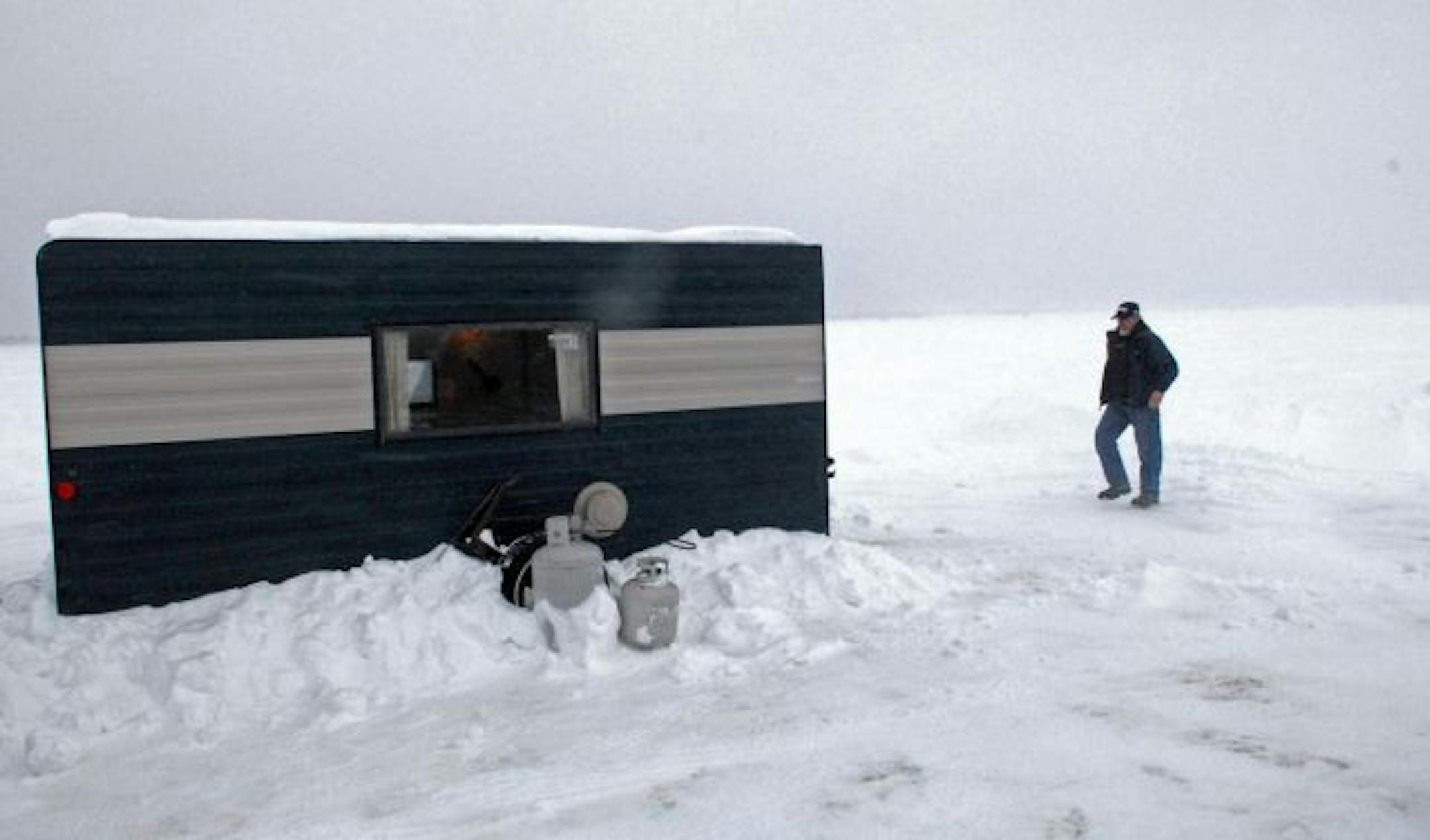
Spider Johnson, originally from the Willmar area, has for many years served as a guide on giant Upper Red Lake in northwest Minnesota, where he also rents fish houses in winter. On Sunday, during a near whiteout on the lake driven by high winds, he checked on one of his houses.
Spider Johnson, originally from the Willmar area, has for many years served as a guide on giant Upper Red Lake in northwest Minnesota, where he also rents fish houses in winter. On Sunday, during a near whiteout on the lake driven by high winds, he checked on one of his houses. (Star Tribune/The Minnesota Star Tribune)

ON UPPER RED LAKE -- Overnight here on Sunday, an incessant wind hurled across miles and miles of ice before enveloping a small village of fish houses about 2 miles from shore. From these sleeper shanties no one would be returning to land until morning, and then, with luck, with a few fish in a bucket.

My friend Spider Johnson rents fish houses on this lake, and I had contracted for a home-away-from-home from him. Two bunks. A heater. A table. Insulated walls. Six holes in the floor from which to dangle minnows and jigs. Perfect.

So much so that among winter pastimes in Minnesota sleeping on frozen water should rank near the top. Except for the ice creaking and groaning, there isn't a quieter place in the state. And any concerns that might trouble you seem never quite to make it very far onto the ice from shore. A peaceful hideout, this, just you and the still snow and creaking ice for miles, beyond which, hereabouts, lie endless miles of jack pine, tamarack and aspen.

Yet Upper Red Lake -- part of the Upper and Lower Red Lake complex, most of which is controlled by the Red Lake band of Chippewa -- has been beset by challenges this winter, as have most Minnesota lakes. Early cold produced early ice, which was good. But then came deep snow, slowing ice formation and, soon, producing slush.

"We couldn't get out as far as we wanted in December," Spider said. "We had some good fishing. But it would have been better if we could have gotten where we wanted to be."

Originally from Spicer, Spider 10 years ago traded his life there as a contractor for one here in the far north as a summer fishing guide and, in winter, a fish-house rental person.

Ironically, the fish that originally drew him here -- crappies, and big ones -- aren't so plentiful anymore in Upper Red.

"It was unbelievable for a while," Spider said. "Remember hauling those big guys in through the ice?"

I said I did. Fifteen-inch crappies, after all, are difficult to forget.

But as it happened, crappies were an anomaly for Upper Red, the product, amazingly, of one super year class, 1995, which occurred at a unique juncture in the fish history of both Upper and Lower Red lakes.

The crappies were only filling a void left by the lakes' remarkable walleye population, which had existed at high levels for centuries before they were nearly netted to extinction by the Red Lake Band of Chippewa and, to some degree, poached by non-band members.

So few walleyes remained in the lake in 1999 that the Department of Natural Resources ended hook-and-line fishing for them. Some people thought the lake would never bounce back -- incredible since it once had so many walleyes the government during World War I opened a processing plant on its shores to help alleviate food shortages.

But credit the DNR, whose biologists said they believed walleyes could be restored in Upper and Lower Red. Together with the Red Lake band, the agency stocked millions of walleye fry in 1999, 2001 and 2003 at a shared cost of about $500,000.

While these fish took hold -- and they did, eventually, fueling the most recent rebirth of Upper and Lower Red walleyes -- crappies in the lakes exploded.

Suddenly, on a winter's day, 10,000 anglers or more could be found on the ice, jigging for black slabs -- and finding them.

• • •

Spider showed me my house and headed home. He hadn't been gone a half-hour when I had my first fish, a 13-inch walleye that under other circumstances I might have kept, but on this late afternoon -- considering the bite happened so quickly -- I released, thinking I would find bigger specimens.

Upper Red is essentially a big dish, mostly 14 feet deep, and my plan wasn't complicated: On one rattle wheel I rigged a small jig, with a fathead hooked through the tail. Through another hole I dropped a BuckShot rattlespoon with a minnow head. Both baits were day-glow, and I "flashed" them before dropping each to about 6 inches from the bottom.

Not far from my house were a handful of Spider's other sleepers, each rented by a friendly group from Willmar. But as night fell, the wind turned gale-force, limiting any inter-house visiting. If you left one shanty seeking another, you might never find it, or your way back.

I crawled into a bunk about 10:30; I had two walleyes by then. Hoping for more, I replaced the jig set-up with a second rattle wheel rig, figuring I'd wake up if a fish took either bait.

And I did. Not once but twice. But both times I missed the fish, probably because I was too slow climbing down from the bunk to set the hook. Or perhaps, as Spider had warned me, the fish were biting light, and they would have escaped me regardless.

At sunup, a wheel rattled again. This time the eternal man-fish battle was won by man, and a plump 15-incher soon flopped on the house floor.

Across the ice, the wind had died, and one by one the odd angler revealed himself outside his little ice home. Some had walleyes, some didn't.

A good place to wake up, fishing.

Dennis Anderson • danderson@startribune.com

Spider Johnson lowered a line into Upper Red Lake, unfurling it from a rattle wheel in a fish house.
Spider Johnson lowered a line into Upper Red Lake, unfurling it from a rattle wheel in a fish house. (Star Tribune/The Minnesota Star Tribune)
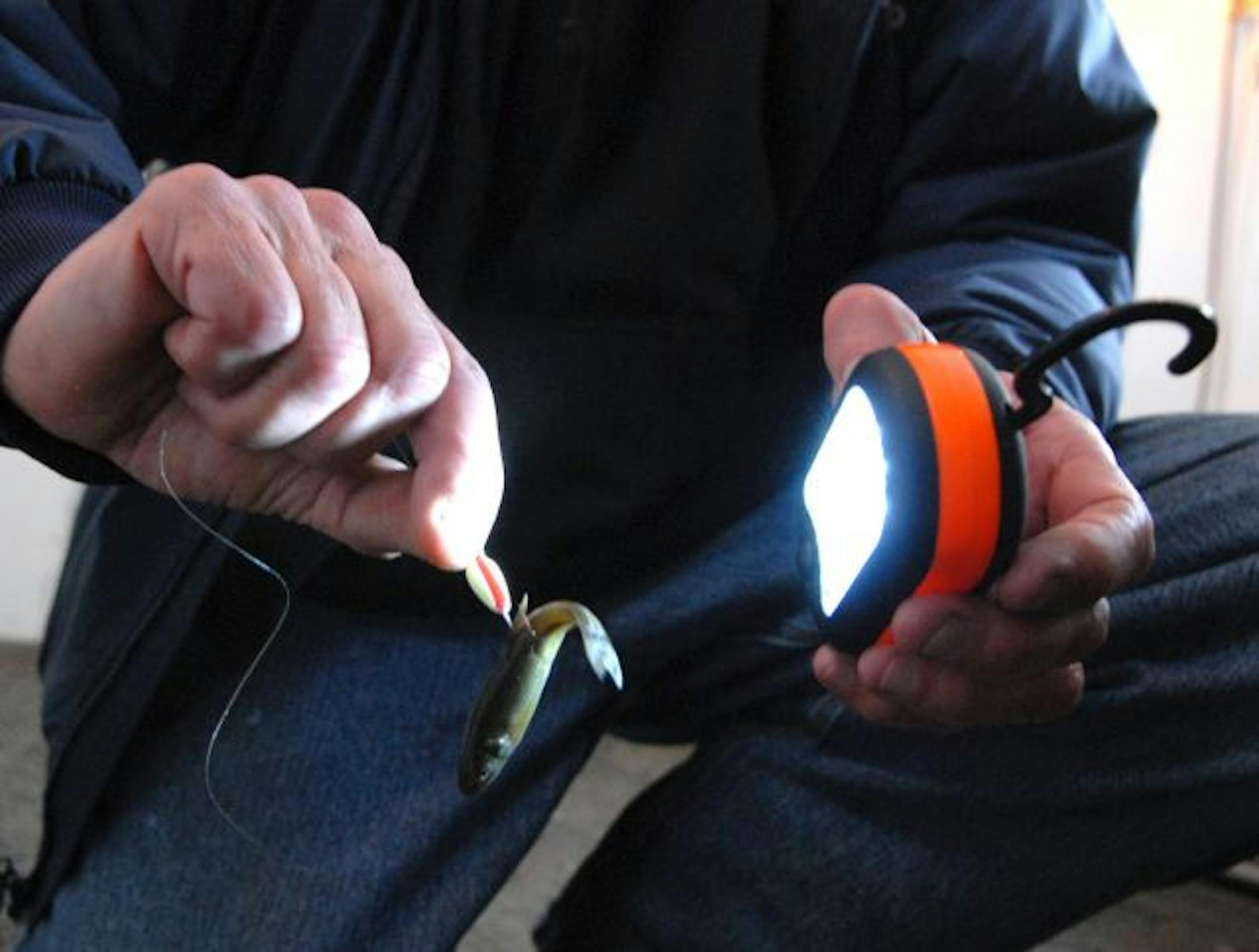
"Flashing'' photo-sensitive jigs to make them glow in the dark winter environs of Upper Red Lake can sometimes trigger walleyes to bite.
“Flashing’’ photo-sensitive jigs to make them glow in the dark winter environs of Upper Red Lake can sometimes trigger walleyes to bite. (Star Tribune/The Minnesota Star Tribune)
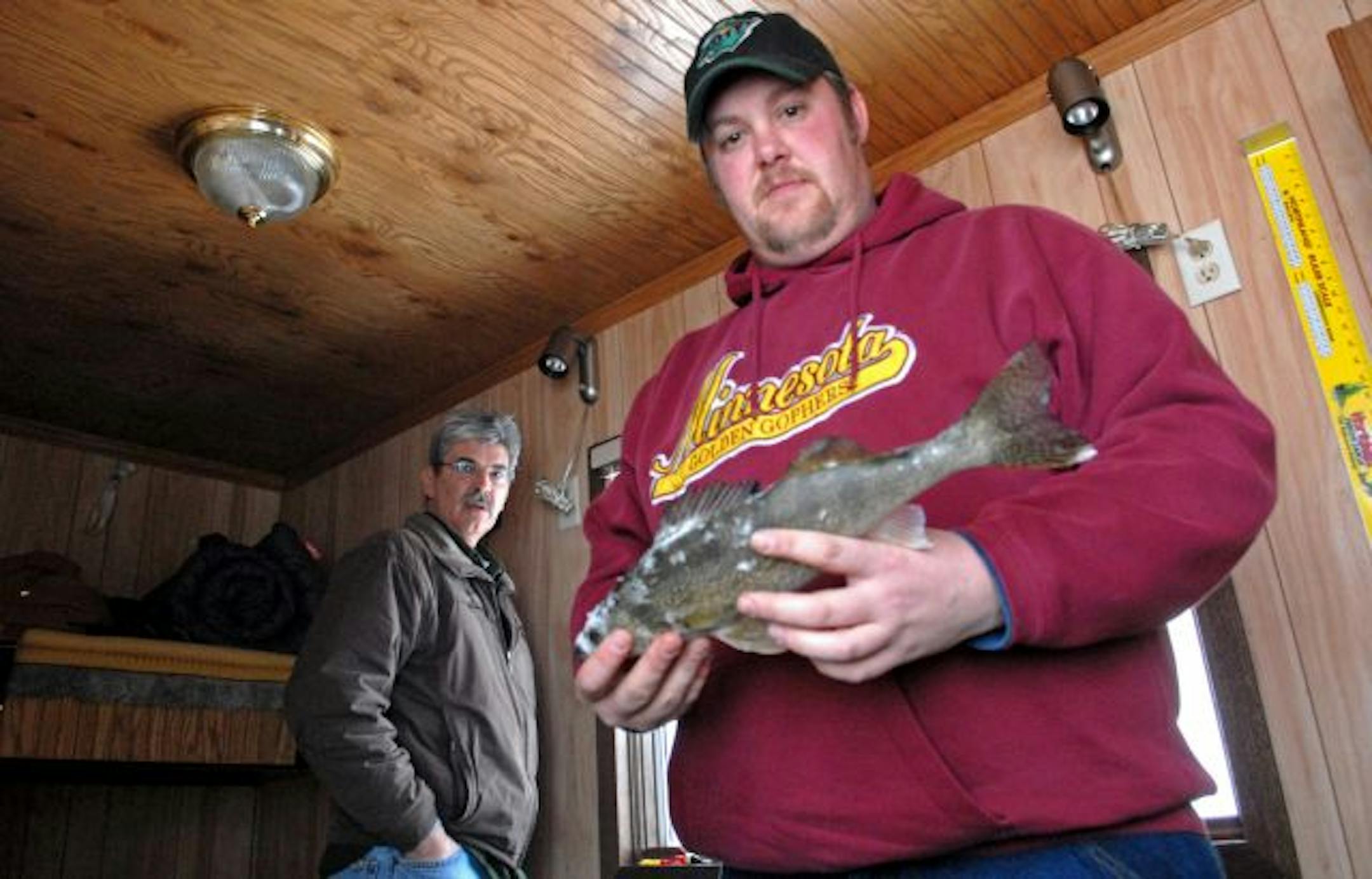
Two anglers renting a Upper Red Lake fish house for a getaway from their homes in west-central Minnesota showed off one of their nice walleyes. On Upper Red Lake, walleyes under 17 inches can be kept.
Two anglers renting a Upper Red Lake fish house for a getaway from their homes in west-central Minnesota showed off one of their nice walleyes. On Upper Red Lake, walleyes under 17 inches can be kept. (Star Tribune/The Minnesota Star Tribune)
about the writer

about the writer

Dennis Anderson

Columnist

Outdoors columnist Dennis Anderson joined the Star Tribune in 1993 after serving in the same position at the St. Paul Pioneer Press for 13 years. His column topics vary widely, and include canoeing, fishing, hunting, adventure travel and conservation of the environment.

See Moreicon