

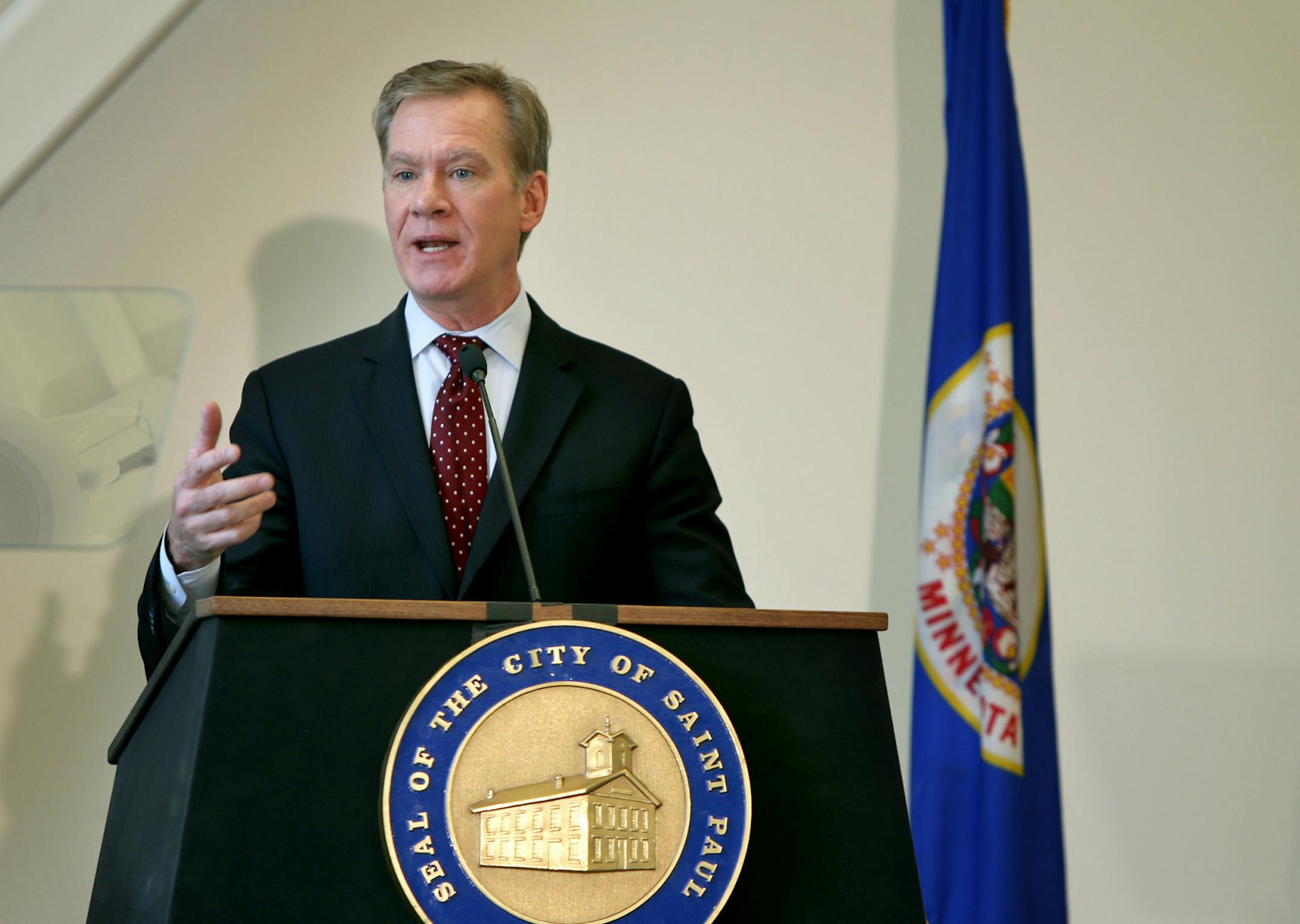
St. Paul is a city on the upswing and its positive momentum must continue, according to its cheerleader-in-chief, Mayor Chris Coleman. His State of the City address this week, sounding a development theme, highlighted exciting projects that have come to fruition in the city in recent years.
It's an impressive list, including downtown and Lowertown revitalization with a new ballpark going up amid more residents, bars, music venues and restaurants. A Lunds grocery store is set to open downtown in six weeks. Construction of several major housing projects proceeds across the city, including the Schmidt Artist Lofts, the West Side Flats and the Pioneer-Endicott apartments. And of course, the Central Corridor light-rail line will connect downtown St. Paul and Minneapolis, beginning in mid-June.
The mayor, to be sure, mentioned some of the city's continuing challenges, including stemming youth violence, improving education and employment opportunities, and performing infrastructure maintenance and repair. We would have liked to hear more about innovative ways to finance that infrastructure work while also keeping property taxes in check.
Referencing this season's particularly difficult "P-word'' (pothole) troubles, Coleman said it would take $70 million to rebuild what he called "the Terrible 20'' stretches of city roads. The mayor plans to call back laid-off street repair workers to get started on fixing heavily pockmarked streets. And he called on the Legislature or Congress to pass transportation bills to help with that work.
Legislators are considering a bill to spend $15 million statewide on pothole repair after this year's difficult winter, but the share of that going to St. Paul likely would only amount to $85,000. Any federal help could be minimal as well, which means city leaders must find ways to reallocate or raise revenues to get the job done.
Coleman delivered his ninth annual assessment of the city at the new $14 million Arlington Hills Community Center on the city's East Side. A combination library and recreation center, the facility is expected to open officially on May 22. It's an example of the mayor's push to operate fewer, but more modern, rec centers serving larger swaths of the city. Some City Council members have opposed that approach and favored maintaining the smaller centers, some of which have already closed or lost programming.
This Editorial Board has supported the mayor's intra-government partnerships to provide enhanced city services more efficiently. The Arlington Hills center is an example of that kind of collaboration between the library system and the parks department. The building houses a gym and a youth technology center that are nearly three times the size of the old rec center and library.
Some young people may have to travel a little farther to use the new centers, but the city is providing transportation through its Sprockets after-school program.


