
Cold night ahead could be record-breaking in southern Minnesota

A long-term forecast calls for a colder and snowier winter than in recent years, but a climatologist says it’s not a sure thing.

The Minnesota Star Tribune
December 3, 2025 at 9:50PM
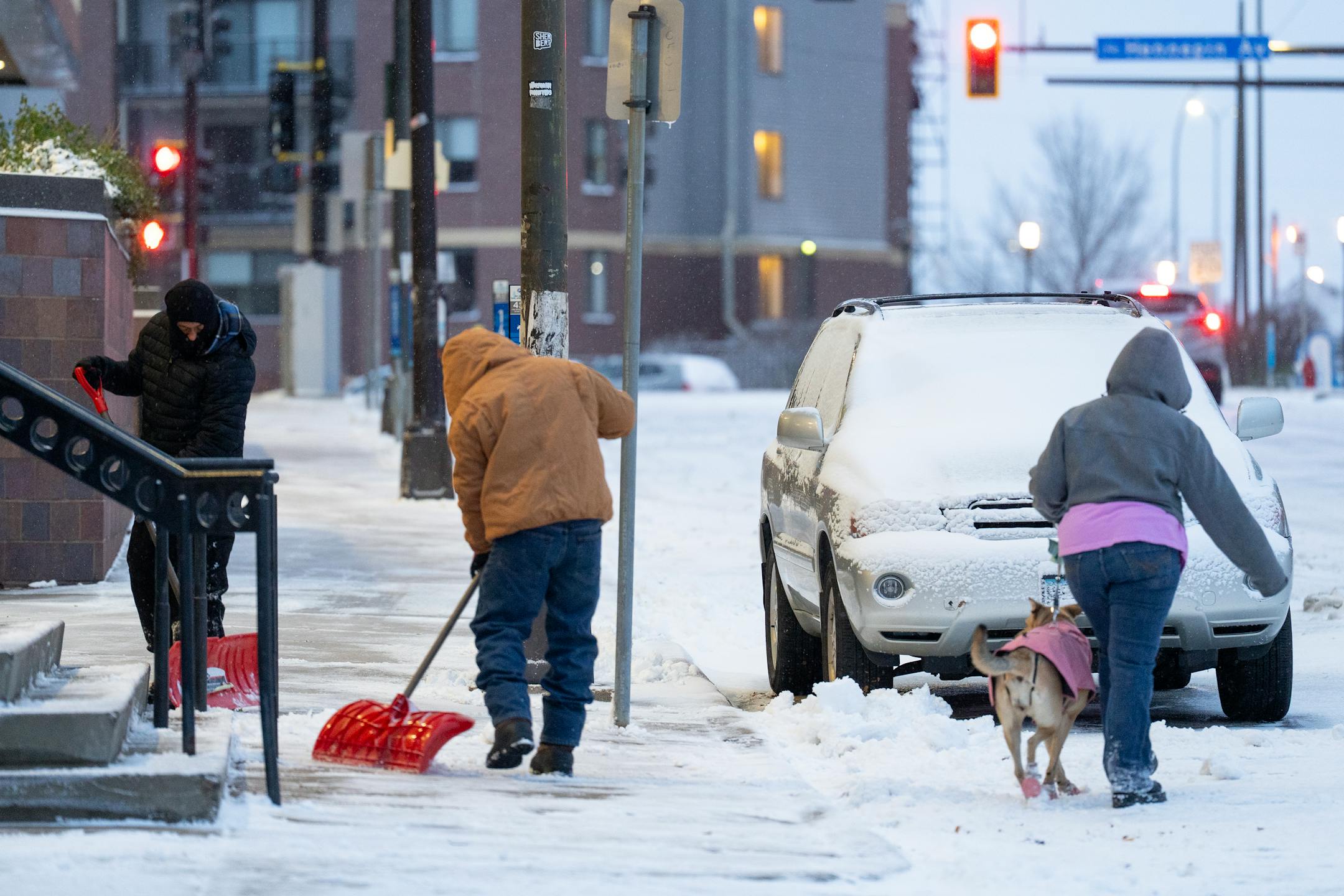
Workers clear snow off the sidewalk in front of Minneapolis College last month while a pedestrian walks their dog. (Alex Kormann/The Minnesota Star Tribune)

Minnesotans should bundle up for a frigid night.

Weather forecasters are predicting subzero temperatures across the state overnight Wednesday into Thursday, with parts of northern Minnesota expected to see lows near minus 20 degrees. It could be the coldest December the state has seen in more than a decade — so cold that some counties in southern Minnesota could even break their record for a daily low overnight.

The National Oceanic and Atmospheric Administration’s latest seasonal outlook shows that Minnesota has a good chance for cold and snowy conditions through February. That’s likely a welcome forecast for Minnesotans, given the state’s string of mild and dry winters in recent years.

But Kenneth Blumenfeld, a climatologist with the state Department of Natural Resources, warns people not to take the prediction as a sure thing.

“I could show you the archive forecast for last winter; it was identical — it was an identical outlook,” Blumenfeld said Wednesday.

Last winter was colder and snowier than its predecessor, dubbed “the lost winter” by state officials. But it was also marked by whiplashing temperatures and midwinter melts. That doesn’t mean meteorologists got it wrong, Blumenfeld said; they were just stating the odds.

This winter, like last winter, could be affected by La Niña, a cooling of ocean waters near the equator. That climate pattern often makes Minnesota winters colder.

Temperature and precipitation forecasts are tricky to understand and often misinterpreted, though, Blumenfeld said.

Blumenfeld breaks down the calculation like this. There are three scenarios for temperature and precipitation for any given month — average, below average and above average — and each scenario has a 33.3% probability if chances are equal. When forecasters say temperature, for example, has a higher chance of being below average for a certain month, the probability could be as low as 33.4%.

The federal forecast for the Twin Cities this winter shows a 38% chance that temperatures will be below average December through February — hence, a cold winter. But it also shows a 33% chance the winter will be average and a 29% chance the winter will be warmer than average. In terms of snow, precipitation this winter in the Twin Cities has only a 34% chance of being above average.

So if you think about it, Blumenfeld said, it’s still quite possible that the Twin Cities will experience an abnormally warm and dry winter like last year. The bright side, he added, is that we’re already seeing cold air and decent snowpack in early December, which “loads the dice” for lower temperatures later this winter. White snow reflects heat back into space, which helps to maintain low temperatures — something known as the albedo effect.

As temperatures were set to plummet Wednesday evening, Blumenfeld said it’s important to remember that Minnesota winters are generally getting warmer. While some parts of Minnesota are likely to set record lows Wednesday night, it’s far more common now to set record highs during the winter.

“Winter is always going to be the coldest season,” he said. “What’s changing is the severity of the cold and then the frequency with which we get severe cold.”

about the writer

about the writer

Kristoffer Tigue

Reporter

Kristoffer Tigue is a reporter for the Minnesota Star Tribune.

See Moreicon