

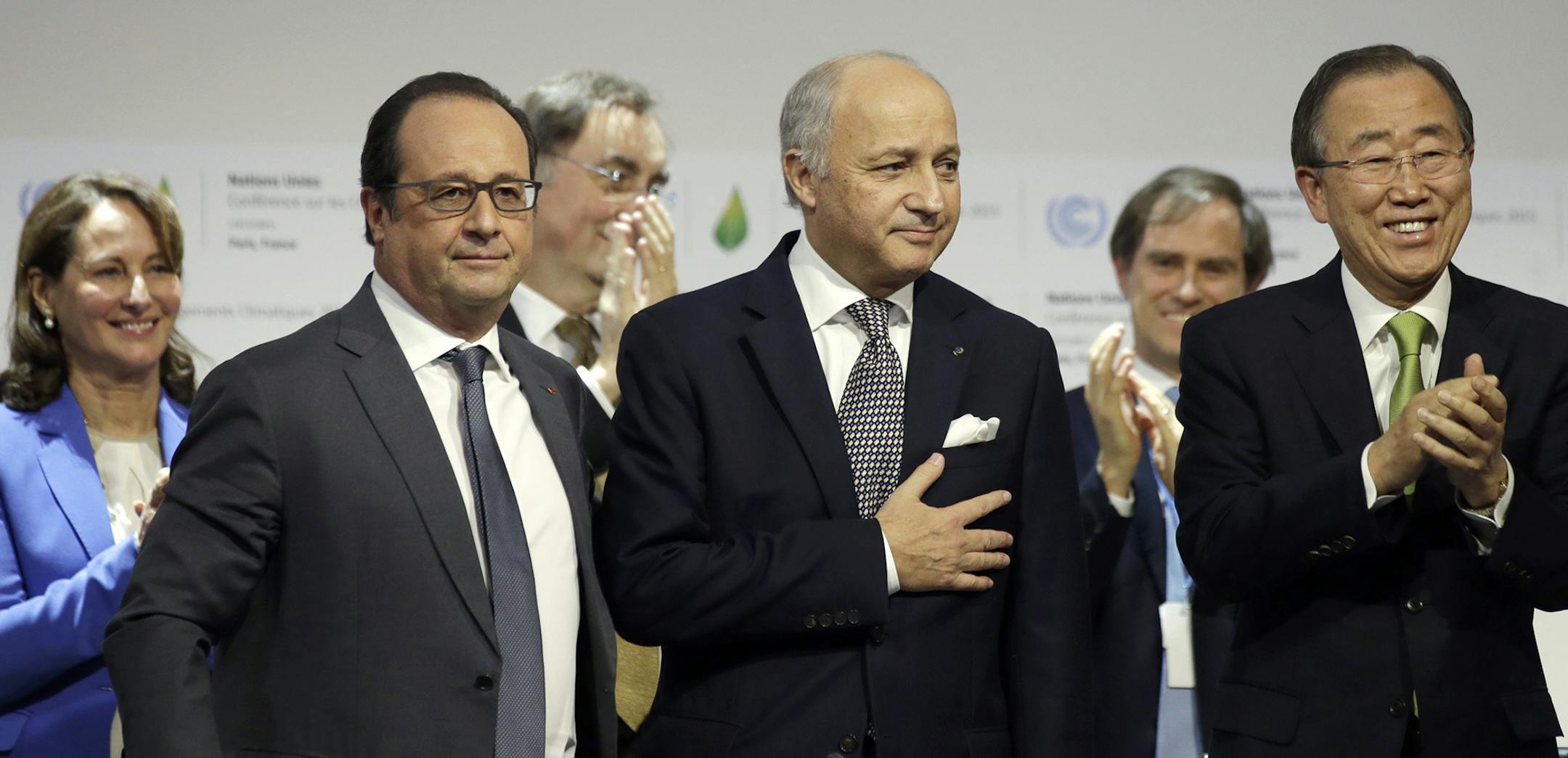
Given the grave danger posed by unchecked climate change, it's understandable that concerned citizens worldwide would want to hail the historic carbon-emission deal inked in Paris last weekend. And, in fact, getting consensus from 195 nations with varying levels of economic and political development — let alone environmental consciousness — is a remarkable diplomatic accomplishment. But with climate scientists stating that the nonbinding agreement won't fully solve the problem — even if it's fully implemented — it's clear that the Paris pact is just the beginning, not the end, of global efforts to curb emissions.
The accord acknowledges that updates to the plan will be needed. There is a legal requirement that every five years each country will need to present new emission reduction targets. This is essential in order to reach the stated objective of holding the increase in the average global temperature to less than 2 degrees Celsius (about 3.6 degrees Fahrenheit). But some scientists suggest that the most devastating climate change impact could be avoided if the increase is at or below 1.5 degrees Celsius.
Achieving either of these goals will require advancements in technology and, perhaps more challenging, political will. Transitioning to lower carbon emissions will be difficult and expensive, but it won't be as costly as the economic, political and security upheavals that aggressive global warming would bring.
Developing nations are among those that could be most impacted. That's why it's important that while every country is expected to contribute to the solution, there is a suggested mechanism that may provide funding — up to $100 billion annually, per some suggestions — to help developing nations adapt more renewable sources of energy.
Of course, the top emitters are the U.S. and China, which have the world's top two economies. So it was important that these two nations announced in advance of the conference plans to reduce carbon emissions.
Each nation will have its own unique challenges, however. China is still trying to lift millions out of poverty, and a further economic slowdown from cutting emissions may retard that objective. But the need is apparent, as evidenced by last week's latest first air pollution "red alert" in Beijing, and the central government's rule by fiat will likely mean movement toward its commitment.
U.S. leadership is imperiled, too, since President Obama's incremental progress could be undone by Republicans, especially by 2016 presidential candidates who pledge to undo Obama's executive actions to lower emissions.
That would be a terrible decision in the short-term but especially in the long-term, because the hard work on combating climate change has only just begun.


