
City Council votes to keep Dinkytown building

Preserving the character of the University of Minnesota's storied Dinkytown area was at the heart of a vote Friday to block demolition – for now – of a one story commercial building in the heart of the district.

February 21, 2014 at 10:52PM
(The Minnesota Star Tribune)

Updated at 12:43 p.m.

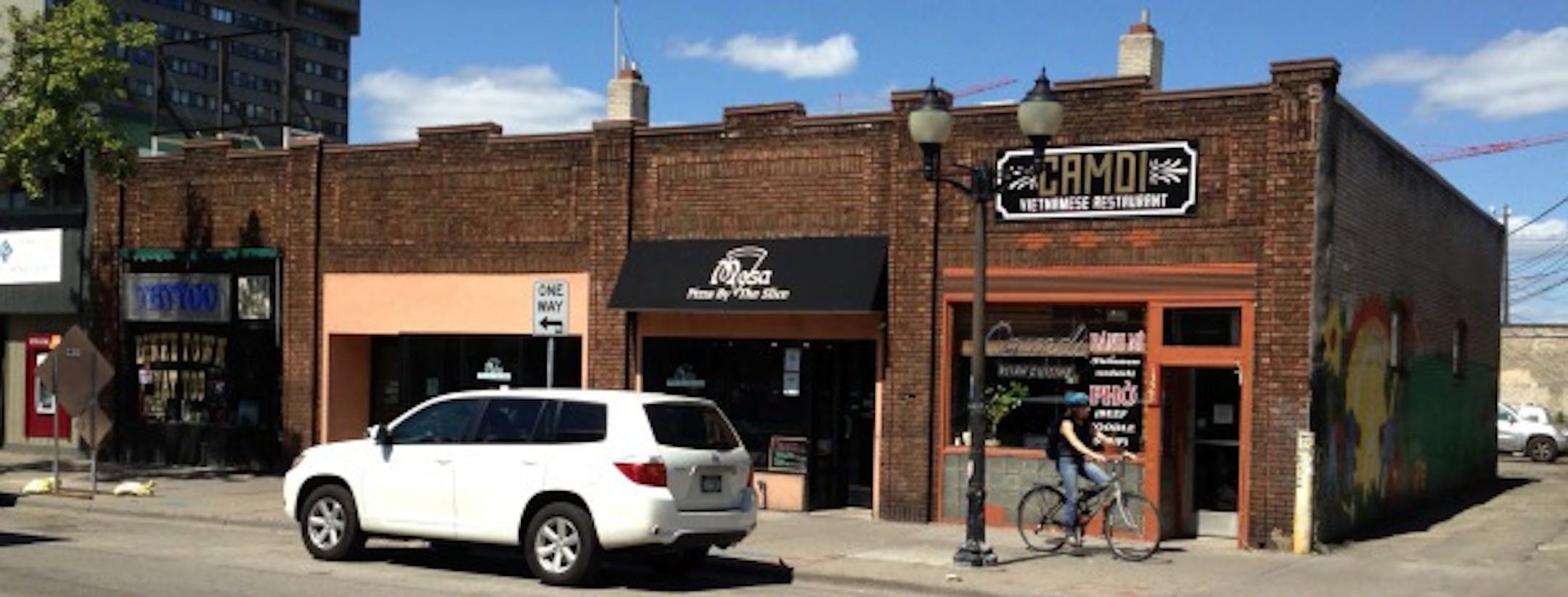
A proposed hotel in the heart of the University of Minnesota's storied Dinkytown area won't be constructed after a City Council vote Friday to block demolition -- for now -- of a one story commercial building in the heart of the district.

The 8-4 vote was the first major development decision of the new council, many of whom ran on pro-density platforms. Developer Kelly Doran has proposed demolishing 1319 4th Street Southeast, a 1920s brick building currently home to Mesa Pizza and Camdi restaurant, plus two other buildings to make way for a six-story hotel.

Doran said afterward that the hotel project is "over for now," since it is not economically feasible to work around the existing building, which he called dilapidated. He added that keeping the building would eliminate the ability to build underground parking beneath it, a key issue for the neighborhood.

"Any area that doesn't evolve and grow eventually decays and dies," Doran said. "Dinkytown is decaying and people don't want to agknowledge that."

Rather than demolishing the building, the city will instead study it to determine if it qualifies for historic designation – a process that could take upwards of a year.

"Dinkytown…is one of the last remaining old-school commercial corridors in our entire city," said Jacob Frey, who represents the area and voted to block the demolition. "When I say old-school commercial corridors I'm talking about small, tightly-situated one -and two-story buildings that do contribute to an overarching bohemian character."

He added that increased density is already coming to the neighborhood, in the form of more than 2,000 residential units which have sprung up.

Lisa Bender, the chair of the city's zoning and planning committee, said city plans focus growth along transit corridors, most of which are former streetcar corridors.

"I'm concerned about our staff resources and the development framework that we're creating in our city," said Bender, who supported demolition. "It is a big deal to add one year to 18 months to any project along a transit corridor in our city."

Council member Andrew Johnsons said the quasi-judicial nature of this vote requires that the council examine the historic nature of the property itself, rather than its context. "Neither the staff nor [the Heritage Preservation Commission], nor any of the people testifying, nor any council members mentioned that they saw value in this individual property in terms of warranting a historical study on this specific property," Johnson said.

Frey pointed out some activities that have occurred at the property, including its role as an anti-war activist organizational hub from the 1960s to the 1980s. That block was also the site of a famous clash between protestors and police over a proposed Red Barn restaurant in 1970.

Council members who voted to preserve the building were John Quincy, Abdi Warsame, Frey, Linea Palmisano, Lisa Goodman, Alondra Cano, Kevin Reich and Barb Johnson. Those supporting the demolition were Bender, Elizabeth Glidden, Blong Yang and Johnson.

The council approved demolition of the other buildings needed for the hotel, 1315 4th Street SE and 410 13th Avenue Southeast.

Council Member Lisa Goodman said the developer might consider building the hotel around the 1319 4th Street building. "I don't think it's an either or situation," Goodman said.

about the writer

about the writer

ericroper

More from No Section

See More
FILE -- A rent deposit slot at an apartment complex in Tucker, Ga., on July 21, 2020. As an eviction crisis has seemed increasingly likely this summer, everyone in the housing market has made the same plea to Washington: Send money — lots of it — that would keep renters in their homes and landlords afloat. (Melissa Golden/The New York Times) ORG XMIT: XNYT58
Melissa Golden/The New York Times

It’s too soon to tell how much the immigration crackdown is to blame.