
Cities take another look at rail disaster response plans

Under a recently enacted state law, railroads will help train firefighters and police officers on how to respond to hazardous materials spills.

May 28, 2014 at 10:09AM
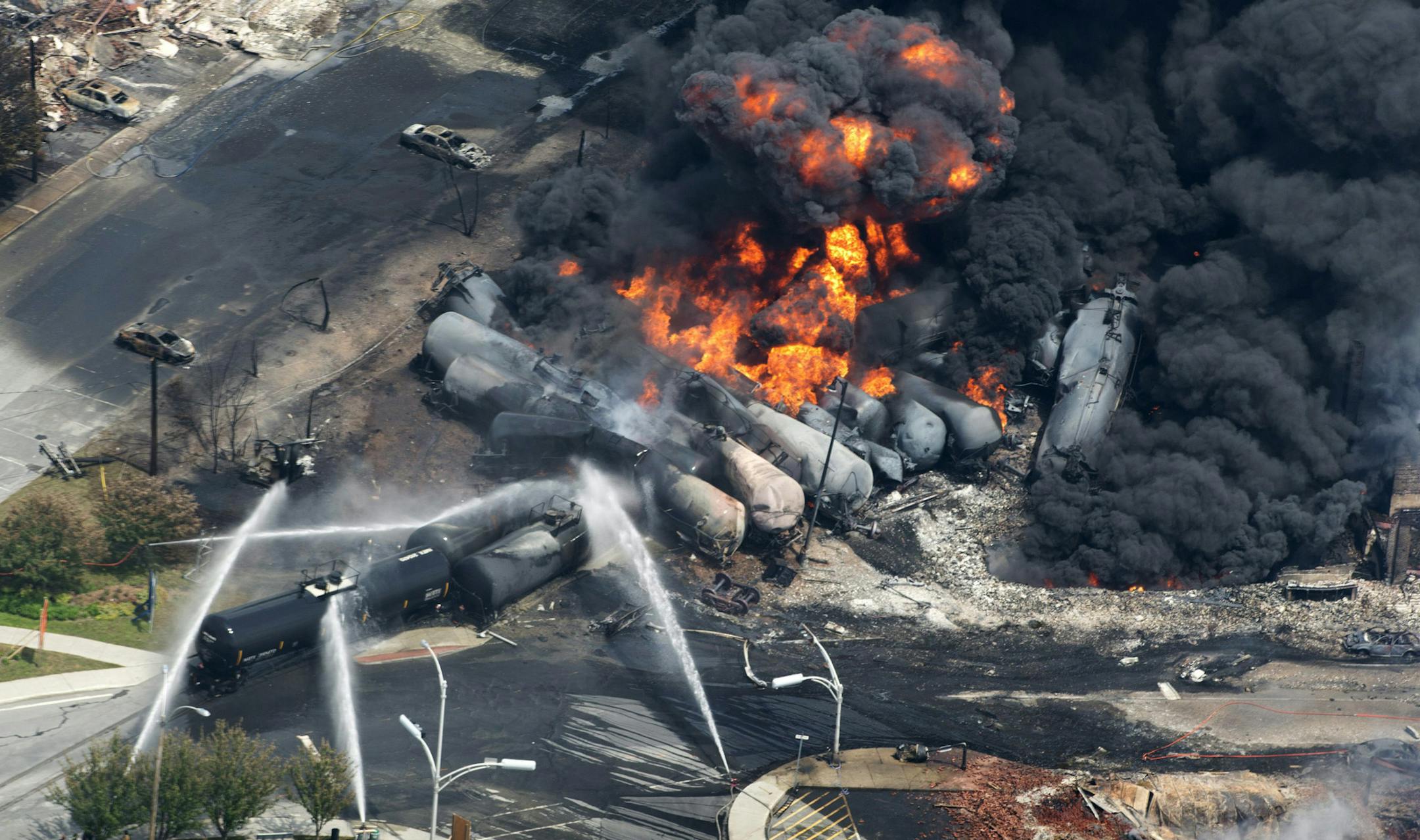
FILE - In this July 6, 2013 photo, smoke rises from flaming railway cars that were carrying crude oil after it a train derailed in downtown Lac Megantic, Quebec, Canada. A large swath of the town was destroyed after the derailment, sparking several explosions and fires that claimed 47 lives. John Giles, top executive of Central Maine and Quebec Railway, that purchased the railroad responsible for the derailment, said Friday, May 16, 2014 that they plan to resume oil shipments after track safety
A derailment in July 2013 in downtown Lac Megantic, Quebec, destroyed a large swath of the town and killed 47 people. As a result, the United States issued more stringent crude oil transportation guidelines. (The Minnesota Star Tribune)

Several local fire and police departments are working with Union Pacific Railroad to rewrite emergency response plans to include measures for evacuating residents and otherwise dealing with catastrophic oil train accidents like the one in Canada that killed nearly 50 people last year.

"Given the new realization of the increased hazard of the crude oil, it's caused us to sit down and talk again, but we feel that we're prepared to respond to any scenario," said Mark Erickson, assistant fire chief of the South Metro Fire Department, which covers West St. Paul and South St. Paul. But, he added, "we don't have anything specific to the railroad."

That may soon change under a new state law, signed by Gov. Mark Dayton last week, requiring railroad and oil pipeline companies to help pay for training and equipment for emergency personnel responding to hazardous materials spills.

Erickson has been meeting with Union Pacific (UP), which owns tracks that run through Inver Grove Heights and South St. Paul, to go over what police and fire departments would do in the event of a ­catastrophe. But he added that, given the area's status as a major freight hub, local officials had already been working with the rail company to review response procedures.

South St. Paul Police Chief William Messerich said the city has well-established crisis-response protocols for any incident involving hazardous materials.

"Even before some of these derailments happened, we were already dealing with UP on this," he said, adding that some confusion remains about whether the city will have to augment its existing disaster plans or formulate new safeguards for rail-related accidents.

Under a recently enacted state law, the state will collect $2.5 million annually from railroad and oil pipeline companies operating in Minnesota, money that will be used to train police officers and firefighters to respond to rail accidents involving crude oil and other hazardous materials.

There have been several high-profile rail accidents across the country and Canada in recent years, including fiery derailments in Virginia and North Dakota, and a July 2013 accident in Lac-Mégantic, Quebec, in which 47 people were killed.

The U.S. Department of Transportation issued emergency orders after the accidents in Canada and Virginia, establishing for more ­stringent crude transport guidelines.

"We're looking at those incidents, and what's being done in response to those, and saying now that we've learned about what was done there, is there anything further that can be done here?" said Erickson, the assistant fire chief.

Mark Davis, Union Pacific's regional spokesman, said the rail company has already been notifying local emergency officials of the routing, volume and frequency of incoming crude shipments.

"Any first response agency historically, we do provide them information on what comes through their community. And that helps them in the unlikely event that there is an incident," Davis said.

Libor Jany • 651-925-5033

Twitter:@StribJany

about the writer

about the writer

Libor Jany

Reporter

Libor Jany is the Minneapolis crime reporter for the Star Tribune. He joined the newspaper in 2013, after stints in newsrooms in Connecticut, New Jersey, California and Mississippi. He spent his first year working out of the paper's Washington County bureau, focusing on transportation and education issues, before moving to the Dakota County team.

See Moreicon