Is there an ideal Christmas streetscape? Of course. But it's probably not the one you knew growing up.
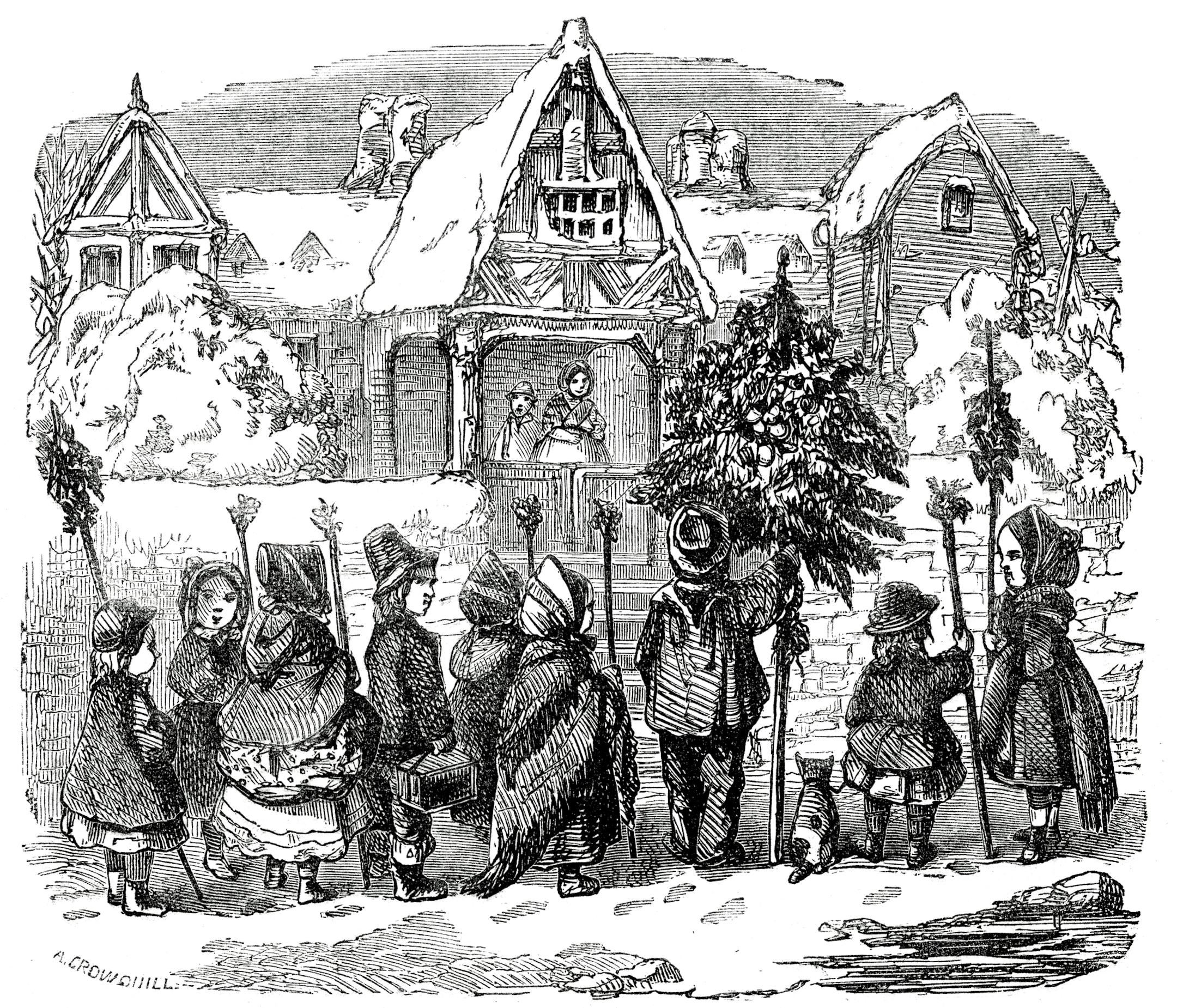
Our storybook version of Christmas is a Victorian streetscape in Merrie Olde England, subset Jolly Olde London. It's night; hissing gas lamps cast a warm glow over the freshly fallen snow. The windows are lit, and if you peek through the glass you see overdressed people making merry. Perhaps there's a goose in the window, eyed by some urchin. Men in top hats with thick scarves are hurrying along.
How did that come to be?
Why doesn't our ideal Christmas look like 1962, with a big aluminum tree spot-lit by a Penetray Color Wheel?
Because … well, because it didn't turn out that way, thanks to a book, and movies made from it.
As the Cliffs Notes version of Christmas history has it, the mid-19th century wasn't too keen on Christmas celebrations. The Industrial Revolution had reset the agrarian pace of English life, and people were crammed 20-to-a-room in tenements, where everyone was dirty and coughed a lot. No one could afford gifts. Who'd want Christmas under those circumstances?
When Charles Dickens wrote "A Christmas Carol" in 1843, it revived Christmas as a holiday, and carved in stone Dickens' Victorian Christmas as the model for Christmases future.
He had some help. By the time he wrote his marvelous story, Christmas was starting to take on some of the trappings we know today. Prince Albert, a German, had introduced Britons to the idea of the Christmas tree. Carols were becoming more popular each year. And the sense that the modern world had thrown society off kilter — producing great wealth and such poverty — made people yearn for unifying traditions.