
China's Korean War dead finally go home

The New York Times
March 29, 2014 at 1:14AM
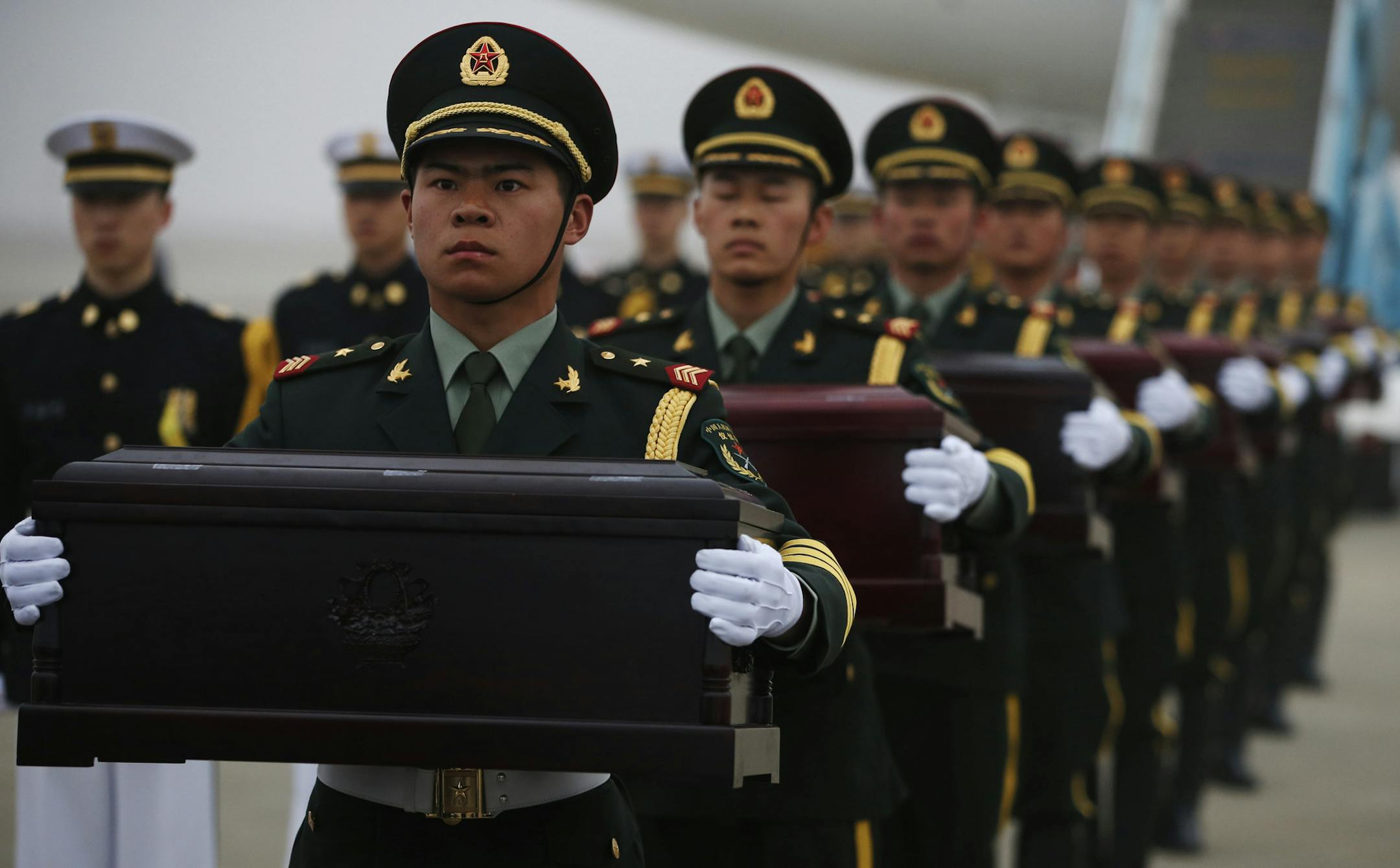
Chinese honor guards hold caskets containing the remains of Chinese soldiers during the handing over ceremony of the remains at the Incheon International Airport in Incheon, South Korea Friday, March 28, 2014. The remains of more than 400 Chinese soldiers killed during the 1950-53 Korean War were transferred from the temporary columbarium in South Korea to the airport to return home for permanent burial. (AP Photo/Kim Hong-ji, Pool)
Chinese honor guards, top, held caskets containing Chinese soldiers’ remains during a ceremony in Incheon, South Korea, on Friday. Below, Chinese Ambassador to South Korea Qiu Guohong covered a casket with a Chinese flag. The remains of more than 400 Chinese soldiers killed six decades ago in the Korean War were returned to China. (The Minnesota Star Tribune)

SEOUL, South Korea – South Korea on Friday repatriated the remains of 437 Chinese soldiers killed during the Korean War six decades ago, making a gesture symbolic of warming ties between the two nations.

China sent a flood of soldiers to help its Communist ally North Korea, which invaded South Korea in June 1950. Its intervention saved the North, whose forces had been pushed back toward the country's northern corner by U.S.-led U.N. forces. The three-year war ended in a cease-fire, leaving the divided Korean Peninsula technically in a state of war.

Over the years, when South Korea discovered the remains of hundreds of Communist soldiers in old battle sites, it kept them in a tucked-away, little-known temporary burial ground north of Seoul, until recently known as "the enemy cemetery."

That it took six decades for the bodies of the fallen Chinese soldiers to return home bore testimony to political uneasiness rooted in a war that was never formally put to rest.

Between 1981 and 1989, North Korea accepted the remains of 42 Chinese soldiers from South Korea and handed them over to Beijing. But it has never been willing to negotiate for the return of its own fallen soldiers. Accepting their return would be seen as a conclusion of the war, which North Korea insists will not be over until Washington signs a peace treaty with it.

A breakthrough came last June when President Park Geun-hye of South Korea visited China to cultivate warmer ties and offered to send the remains home as a goodwill gesture.

The remains of 770 North Korean soldiers still are marooned in the cemetery, their grave markers emblematic of unresolved hostilities. Their graves all face north, looking homeward.
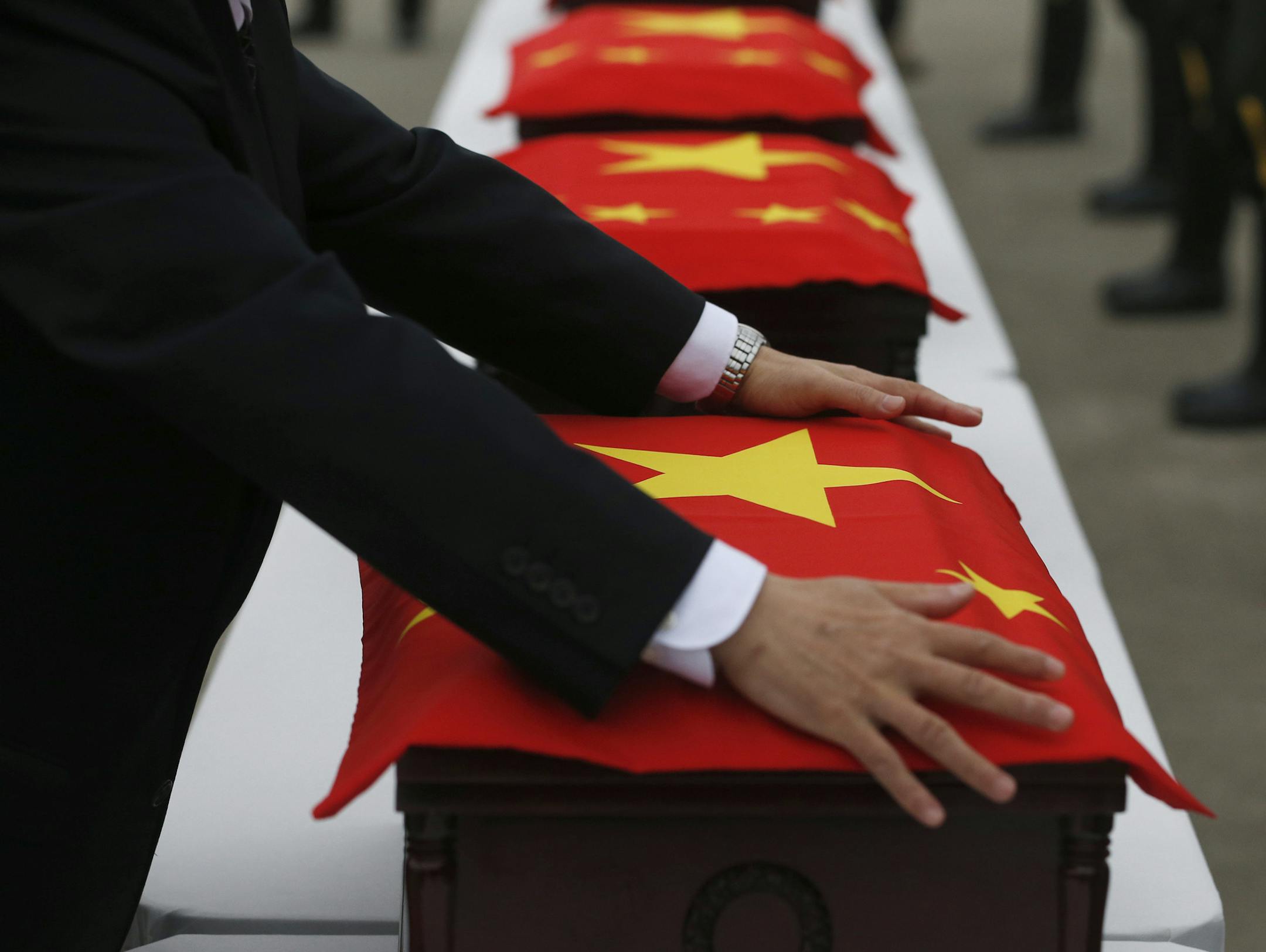
Chinese Ambassador to South Korea Qiu Guohong covers caskets containing the remains of Chinese soldiers with a Chinese national flag during the handing over ceremony of the remains at the Incheon International Airport in Incheon, South Korea Friday, March 28, 2014. The remains of more than 400 Chinese soldiers killed during the 1950-53 Korean War were transferred from the temporary columbarium in South Korea to the airport to return home for permanent burial. (AP Photo/Kim Hong-ji, Pool)
Chinese Ambassador to South Korea Qiu Guohong covers caskets containing the remains of Chinese soldiers with a Chinese national flag during the handing over ceremony of the remains at the Incheon International Airport in Incheon, South Korea Friday, March 28, 2014. The remains of more than 400 Chinese soldiers killed during the 1950-53 Korean War were transferred from the temporary columbarium in South Korea to the airport to return home for permanent burial. (AP Photo/Kim Hong-ji, Pool) (The Minnesota Star Tribune)
about the writer

about the writer

More from No Section

See More
FILE -- A rent deposit slot at an apartment complex in Tucker, Ga., on July 21, 2020. As an eviction crisis has seemed increasingly likely this summer, everyone in the housing market has made the same plea to Washington: Send money — lots of it — that would keep renters in their homes and landlords afloat. (Melissa Golden/The New York Times) ORG XMIT: XNYT58
Melissa Golden/The New York Times

It’s too soon to tell how much the immigration crackdown is to blame.