

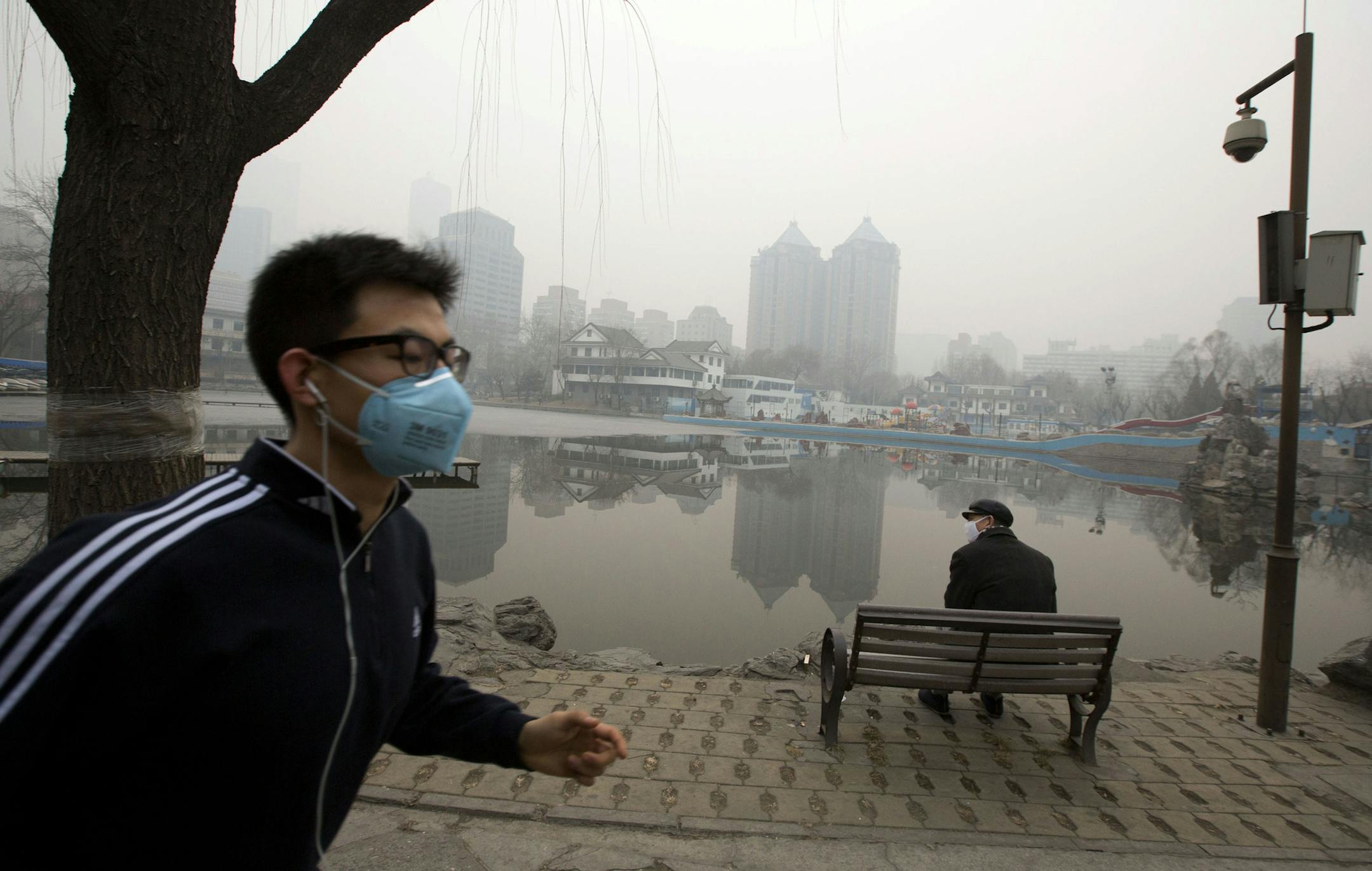
BEIJING – China's capital region remained swathed Monday in a cloud of choking smog, prompting a rise in hospital visits and sales of indoor air purifiers and reports of rare industry shutdowns.
China's Ministry of Environmental Protection on Sunday dispatched inspection teams to fine and close polluting industries in the region, and there were reports that regulators had idled a major concrete kiln and other factories outside Beijing.
But the shutdowns did little to end a four-day bout of heavy particulate smog. Nor are they likely to ameliorate skepticism among residents and outside experts about China's commitment to environmental protection.
Alex Wang, who teaches law at the University of California, Los Angeles, said China had extensive environmental laws on the books and an increasingly sophisticated ability to monitor sources of smog.
"The problem is not a lack of knowledge about pollution sources," said Wang, who previously headed the Beijing office of the Natural Resources Defense Council. "Rather, the problem is that environmental regulators lack sufficient authority to deter polluters from violating the law."
Beijing's 5 million vehicles are an increasing contributor to the city's air pollution, but the biggest sources are thought to be industries, smelters and utilities outside the city that use coal as a power source.
Smell of soot in the morning
On Beijing's worst days, the smell of coal soot hangs heavy in the air. At 6 p.m. Monday, the air monitor at the U.S. Embassy in Beijing reported that levels of so-called PM 2.5 contaminants — fine particles produced by coal burning that pose the worst risk to human health — had topped 400 micrograms per cubic meter. That's about 16 times higher than the World Health Organization deems safe, and about five times higher than recent soot levels in Los Angeles.
Beijing's recent smog bout started more than a week ago and intensified Friday, when authorities issued a code orange alert, reserved for heavy smog that lasts for at least three days. It was the first time authorities had issued such an alert since they established the color-code system — with red reserved for the absolute worst conditions — last October.


