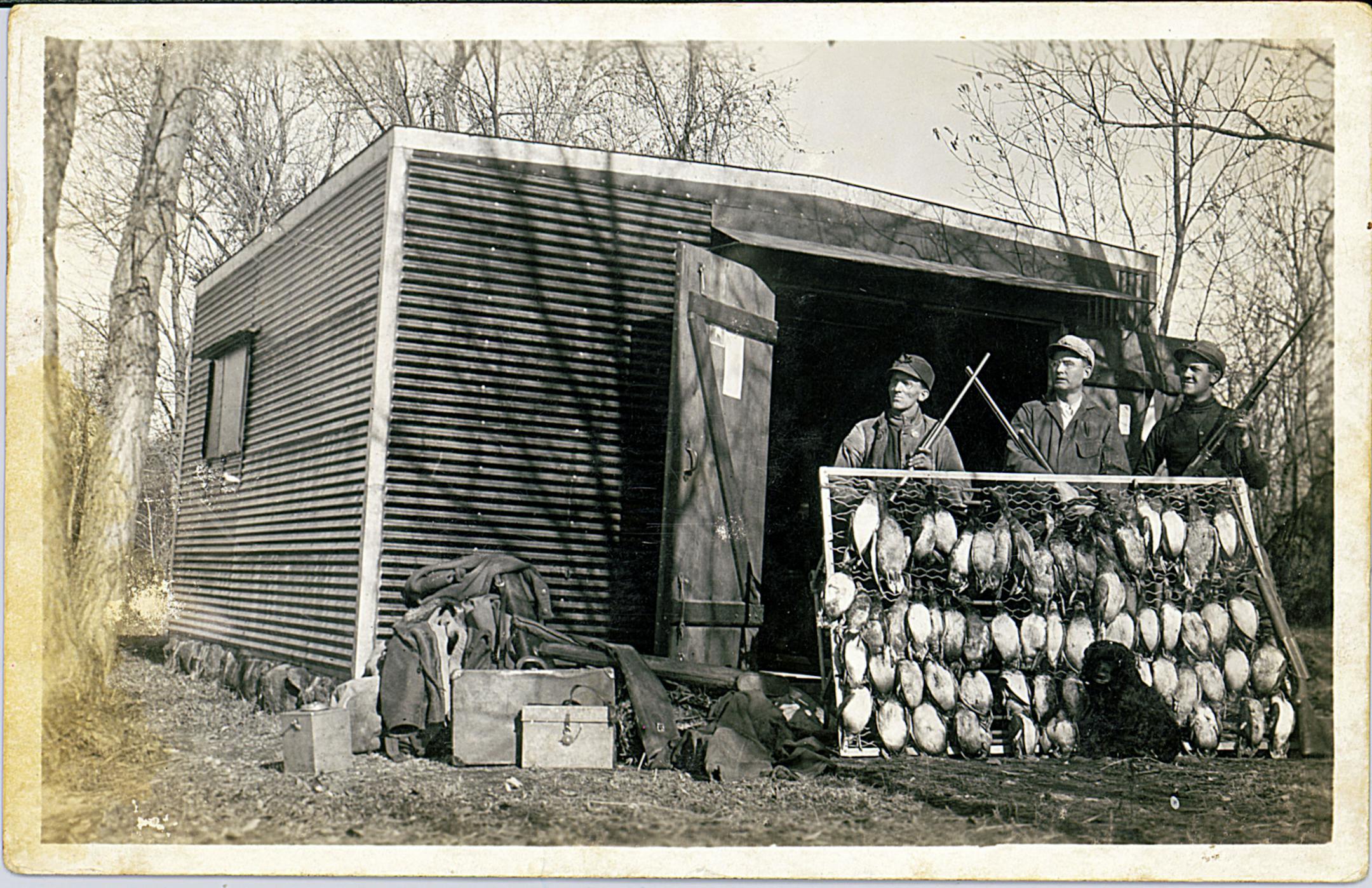
The late Frank Kalash was one of many Minnesotans who grew up around Heron Lake when that large body of water near Iowa was the site of legal duck slaughters — spring and fall. It was an era just before the turn of the 20th century, and restaurant suppliers in Chicago and New York would buy as many ducks and shore birds as Heron Lake hunters could kill. Plumage from the birds was sold to the fashion industry, and railroads were the pipeline to a cluster of lakes the wild game industry dubbed the "Chesapeake of the West."
"When there was no limit on the number of game birds one could have in his possession, it was more a matter of physical endurance and the amount of ammunition," Kalash wrote in a 1958 letter kept by the Jackson County Historical Society.
His writings and those of others document how America came to the realization that dizzying flocks of teal, redheads, canvasbacks, mallards, pintails, wood ducks and other species were not inexhaustible. Those market-hunting days are being recalled this year as the U.S. and Canada celebrate the 100th anniversary of the Migratory Bird Treaty, the first international accord forged to protect wild birds. It also was among the first to protect any wildlife species.
Jerry Serie, a longtime wildlife biologist with the U.S. Fish and Wildlife Service, was quoted by the agency earlier this year as saying the treaty was monumental.
"The centennial celebration of the Migratory Bird Treaty is a testament to all those farsighted individuals who recognized the need, pursued a diplomatic solution, and legislated into law the federal protection of migratory birds," Serie said. "That gave rise to subsequent international treaties, and the development of successful management and research programs throughout North America."
The United States signed similar bilateral treaties with Mexico (1936), Japan (1972) and Russia (1976). The 1916 bird treaty actually was signed with Great Britain, on behalf of Canada. In the U.S., the agreement was enlivened with the Migratory Bird Treaty Act of 1918.
Kalash, who died in 1971 at the age of 85, was an attorney who also ran a well-known hunting camp on the south end of Heron Lake, which is shaped like an hourglass. As a boy, he hunted ducks for money before the state imposed its first limits on game birds in 1903 — 100 birds per day. Three years earlier, Congress had passed the Lacey Act, which sought to suppress the killing of wild game as a business.
"Harry Morrison and I hunted and shot the limit of 100 birds a day many times," Kalash wrote.