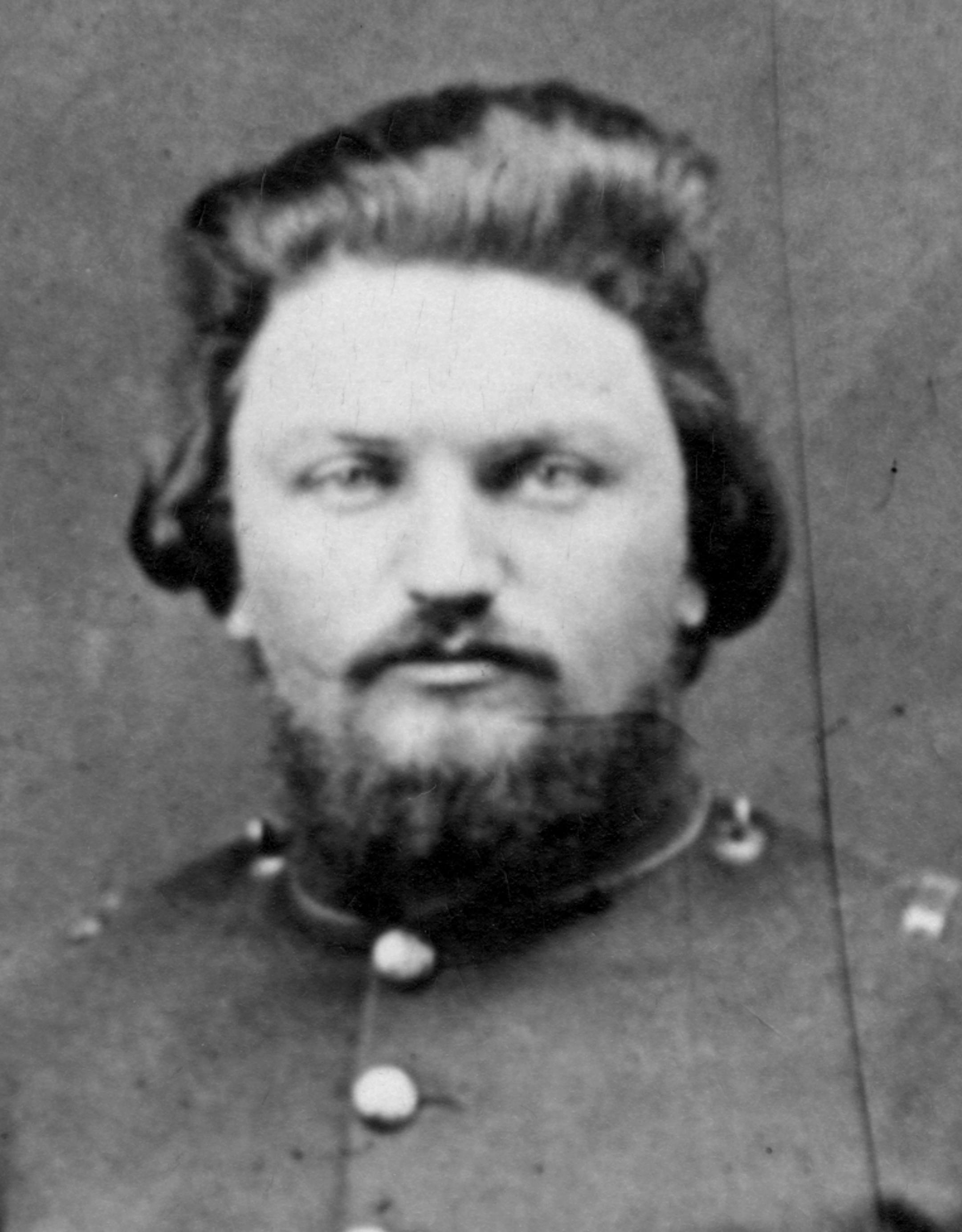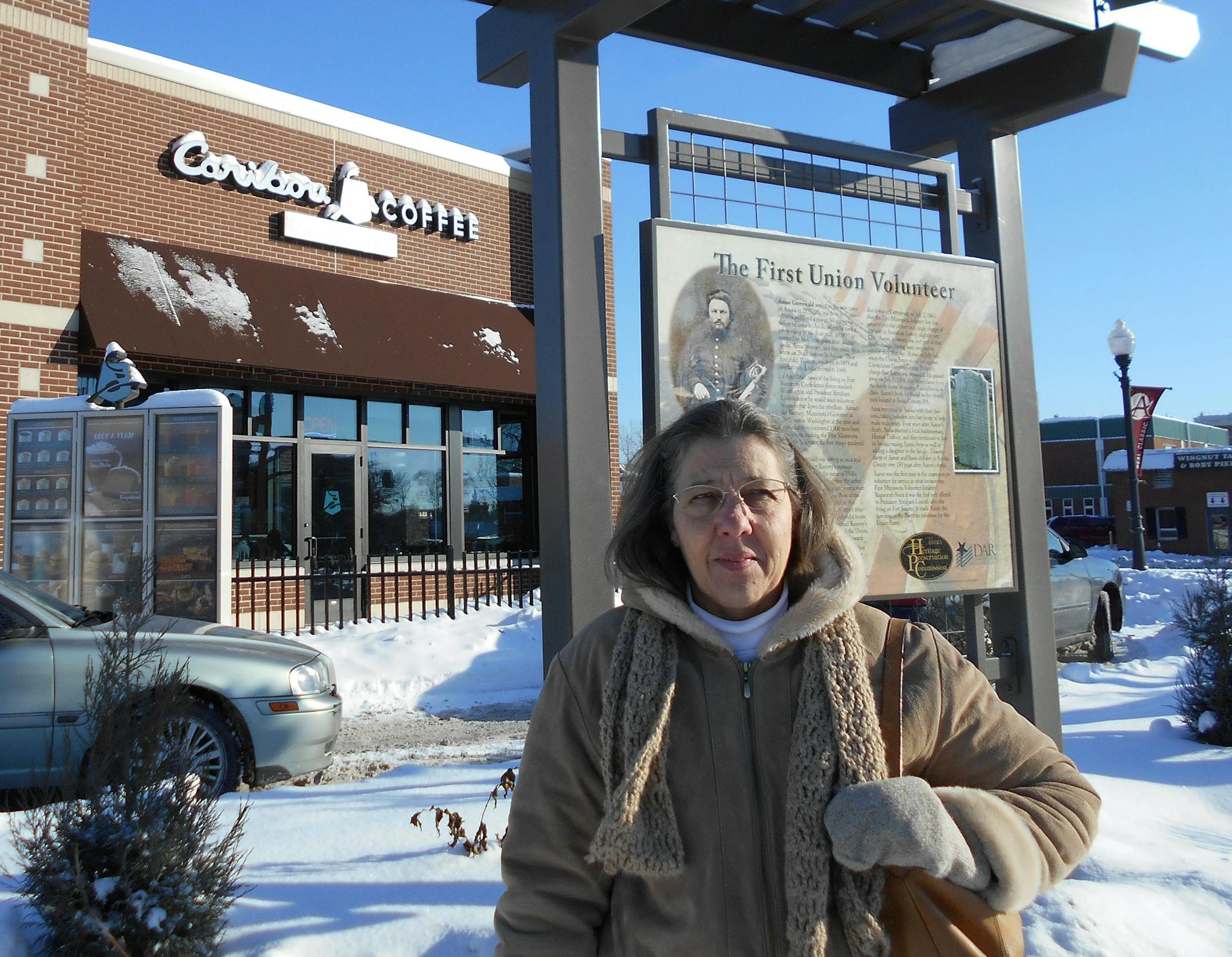
If you stop at the new Caribou coffee shop in downtown Anoka, it would be fitting to raise a cup of joe to the memory of Aaron Greenwald, an Anoka man believed to be the first Minnesotan to volunteer for the Union Army in the Civil War.
Records indicate that Greenwald, who was killed in action at Gettysburg, was in a courtroom on the northwest corner now occupied by Caribou at Ferry and Main streets when a telegram from the governor was read asking for men to join the Army. Greenwald was the first to do so, said Vickie Wendel, program manager for the Anoka County Historical Society.
She researched and wrote the text on four picture boards displayed outside Caribou that relate the site's history. The signs, which cost $5,000, were a joint effort of the city, the Historical Society and the Daughters of the American Revolution.
There is another link of sorts: A lot of coffee was consumed in the 1860s, said Todd Mahon, the society's executive director. Of course, there were no mocha, decaf or latte varieties, let alone a Caribou. More on coffee later.
Back to 1861
On the morning of April 15, 1861, Greenwald was in the Schuler building, which leased space for county courtrooms, when a rider on horseback arrived from St. Paul with a telegram from Gov. Alexander Ramsey. Ramsey was in Washington, D.C., where he heard that Confederate forces had fired on Fort Sumter in South Carolina, touching off the Civil War. Ramsey made Minnesota the first state to offer volunteers by promising 1,000 men for the Union Army, Wendel said.
Greenwald, 29, was sitting listening to the Anoka trial of a man accused of stealing 10 bushels of cranberries and bed ticking, Wendel said. The rider handed the telegram to attorney Willis Gorman, a friend of Ramsey's. Gorman asked for a court recess while he read aloud the news about Fort Sumter and the governor's request for men, Wendel said. Greenwald promptly volunteered, followed by six other men, all of whom signed an enlistment sheet.
A historic debate has developed about who was really the first volunteer, because that same day in St. Paul, Josias King also volunteered and signed an enlistment document. Wendel said a St. Cloud Journal reporter, Alvah Eastman, wrote in 1911 that his research showed Greenwald was the first to volunteer. But the Anoka enlistment sheet disappeared, leaving St. Paul officials to claim King was the first to officially sign up for the First Minnesota Volunteer Infantry Regiment, the first unit offered to President Abraham Lincoln. Greenwald signed that list later when he reached Fort Snelling.
The Anoka sheet has never been found, although Wendel said she has searched state history records and those of several area counties. King survived the war and lived to see a statue erected in his honor in 1906. Greenwald, who migrated from Pennsylvania in 1855 to the frontier town of Anoka, perished at Gettysburg in 1863, leaving behind a wife and two young sons in Anoka.