
Campusus debate limits to free speech protections

The death of Heather Heyer in Charlottesville showed how hateful speech can lead to violence.

August 26, 2017 at 8:47PM
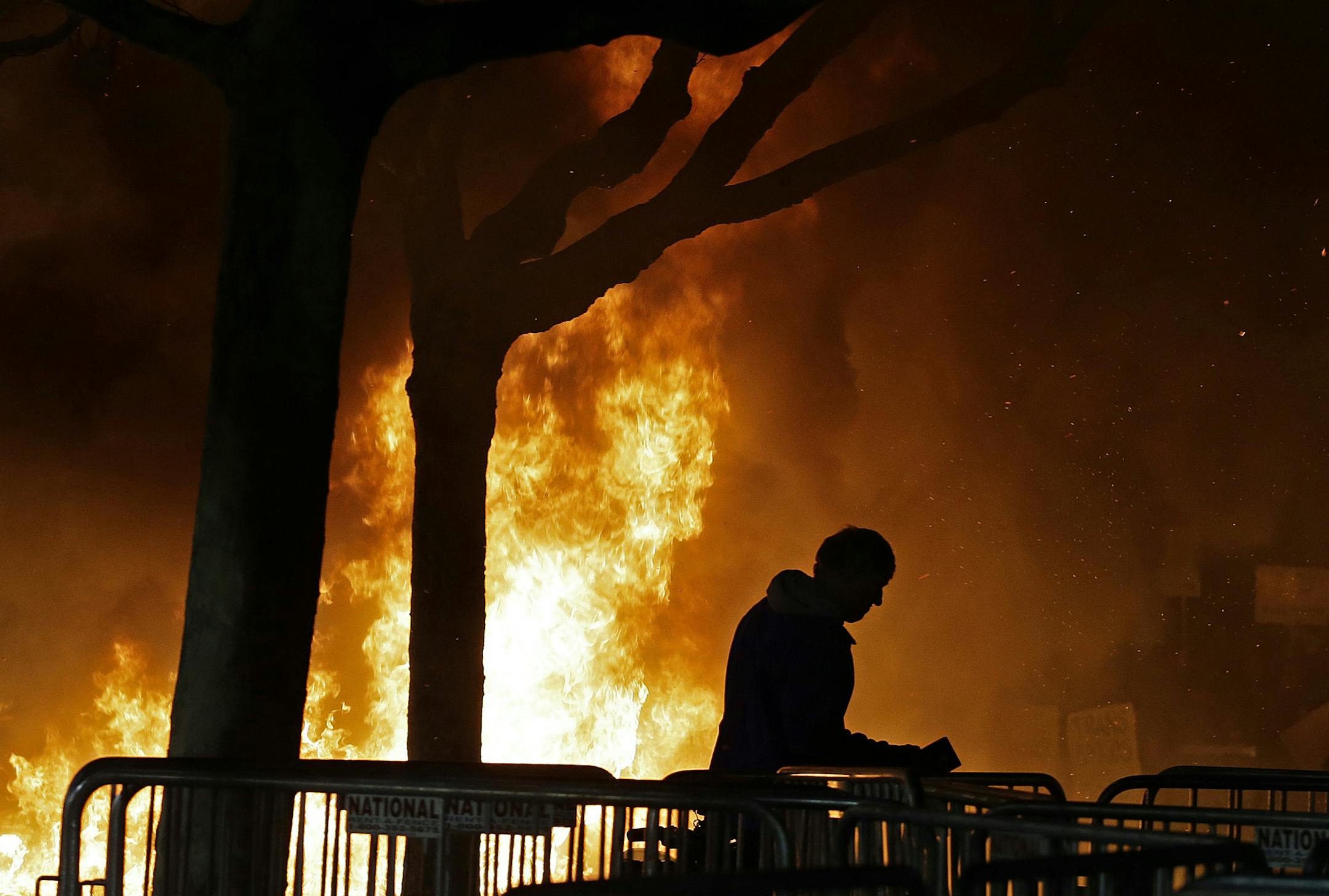
FILE - In this Feb. 1, 2017 file photo, a fire set by demonstrators protesting a scheduled speaking appearance by Breitbart News editor Milo Yiannopoulos burns on Sproul Plaza on the University of California, Berkeley campus. Northern California police and civic leaders are hoping for calm, but bracing for violence this weekend when hundreds, possibly thousands, of demonstrators of all stripes flock to the San Francisco Bay Area for dueling political rallies. Law enforcement officials in San Fra
California: In February, a fire set at the University of California, Berkeley, protested a scheduled speaking appearance — later canceled — by Breitbart editor Milo Yiannopoulos. (The Minnesota Star Tribune)

WASHINGTON – The sight of white supremacists marching through the heart of the University of Virginia, carrying flaming tiki torches and shouting "Jews will not replace us!" — followed by the killing of a counterprotester at a rally in downtown Charlottesville the next day — may put the brakes on state efforts to strengthen campus free speech protections.

At least seven states (Arizona, Colorado, Missouri, North Carolina, Tennessee, Utah and Virginia) have enacted such laws since 2014, and other states considered them this year. But the death of Heather Heyer in Charlottesville this month showed how hateful speech can lead to violence. That might prompt legislators to rethink how the bills are written or whether to support them at all.

"It has been really distressing and upsetting to watch violence used against protesters, and I expect that to have a profound effect on how lawmakers view these issues," said Joe Cohn, legislative and policy director for the Foundation for Individual Rights in Education, a nonpartisan group that helps lawmakers write free speech bills.

As emboldened white supremacist groups plan events intended, in part, to provoke diverse, liberal communities, political leaders and even such free speech advocates as the American Civil Liberties Union have struggled to respond.

Legal experts say campus free speech laws are often redundant, because public institutions have to uphold the First Amendment under federal law anyway. Colleges generally have adequate policies for disciplining overly disruptive heckling and other violations of free speech without being required to by state law, said Michael Olivas, a higher education law expert and professor at the University of Houston Law Center.

But college and university leaders say some measures state lawmakers have considered recently could prevent campuses from disinviting speakers who pose a threat to safety or could suppress the rights of counterprotesters.

Michigan state Sen. Patrick Colbeck said that the death in Charlottesville hasn't deterred him from pushing legislation to promote campus free speech. "I think the clashes that we saw there are more a result [of the fact] that we haven't had an open dialogue," the Republican said.

This year, lawmakers in 22 states considered bills to protect free speech on public college campuses, according to the American Association of State Colleges and Universities. That count includes some bills designed to protect student journalists, said Thomas Harnisch, director of state relations and policy analysis for the organization.
Republicans, in particular, have pushed these laws in response to what they see as hostility toward conservative speech on liberal campuses. In recent years, student protesters have driven away such speakers as former Secretary of State Condoleezza Rice, shouted down remarks by conservative author Charles Murray and escalated into riots ahead of a speech by provocateur Milo Yiannopoulos.

Colbeck said that such incidents remind him of the propaganda agency that sought to eliminate free thinking in George Orwell's novel 1984. "Our universities have devolved into those 'ministries of truth' George Orwell warned us about," he said.

Most of the laws enacted or considered so far don't go further than reinforcing existing First Amendment law. "We have the First Amendment. So any law a legislature is going to pass is going to take the form of, 'and we really mean it," said Jim Manley, an attorney at the Goldwater ­Institute, a ­conservative think tank in Arizona that supports campus free speech ­legislation.

But some of the new laws penalize colleges for suppressing free speech, and some proposed laws would penalize students for doing so.

Five of the state laws passed so far are based on model legislation produced by the Foundation for Individual Rights in Education. Arizona, Colorado, Missouri, Utah and Virginia have enacted laws that prevent public universities from creating "free speech zones," designated areas for protests, rallies and pamphleteering. Under the Missouri and Utah laws, courts will automatically award damages to a person whose free speech rights are violated.

North Carolina enacted a law this summer based on a model from the Goldwater Institute. The law directs the Board of Governors of the University of North Carolina system to create a committee to monitor free expression on campus and requires university campuses to include a discussion of free speech in freshman orientation.

It also directs the Board of Governors to develop a free expression policy that, among other provisions, requires universities to discipline ­students who substantially disrupt protests, demonstrations or other speech and abolish both free speech zones and "safe spaces," ­designated areas where ­students can avoid upsetting ideas.

Some proposed measures, such as the one the Wisconsin Assembly approved this summer and the state Senate is now considering, contain stronger language. The Wisconsin bill threatens students with suspension or expulsion if they repeatedly disrupt the free speech of others with violent or disorderly ­conduct.

Opponents say that language is too prescriptive and argue that the bill could prevent students from exerting their own First Amendment right to protest.

"I think it's unconstitutional, this bill," said state Rep. Chris Taylor, a Democrat who represents Madison. "It would kill speech."

Colbeck also has authored two bills on campus free speech — one that would abolish free speech zones and one modeled on the Goldwater legislation — that would apply to both public universities and community colleges. The legislation is opposed by the American Civil Liberties Union of Michigan, which says it vaguely defines what counts as interfering with another's speech and prevents universities from penalizing free speech disruptions on a case-by-case basis.

Meanwhile, universities are trying to figure out how to balance their responsibility to uphold the First Amendment with considerations, such as safety and the need to protect individuals from harassment and discrimination.

Free speech shouldn't be a free-for-all, said Jonathan Alger, president of James Madison University, a public university in Virginia. "The First Amendment is not completely unlimited," he said.

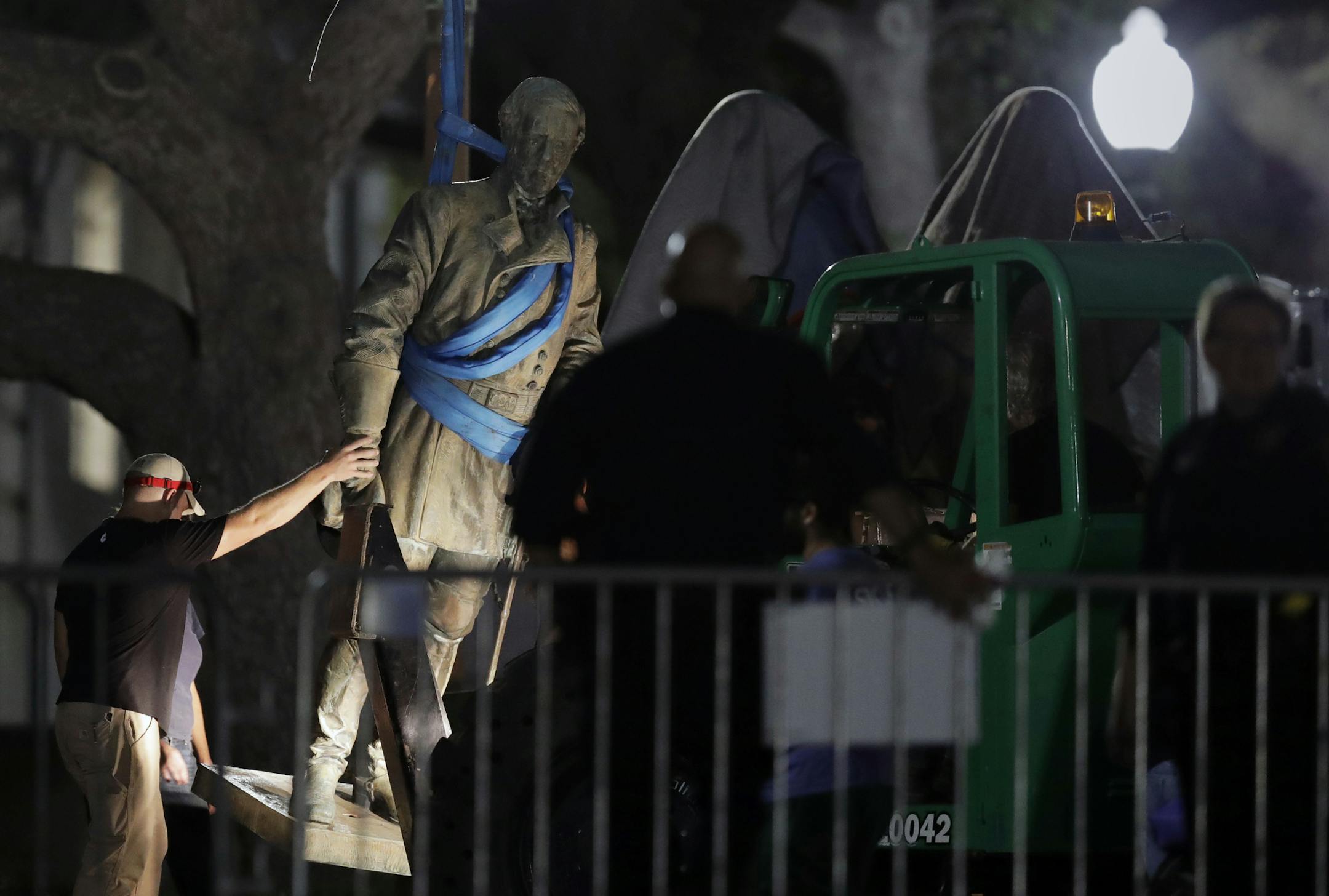
FILE - In this Aug. 21, 2017, file photo, a statue of Confederate Gen. Robert E. Lee is removed from the University of Texas campus in Austin, Texas. The University of Texas is being sued for removing four Confederate statues from the main area of is Austin campus. The Sons of Confederate Veterans filed the lawsuit three days after the statues were quickly taken down following an order from the university's president. The removals followed the deadly white supremacist rally in Virginia. The stat
Texas: A statue of Gen. Robert E. Lee was removed from the University of Texas campus in Austin last Monday. The school is being sued for removing four Confederate statues. (The Minnesota Star Tribune)
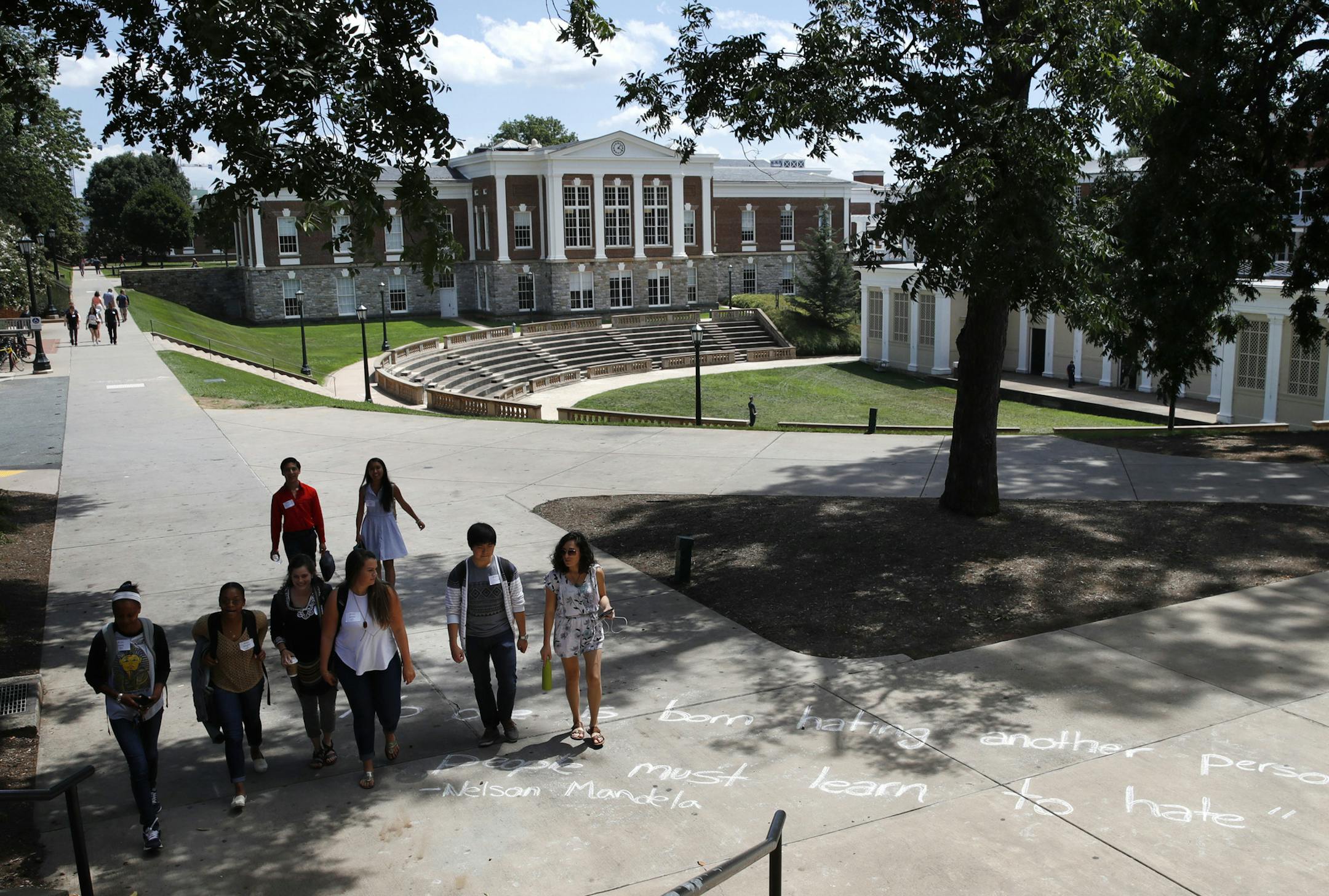
Students walks past a quote in chalk credited to Nelson Mandela at the University of Virginia, Friday, Aug. 18, 2017, in Charlottesville, Va., a week after a white nationalist rally took place on campus. The quote says "No one is born hating another person...people must learn to hate." (AP Photo/Jacquelyn Martin)
Virginia: Returning University of Virginia students took in a Nelson Mandela quote written in chalk: “No one is born hating another person. … People must learn to hate.” (The Minnesota Star Tribune)
about the writer

about the writer

Sophie Quinton, Stateline.org

More from No Section

See More
FILE -- A rent deposit slot at an apartment complex in Tucker, Ga., on July 21, 2020. As an eviction crisis has seemed increasingly likely this summer, everyone in the housing market has made the same plea to Washington: Send money — lots of it — that would keep renters in their homes and landlords afloat. (Melissa Golden/The New York Times) ORG XMIT: XNYT58
Melissa Golden/The New York Times

It’s too soon to tell how much the immigration crackdown is to blame.