

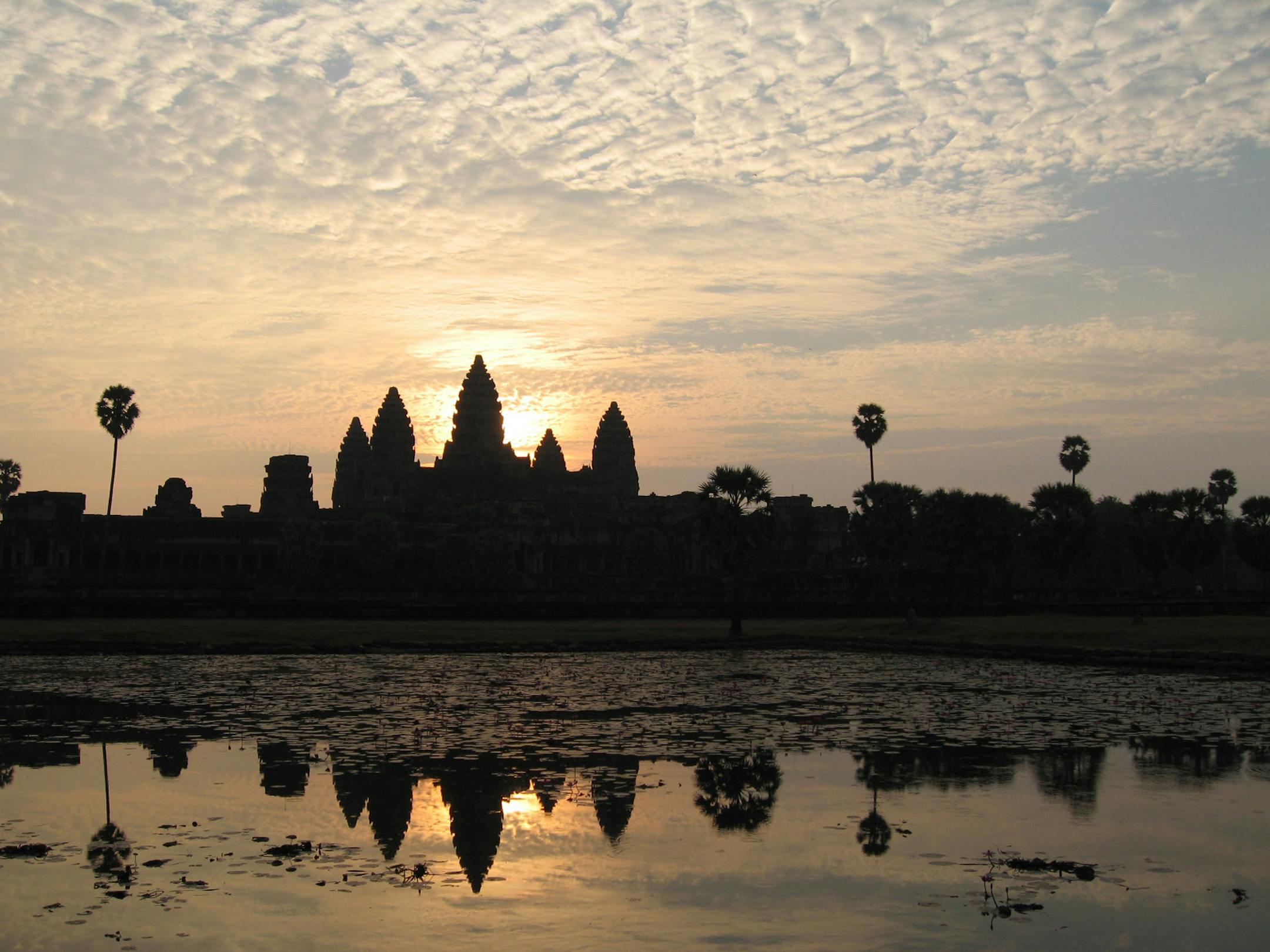
As I approached Angkor Wat, I paused on a causeway over the moat that surrounds it. Reflections of the monument's five spires shimmered below, each shaped like the delicate, pink lotus buds that floated on the water's surface. The quintet represents the five peaks of Mount Meru, the mythical center of the Hindu universe that's home to a pantheon of powerful deities. The weathered stones of this vast temple complex, originally dedicated to the Hindu god Vishnu, blend harmoniously with the lush, verdant landscape.
One glance, and I was spellbound.
Determined to get the perfect shot, I clicked my camera until my husband, Wesley, reminded me that the religious site sprawls across more than 400 acres, and we had yet to step inside. (Angkor Wat is the world's largest religious structure; Vatican City, by contrast, encompasses a mere 108 acres.) I reluctantly moved along, madly waving the cheap fan I had bought at a local market in a vain attempt to keep the oppressive tropical heat at bay.
Hundreds of temple ruins dot Angkor. Its Angkor Archaeological Park, a UNESCO World Heritage Site, contains the remains of several capitals of the Khmer Empire that flourished from the ninth to the 15th centuries. But Angkor Wat, at the epicenter of the once grand city, is the most famous landmark by far. It is such a source of national pride that the Cambodian flag features it prominently.
The temple embodies a time when the Khmer Empire was the region's superpower. Back then, Angkor was a bustling metropolis that covered an area about the size of New York's five boroughs, making it the largest pre-industrial city in the world. An innovative system of canals and reservoirs helped produce sizable rice harvests, enough to support an estimated population of around 1 million.
Today, a landscape strewn with stone temple ruins is all that remains of the flourishing civilization that suddenly vanished about 500 years ago, an enigma for 21st-century archaeologists.
French naturalist Henri Mouhot is credited with discovering the lost city in 1860 as he searched for exotic tropical insects, though Cambodians knew of it all along. Mouhot's journals, published posthumously in 1863, provided intriguing descriptions of Angkor Wat and captured the imagination of the West just as the French began their colonial expansion into Southeast Asia.
New discoveries are still being made. A centuries-old, 440-pound statue of a guard was unearthed in the archaeological park last July. Astoundingly, it was almost perfectly intact.

