
Cairo defiant in face of curfew

City's typical 24-hour life has been slashed to just 13.

The Associated Press
August 28, 2013 at 12:44AM
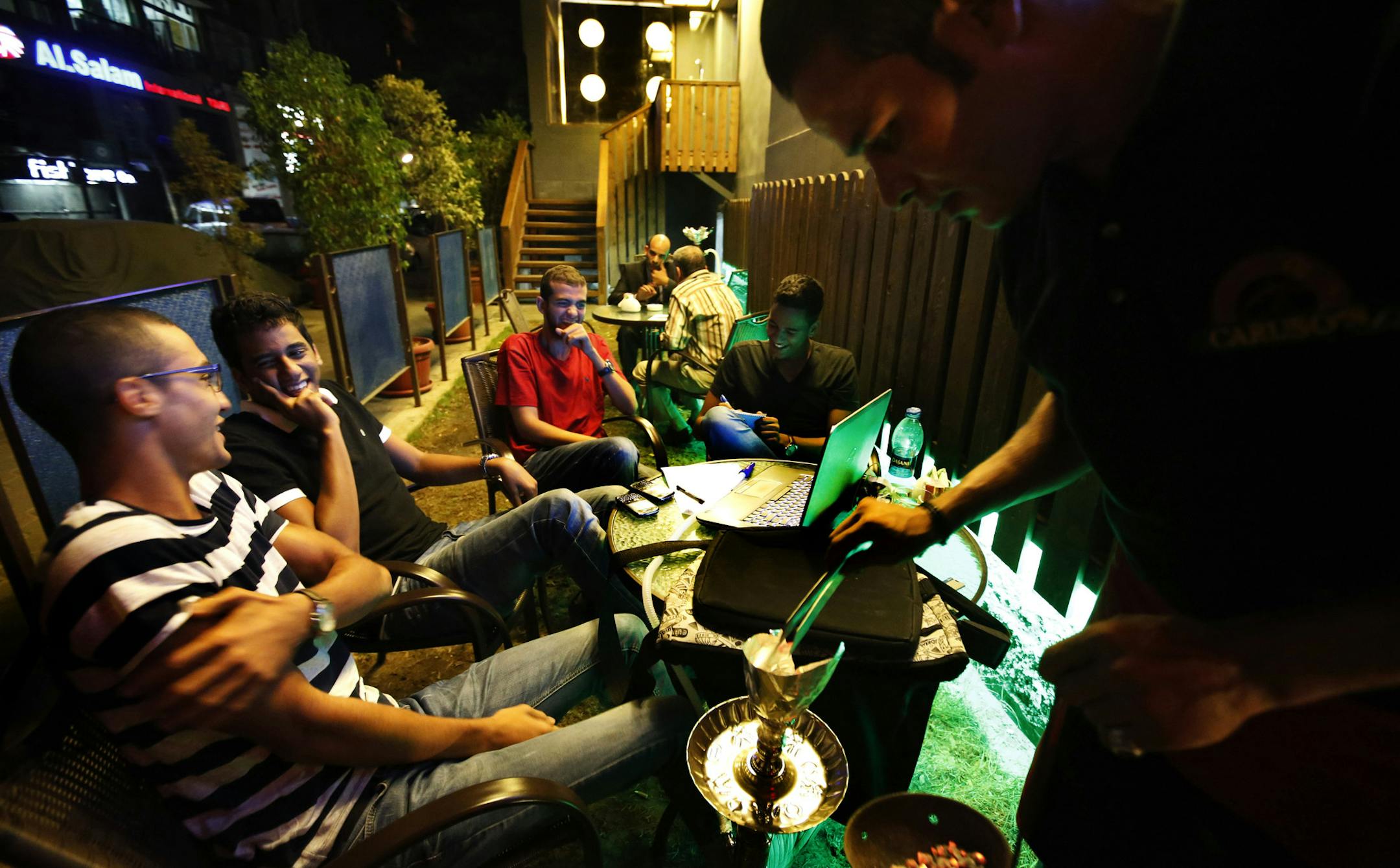
In this Sunday, Aug. 25, 2013 photo, students study at a coffee shop in Cairo, Egypt, during curfew. The curfew has been a shock to Cairo, a city where cafes stay packed into the night and parents routinely take their children out for dinners nearing midnight. The military-backed governmentís curfew, after violent unrest following the July 3 coup that ousted President Mohammed Morsi, slashed the typical Cairo 24-hour life to just 11 hours. (AP Photo/Lefteris Pitarakis)
after dark: Students gathered to study for exams at a coffee shop in Cairo after curfew. (The Minnesota Star Tribune)

CAIRO – In every corner of the Egyptian capital, a bustling city of 18 million that rarely sleeps, people are locked up in their homes at night under a military-imposed curfew that has driven people up the walls, sometimes literally.

To kill time, one said he spent the night counting flowers on his wallpaper — a staggering 865. Another tested how many cucumbers he can fit in a refrigerator drawer. A third calculated the speed of an ant crawling on his balcony rail.

The curfew has been a shock to Cairo, a city where cafes stay packed into the night and parents routinely take their children out for dinners nearing midnight. The two-week-old military-backed government's curfew, after violent unrest following the July 3 coup that ousted President Mohammed Morsi, slashed the typical Cairo 24-hour life to just 13 hours.

Forced to close early, businesses and restaurants are hurting in a city where night life is a key source of income. The city's metro system reportedly loses $71,500 a day.

So how have people handled what some online have referred to as "British boarding school hell"?

A few have defiantly attempted to break the curfew, dodging the abundant police and military checkpoints on major highways and overpasses. They have organized underground slumber parties, publicized among friends via social media and mass text messages.

'Not used to sitting at home'

One cafe in the upscale neighborhood of Zamalek even opened for the first time less than two weeks ago and almost all its business has come after curfew hours.

"The first few days we were conforming to the curfew, but then people demanded we stay open later and so we did," said manager Mohammed, who asked his last name and the name of the cafe not be published to avoid reprisals. "People are just not used to sitting at home or adhering [to rules]."
Four students at the cafe studied for a marketing exam for their summer course. "Before the curfew I am home. After the curfew I go out," Mahmoud Emam, 20, said.

Others chose to flee the heat and turmoil in Cairo to the Mediterranean coastline, where the curfew doesn't exist.

Many find it a challenge to fill the time. Some predicted a baby boom next winter. Cynics suggest a hike in divorce rates — spouses are locked up together for longer hours.

The Arabic Twitter hashtag "discoveries of the curfew" has become a way for some to vent their frustration. One man discovered that his refrigerator drawer can take 78 lemons or 65 cucumbers standing upright, or 75 if laid horizontally. Another mused that he has found 33 positions to sleep at night and 12 different ways to hug a pillow.

'Stuffing our face'

"Boredom is the devil. It makes you do things that you can never imagine," an Egyptian on a popular online video says. "We are turning into toothpaste tubes because of how much we are stuffing our face with food."

One activist declared she's only now realized it's been three years since she's had a job.

This is the second government-called curfew in Cairo since Egypt's 2011 uprising against autocratic leader Hosni Mubarak. The army tried it in 2011 but hundreds of thousands held their ground in Tahrir Square, demanding Mubarak step down. This time has seen widespread compliance. Part of that comes from fear, as more than 1,000 people had been killed across Egypt in recent violence. Others view it as a stand with the military against the country's ousted president and the Muslim Brotherhood, blamed by the government for inciting much of the unrest.

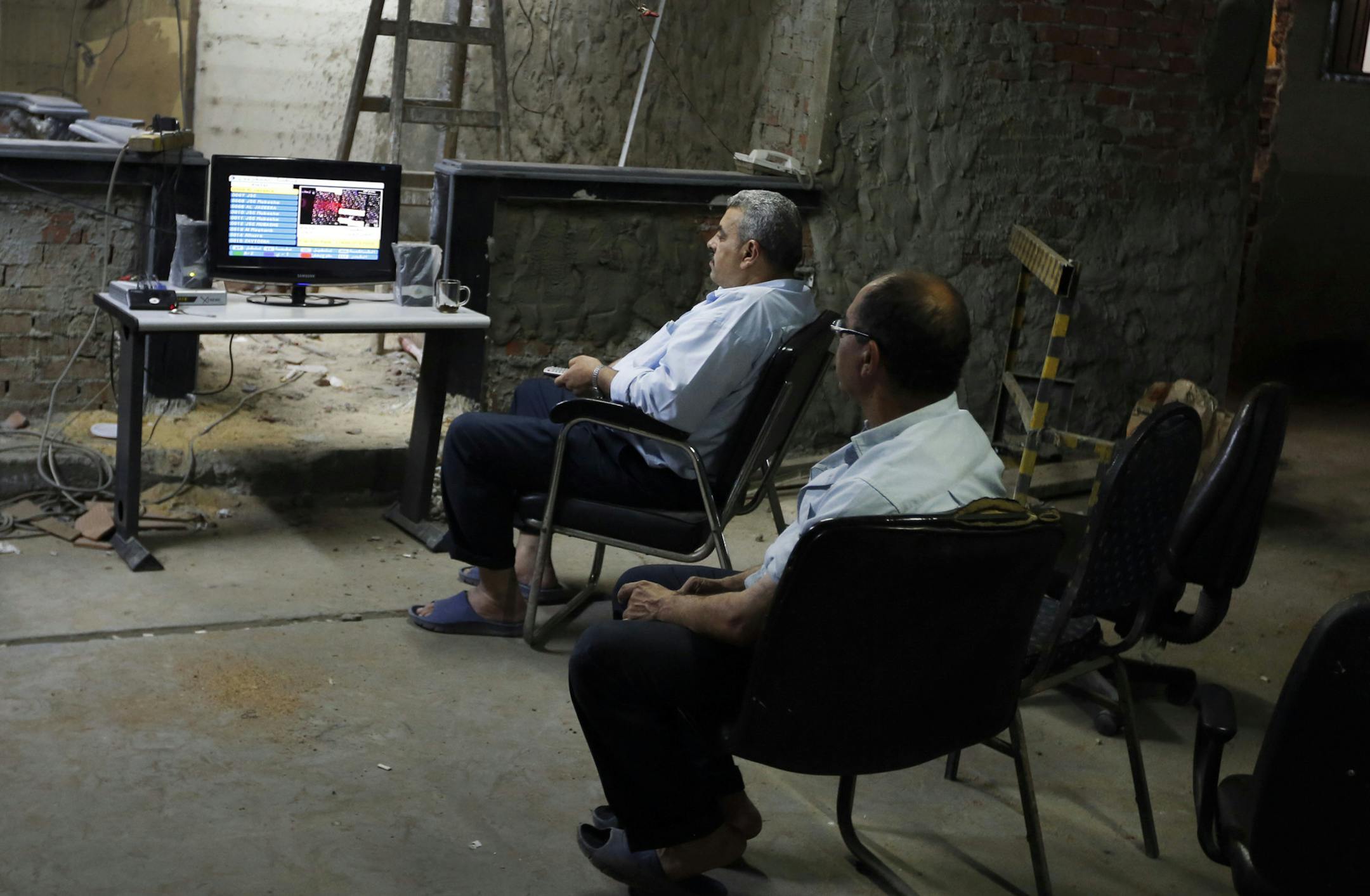
In this Sunday, Aug. 25, 2013 photo, people watch a television news broadcast in Cairo, Egypt, during curfew. The curfew has been a shock to Cairo, a city where cafes stay packed into the night and parents routinely take their children out for dinners nearing midnight. The military-backed governmentís curfew, after violent unrest following the July 3 coup that ousted President Mohammed Morsi, slashed the typical Cairo 24-hour life to just 11 hours. (AP Photo/Lefteris Pitarakis)
passing time: People watched the news in Cairo during curfew. Venting on Twitter, one man tested how many lemons fit in his fridge, another tested ways to hug a pillow. (The Minnesota Star Tribune)
about the writers

about the writers

AYA BATRAWY

SARAH EL DEEB

More from No Section

See More
FILE -- A rent deposit slot at an apartment complex in Tucker, Ga., on July 21, 2020. As an eviction crisis has seemed increasingly likely this summer, everyone in the housing market has made the same plea to Washington: Send money — lots of it — that would keep renters in their homes and landlords afloat. (Melissa Golden/The New York Times) ORG XMIT: XNYT58
Melissa Golden/The New York Times

It’s too soon to tell how much the immigration crackdown is to blame.