0:55
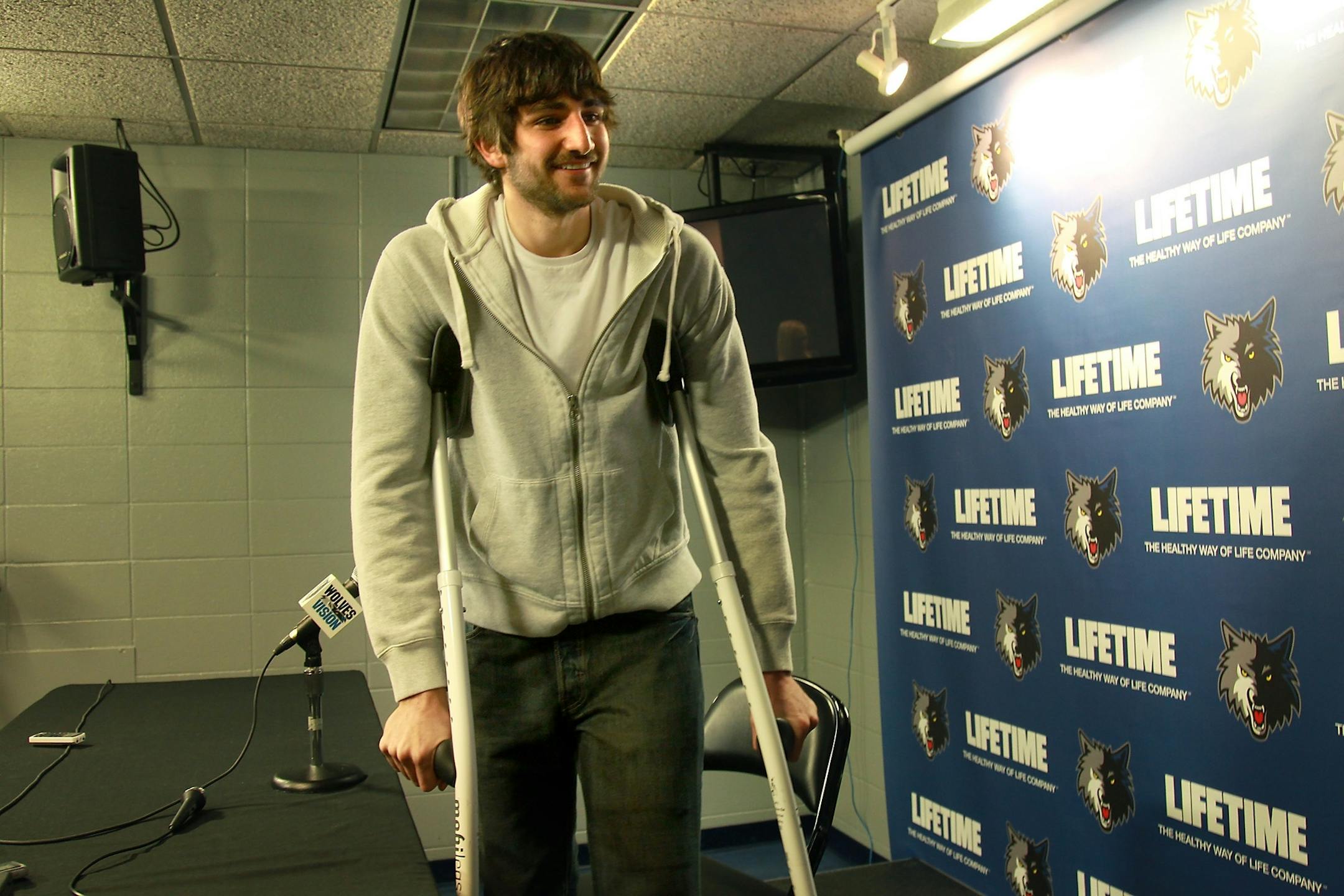
0:55Ricky Rubio hobbled in the glamorous footsteps of Halle Berry when Mobilegs crutches brought the injured Timberwolf to Tuesday's dog-and-pony show.
Mobilegs are award-winning, ergonomically correct crutches designed by Minnesotan Jeff Weber.
I first saw the crutches with the meshed arm saddle a few weeks ago when I visited WCCO-TV anchor Frank Vascellaro, who was recuperating from left hip replacement surgery. Vascellaro absolutely raved about the crutches, which he described as "cool looking" as he explained how they work and talked about the theory behind their design and the local guy who created them. (Dear "Where's Frank?" e-mailers: Since I wrote that he had bum hips back when I reported that his right hip was being replaced, I didn't think there was any rush to write about his latest surgery. As you can see, he returned to work on Tuesday.)
Speaking to media for the first time since injuring his ACL March 9 against the Lakers, Rubio said he already hates his crutches and can't wait until he doesn't need them. The rookie guard is too young to appreciate this advancement in crutch technology.
"The fundamental design of crutches hasn't changed for over 150 years," according to Jeff Stoner, veep of sales and marketing for Bloomington-based Mobilegs.
"Nobody likes to be on crutches. Obviously, what we're trying to do is make it as comfortable as possible when people have to be on them," said Stoner.
"We introduced them to the market in 2011. They were designed by Jeff Weber, a local designer who was instrumental in the design of the Herman Miller Aeron chair and its successor, the Embody. He [Weber] broke his heel about five years ago, was on crutches for about 13 weeks. He was so frustrated with the pain and soreness that he said, This is a solvable problem. Let me take a patient-centric view and design them in a way they should be designed."
Weber, who was not available for comment, realized that whether a person needs crutches for short-term use or a chronic condition, "There is a way to eliminate the discomfort under the arms, which is what the saddle does," said Stoner. "It has a spring to it; it's mesh, to keep things cool. The handle is at a very intentional angle. It helps keep the wrist in a neutral position and uses the strongest part of the hand." Traditional crutches require use of the weakest part of the hand.