

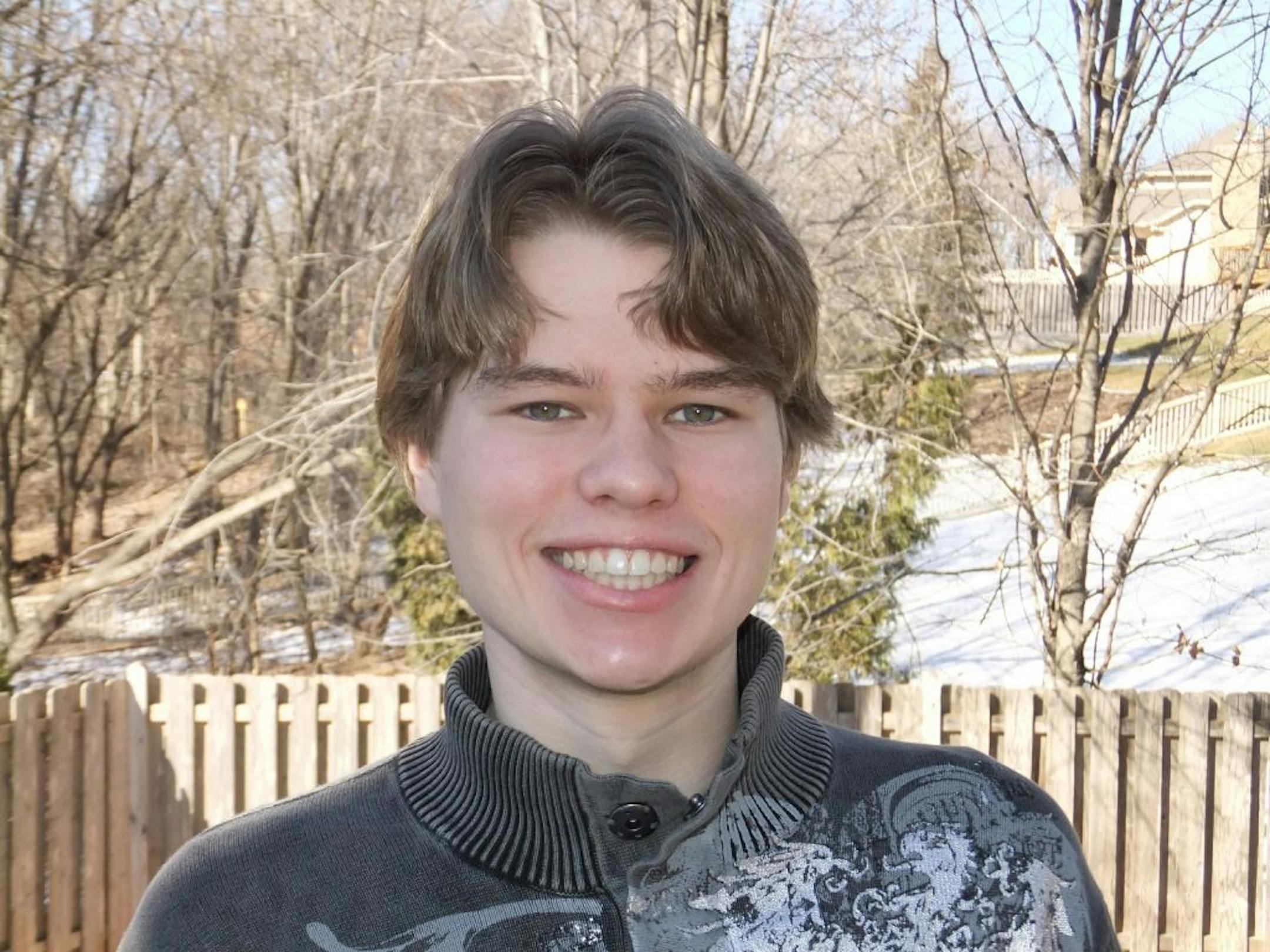
On a cloudy day in Northfield, Michael Coughlin sits hunched over a small brown table and draws a picture.
"It has what's called an interferometer," says the 6-foot-2 Carleton College senior, motioning to the primitive drawing on the table. He explains that laser lights are emitted and split by a beam splitter, eventually to be directed toward two unevenly spaced mirrors, all within an unimaginably small space, "in the hopes of detecting a gravitational wave."
Coughlin isn't talking about an abstract idea or a sci-fi movie scene. The jumble of shapes is a depiction of a very sensitive technology called a gravitational wave detector.
There are a number of them around the world, meant to detect ripples in space-time emitted by a moving force. It was Albert Einstein who first predicted their existence in his Theory of General Relativity. It is Coughlin who now hopes to move the idea forward, with the help of a $40,000 to $50,000 scholarship from the Winston Churchill Foundation of the United States.
Coughlin, a Burnsville native, is one of 14 students in the United States to receive the award, which will pay all of his costs to spend a year at Cambridge University's Institute of Astronomy studying the waves and completing his master's degree. He ranks as the fifth Churchill Scholar in the history of Carleton College; the University of Minnesota, a much larger school, has had only six.
During his year at Cambridge, Coughlin will have data produced by gravitational wave detectors around the world right at his fingertips for analysis. He hopes to find new information about the forces emitting the gravitational waves, whether they be a black hole colliding with a star, a supernova occurrence "or if two black holes collide ... a terrifying thought."
"There are models for what a gravitational pull should look like, depending on how big a black hole was, how fast it was spinning or if it was spinning at all," Coughlin said. "The project is to assume we've detected these [gravitational waves] and figure out the best way to pull out these characteristics from what we've seen in a gravitational way."
For Coughlin, the scholarship is not only a dream come true, but one he never thought he had a realistic chance at winning. Even his parents, Bill and Lisa Coughlin of Burnsville, were more than skeptical.


