

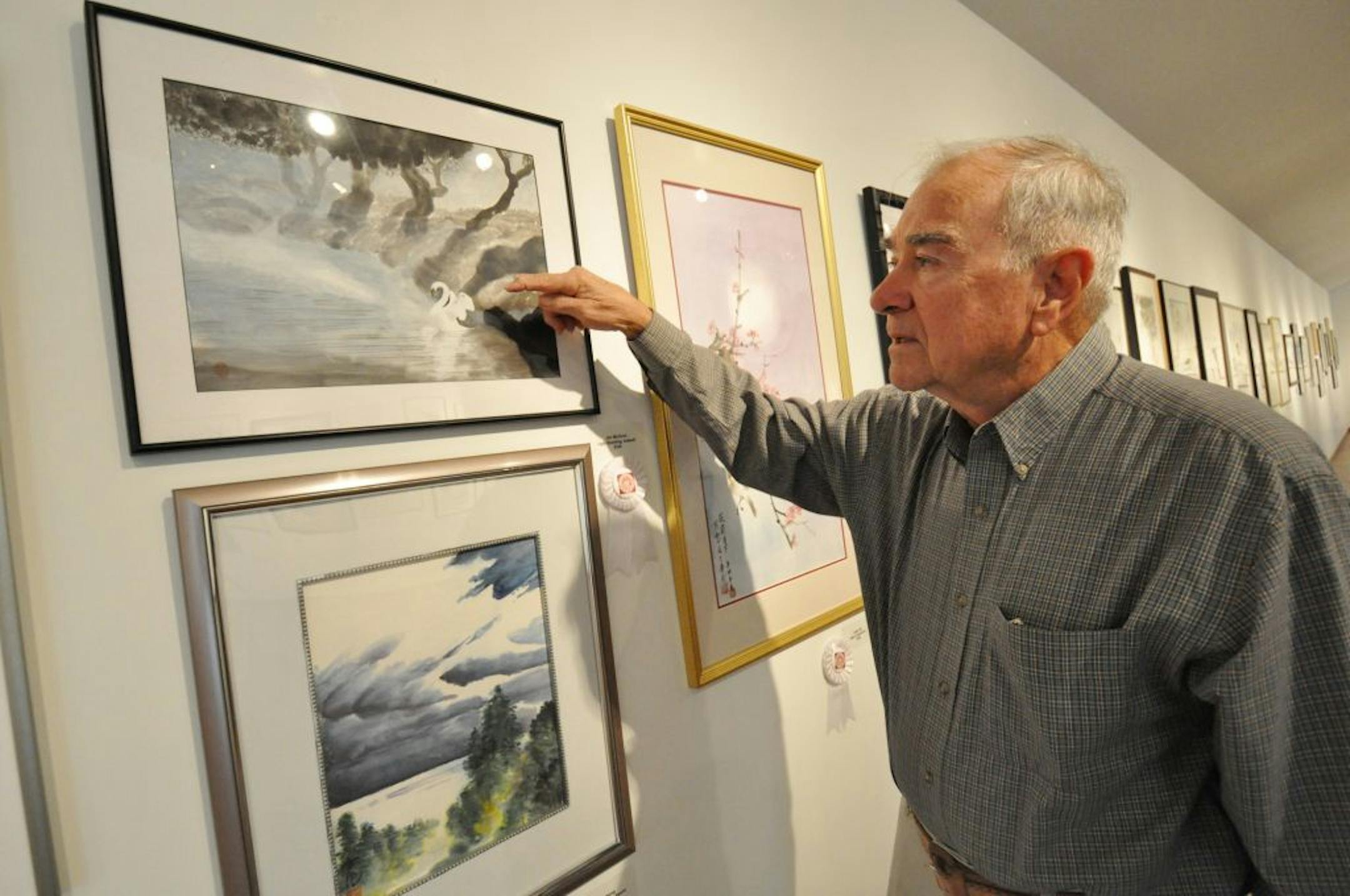
When Jim McGuire of Rosemount traveled to China a few years ago, he promised himself he wouldn't buy any more paintbrushes.
Of course, he came back with a handful -- "You have to have a billy goat whisker brush," he said -- as well as several "chops," the hand-carved stamps to make red signature seals on his Asian brush paintings.
McGuire, an avid Sumi-e artist for the past 35 years, had one of his paintings chosen for an international show that recently finished touring Japan and China.
He also just took home an award at the annual Ming Chiao Sumi-e (Japanese for "ink painting") Society of America show, which runs through next Sunday at the Burnsville Performing Arts Center gallery. The show features 68 paintings and 17 pieces of calligraphy from painters all over the country, many from Minnesota.
"We have a growing interest in Sumi-e painting in Minnesota," said Pat Gustafson of Faribault, national events chairwoman for the show. "It's exciting for those of us who have taken it on." There are a number of master teachers in the state, she said, such as the show's two jurors, Hong Dhang, a University of Minnesota instructor who judged the calligraphy portion, and painting judge Yudong Shen, who runs Meilin Art Studio in Shoreview.
East Asian brush painting, or ink-wash painting, traditionally uses brushes, an ink stick, which is ground on an ink stone with water, and rice paper. "It is almost like tissue," Gustafson said. "Water moves on the paper more freely."
The composition is different than much of Western art "in that the open space is as important a part of the composition as the object itself," McGuire said. "Lots of times, Western artists fill the whole canvas. It's a beautiful study in simplicity, although lots of time I slop over into the Western style a little bit."
Ming Chiao, Chinese for "Minnesota bridge," McGuire said, is meant to represent the merging of East and West. The group meets every other month and plans special activities, such as workshops, group shows and outings.


