
Burl poachers ruin old-growth redwoods

Thieves are slicing knobby growths from ancient trees.

The Associated Press
March 6, 2014 at 3:38AM
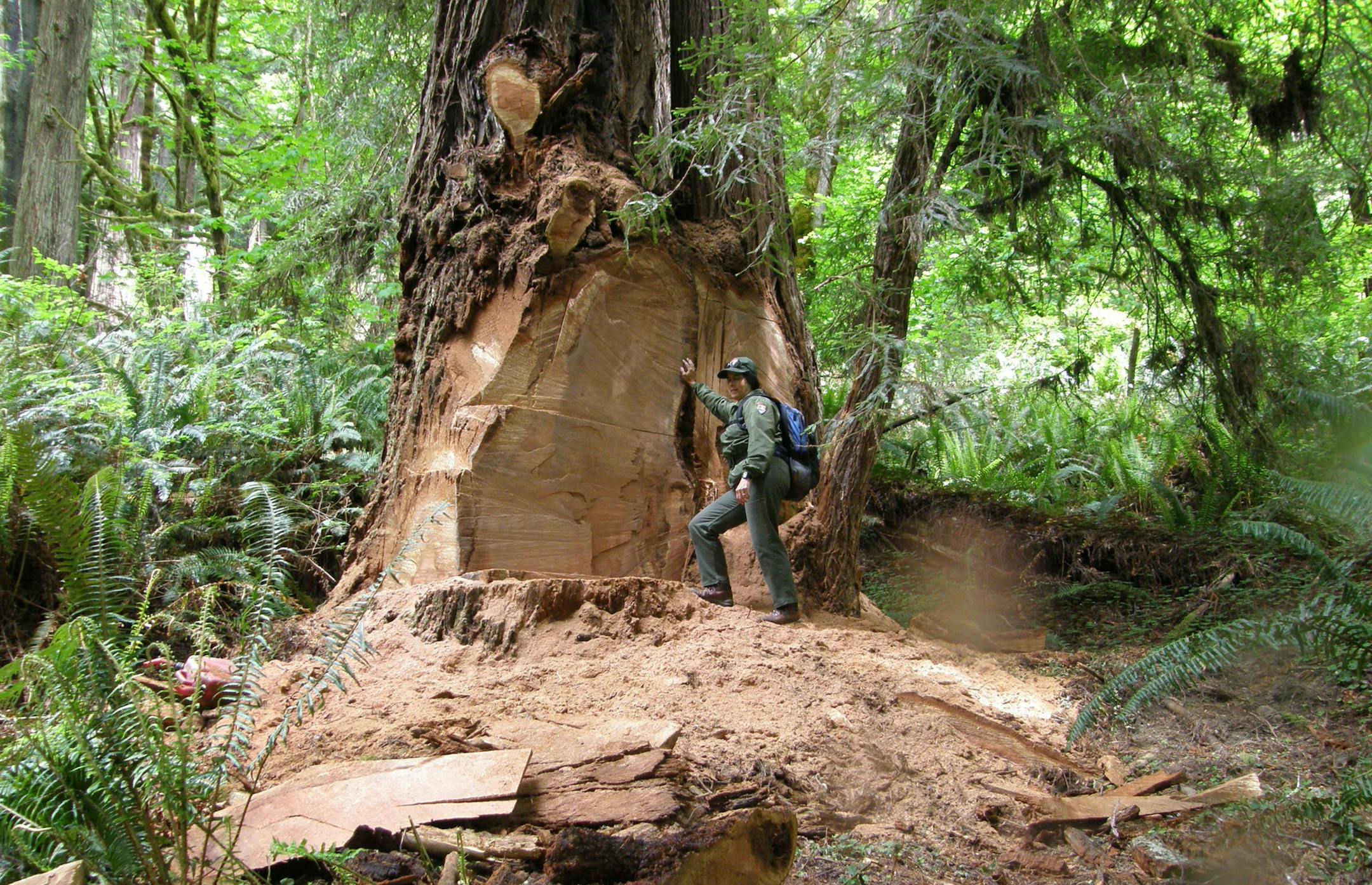
This May 21, 2013 photo provided by the National Park Service shows wildlife biologist Terry Hines standing next to a massive scar on an old growth redwood tree in the Redwood National and State Parks near Klamath, Calif., where poachers have cut off a burl to sell for decorative wood. The park recently took the unusual step of closing at night a 10-mile road through a section of the park to deter thieves. (AP Photo/Redwood National and State Parks, Laura Denn)
Wildlife biologist Terry Hines stood next to a massive scar on a redwood tree near Klamath, Calif. (The Minnesota Star Tribune)

Authorities say unemployment and drug addiction have spurred an increase in the destructive practice of cutting off the knobby growths at the base of ancient redwood trees to make decorative pieces like coffee tables and wall clocks.

The practice — known as burl poaching — has become so prevalent along the Northern California coast that Redwood National and State Parks on Saturday started closing the popular Newton B. Drury Scenic Parkway at night in a desperate attempt to deter thieves.

Law enforcement Ranger Laura Denny said that poachers have been stalking the remote reaches of the park with their chain saws and ATVs for decades, but lately the size and frequency of thefts have been on the rise.

"When I interview suspects, that is the [reason] they say: their addiction to drugs and they can't find jobs," she said.

Her husband, park district interpretation supervisor Jeff Denny, said it is comparable to the poaching of rare rhinos in Africa to sell their horns. Jobs are hard to come by since the timber and commercial fishing industries went into decline.

A redwood tree can survive the practice, but the legacy of the organism that could be 1,000 years old is threatened, because the burl is where it sprouts a clone before dying. Sprouting from burls is the prevalent method of redwood propagation, he said.

Lorin Sandberg, a burl dealer in Scio, Ore., occasionally goes to Northern California to buy burl, but it is tough to find any more, with almost all of the old growth that makes the best burls protected on public land. The good stuff with a lacy grain full of eyes will go for $2 to $3 a pound, unseasoned.

Finished dining room tables are offered for $13,000 on eBay.

"I don't buy them unless they have proof of where they got it," he said.

Laura Denny is currently chasing whoever cut a massive burl from a redwood just south of the mouth of the Klamath River. The cut left a scar measuring 8 feet by 10 feet.

Over the course of weeks, the thieves cut the burl into slabs weighing more than 100 pounds each that they dragged behind ATVs to a road.

She found the slabs in a burl dealer's yard. After matching the wood to pieces left behind at the scarred tree, she seized the slabs.

The dealer had paid $1,600 for eight slabs that he was going to sell for $700 apiece.

about the writer

about the writer

Jeff Barnard

More from No Section

See More
FILE -- A rent deposit slot at an apartment complex in Tucker, Ga., on July 21, 2020. As an eviction crisis has seemed increasingly likely this summer, everyone in the housing market has made the same plea to Washington: Send money — lots of it — that would keep renters in their homes and landlords afloat. (Melissa Golden/The New York Times) ORG XMIT: XNYT58
Melissa Golden/The New York Times

It’s too soon to tell how much the immigration crackdown is to blame.