

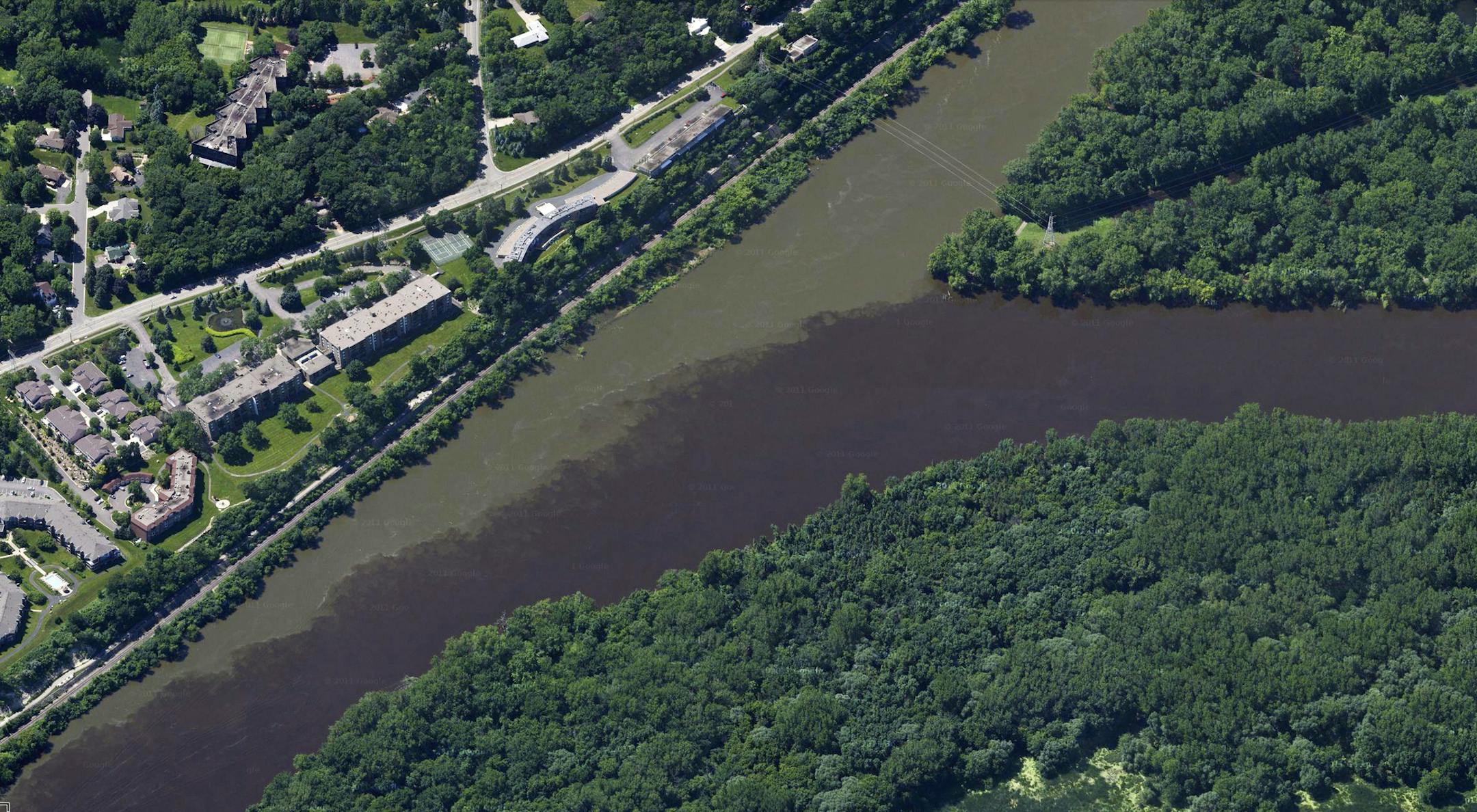
In a May 5 editorial ("Don't backpedal on 'buffer strips' bill"), the Star Tribune contrasts the differences in appearance of the Minnesota and Mississippi rivers where they meet by Fort Snelling when viewed in aerial photos. The reader is given the narrative that were it not for agriculture in the Minnesota River drainage area, its water would have the clarity of the St. Croix River or the Mississippi River north of Fort Snelling.
Neither I nor the Star Tribune Editorial Board has an aerial photo from 1850, a time before the arrival of nonnative agriculture. However, we do have statements from travelers on the rivers in the early 19th century:
Sept. 22, 1835
Soon after 8 A.M. we came to the mouth of the Mahkatoh, or "Blue Earth River," a work composed of mahka ("earth") and toh ("blue"). This was a bold stream, about eighty yards wide, loaded with mud of a blueish colour, evidently the cause of the St. Peter's [now the Minnesota River] being so turbid. … The Mahkatoh appears to form about half the volume of the St. Peter's, and is a very rapid stream.
From "A Canoe Voyage Up The Minnay Sotor," Vol. 1, by George W. Featherstonhaugh; published by Richard Bentley in London (1847). Minnesota Historical Society Press (1970).
July 3, 1823
While at [St. Anthony] Falls, an old Sergeant gave us for dinner a very fine black bass. That fish is taken here in great abundance, as also catfish, pike, pickerel [etc.]. Antonio [de] Ulloa speaking in reference to the lower Mississippi says the coldness of the water is the cause of its having no more than two or three species of fish & that those are neither numerous or delicate. He would not have thought so had he visited the upper Mississippi. If in truth there are so few fish lower down, it is to be attributed to the muddiness of the water & in some degree perhaps to the limestone of the region. One of those causes banishes the brook trout from all the eastern tributaries of the Mississippi & from the western also except about their sources. The same may be the case with other species of fish.
From "The Northern Expeditions of Stephen H. Long: The Journals of 1817 and 1823 and Related Documents," by Kane, Holmquist, and Gilman; Minnesota Historical Society Press (1978).
July 9, 1823
I remarked before that the St. Peter's is 90 yards broad at its mouth. It has there no perceptible current & it is deep. The Sioux call it Wotepa Menesote or the River of Muddy Water.
Also from "The Northern Expeditions of Stephen H. Long: The Journals of 1817 and 1823 and Related Documents."


