
Boy's double hand transplant is the first of its kind

Zion Harvey, 8, of Baltimore, wants to climb the monkey bars. Throw a football. Play the guitar. Maybe even become a doctor.

The Philadelphia Inquirer
August 8, 2015 at 5:05AM
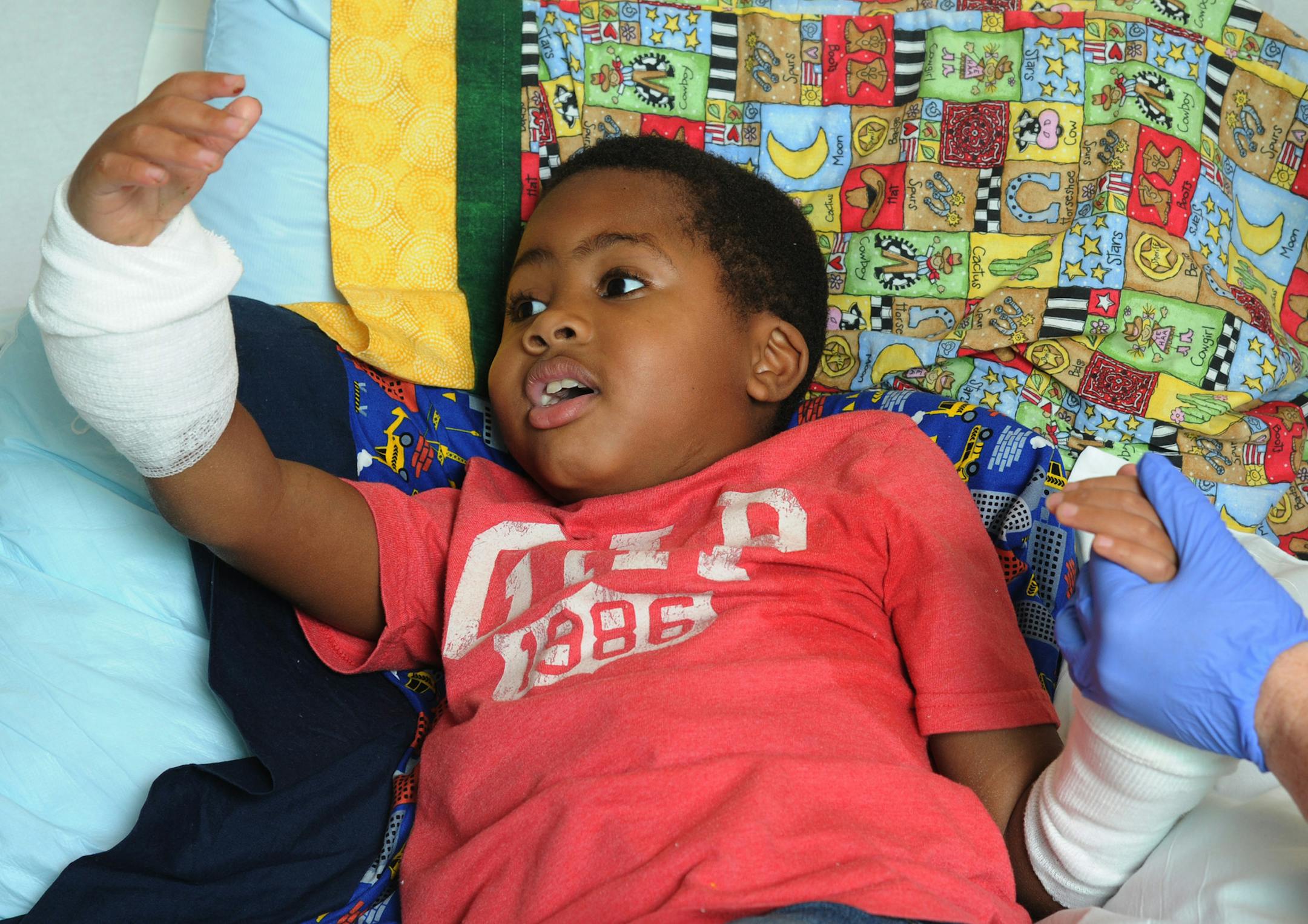
Zion Harvey, 8, of Baltimore, seems to marvel at his new right hand while in his hospital bed on July 27, 2015. Zion lost his hands and feet to a bacterial disease when he was 2, but had a double hand transplant at Children's Hospital of Philadelphia in early July 2015, the first pediatric double hand transplant. (Clem Murray/Philadelphia Inquirer/TNS)
Zion Harvey, 8, of Baltimore, seems to marvel at his new right hand while in his hospital bed on July 27, 2015. Zion lost his hands and feet to a bacterial disease when he was 2, but had a double hand transplant at Children's Hospital of Philadelphia in early July 2015, the first pediatric double hand transplant. (The Minnesota Star Tribune)

Sitting on his bed at Children's Hospital of Philadelphia, the first child in the world to receive a double hand transplant talked about his big plans.

Zion Harvey, 8, of Baltimore, wants to climb the monkey bars. Throw a football. Play the guitar. Maybe even become a doctor.

"But I'll be the kind that doesn't give shots," he said.

No child has ever received a transplant of a single hand, let alone two. Only about 60 people worldwide — including the University of Pennsylvania's first case, a young woman, in 2011 — have undergone upper extremity transplants since the first one in France in 1998, according to the international registry.

These complex "composite" tissue transplants — which involve reattaching blood vessels, bones, nerves, muscles, and skin — remain rare because, unlike major organ replacements, they are not lifesaving. Yet patients must take immune-suppressing drugs for the rest of their lives to prevent rejection, raising their risks of infection, some cancers, and other side effects.

Zion was uniquely suitable because he was already taking anti-rejection drugs to protect his kidney transplant.

At age 2, a life-threatening bloodstream infection required the amputation of his hands and feet, and ruined his kidneys. At age 4, after years on dialysis, he received a kidney from his mother, Pattie Ray.

About two years ago, she took him to Shriner's Hospital for Children in Philadelphia, which specializes in caring for kids with prosthetics like those he wears on his lower legs. There she learned about Penn's hand transplant program. "The doctor at Shriner's thought Zion would be a perfect candidate," recalled Ray, a nursing student at Baltimore Community College
Zion's precocious self-awareness and resilience also impressed the transplant team from Children's and Penn. On a documentary video made by the team, Zion said of his stumps, "I wasn't always like this. When I was 2, I had to get my hands cut off."

Of school, the second-grader said, "I think some of my classmates don't mean to say mean things to me, but it just slips out. Everybody has their own way of thinking about things."

Anticipating the transplant, he said, "When I get these hands, I will be proud of what hands I get. And if it gets messed up, I don't care because I have my family."

His mother said he took the transplant surgery in stride. "This is just another hurdle that he jumps. He's so amazing."

Transplant team leader L. Scott Levin, who established Penn's hand transplant program and expanded it to Children's, called Zion "one of the most remarkable youngsters I've ever met."

"His maturity is way beyond his age, as is his insight and sensitivity," Levin said. "He's brilliant, not just smart. And his stoicism has been remarkable. I've never seen him cry, complain of pain or be withdrawn."

In April, Zion was put on a waiting list for hands, to be obtained through Gift of Life, the region's organ and tissue transplant network.

He and his family were warned that the wait might be a year or two. Federal organ-sharing data showed that only a tiny number of children of the appropriate race, age and sex become donors each year.

But on July 6, Zion underwent the 11-hour surgery, an overnight marathon involving two dozen surgeons, nurses, and anesthesiologists. The process required four separate surgical teams, two for the donor hands and two for Zion.

Steel plates and screws were used to connect the forearm bones, then the arteries and veins were sewn using thread thinner than a human hair. With blood flow re-established, each muscle and tendon was reattached, followed by the nerves.

Zion faces many months of physical rehabilitation. While in the hospital, he has been fitted with a series of custom-molded plastic splints that protect his wrist and fingers, while allowing therapists to help him learn to use his new hands.

"By September, the splint will be less bulky and cumbersome, and his wrist should be free," said Children's occupational therapist Kelly Ferry.

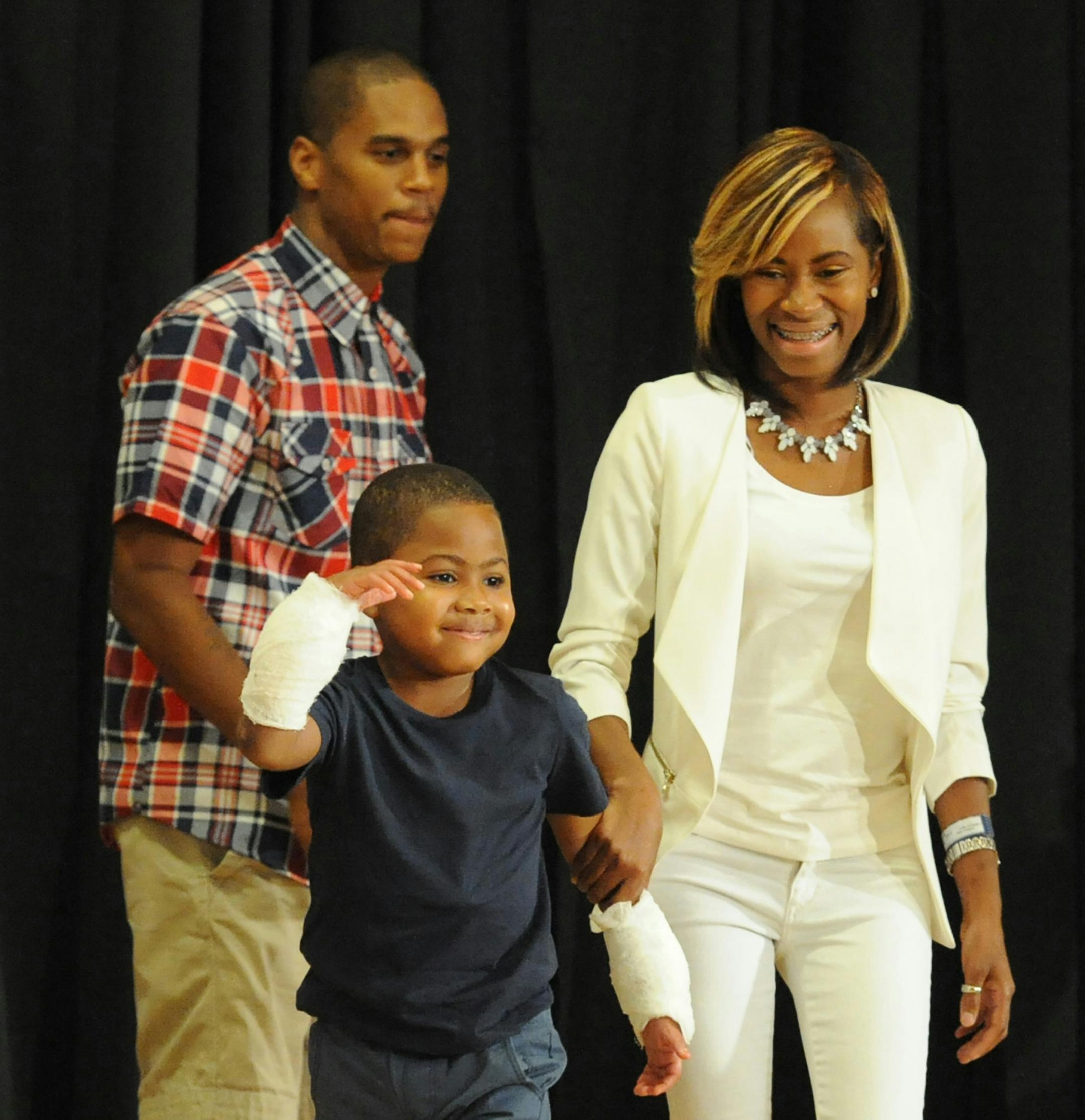
Zion Harvey, 8, of Baltimore, waves to the audience with his new right hand as his mother, Pattie Ray, leads him onstage to the at a news conference at Children's Hospital of Philadelphia on Tuesday, July 28, 2015. Zion, who lost his hands and feet to a bacterial disease as a two-year-old, had a double hand transplant at CHOP in early July 2015, the first pediatric double hand transplant. In the background is his step-father Kevon Gant. (Clem Murray/Philadelphia Inquirer/TNS)
Zion Harvey, 8, waved with his new right hand as his mother, Pattie Ray, and stepfather Kevon Gant led him onstage. (The Minnesota Star Tribune)
about the writer

about the writer

Marie McCullough

More from No Section

See More
FILE -- A rent deposit slot at an apartment complex in Tucker, Ga., on July 21, 2020. As an eviction crisis has seemed increasingly likely this summer, everyone in the housing market has made the same plea to Washington: Send money — lots of it — that would keep renters in their homes and landlords afloat. (Melissa Golden/The New York Times) ORG XMIT: XNYT58
Melissa Golden/The New York Times

It’s too soon to tell how much the immigration crackdown is to blame.