

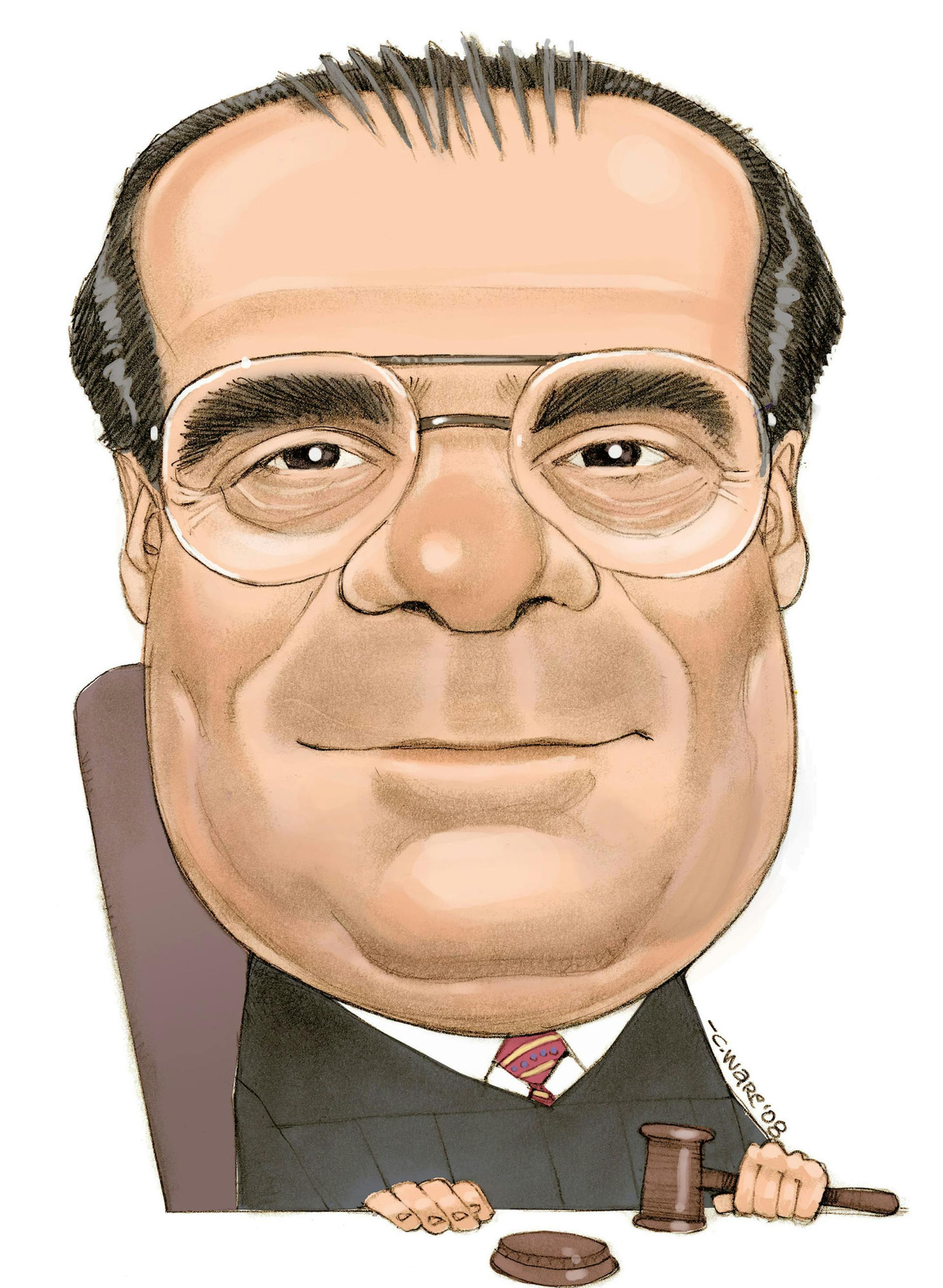
Supreme Court Justice Antonin Scalia may be the most polarizing figure in American law. Conservatives see him as an icon faithful to the Constitution. Liberals see him as an ogre on the wrong side of history.
Last week, liberals asked a pointed question: How can Scalia have the temerity to express constitutional doubts about affirmative-action programs on Monday, and to vote to invalidate the Voting Rights Act on Tuesday — then piously argue on Wednesday that the Supreme Court should defer to Congress and uphold the Defense of Marriage Act?
It's a legitimate question, and whether or not it has a good answer, Scalia remains poorly understood by his admirers and his critics alike.
Perhaps his central goal has been to promote the rule of law, which (as he contended in an important essay in 1989) is "a law of rules." He seeks to increase predictability. He favors general rules, not case-by-case judgments.
In his view, such rules simplify life for ordinary people and the legal system. They also reduce the danger that political preferences will dominate judicial decisions.
Because of his commitment to predictability and democratic self-government, Scalia insists that laws must be interpreted in accordance with their ordinary public meaning — the meaning that their words had in the nation or community that enacted them. Of course, Scalia is aware that words can be ambiguous; in such cases, he is willing to defer to the interpretation of the executive branch (whether the president is a Democrat or a Republican). What he insists on is that the ordinary meaning governs if judges can identify it.
That commitment isn't connected with any political ideology; it can lead to liberal results. For example, Scalia recently wrote an important voting-rights opinion (over vigorous dissents from Justices Clarence Thomas and Samuel Alito), ruling that the language of the National Voter Registration Act bans Arizona from requiring voters to provide documentary evidence of U.S. citizenship.
As an "originalist," Scalia believes that provisions of the Constitution mean what they meant at the time that they were ratified. He thinks that originalism increases predictability and ensures the sovereignty of We the People. The meaning of constitutional provisions is a question of history, not morality.


