

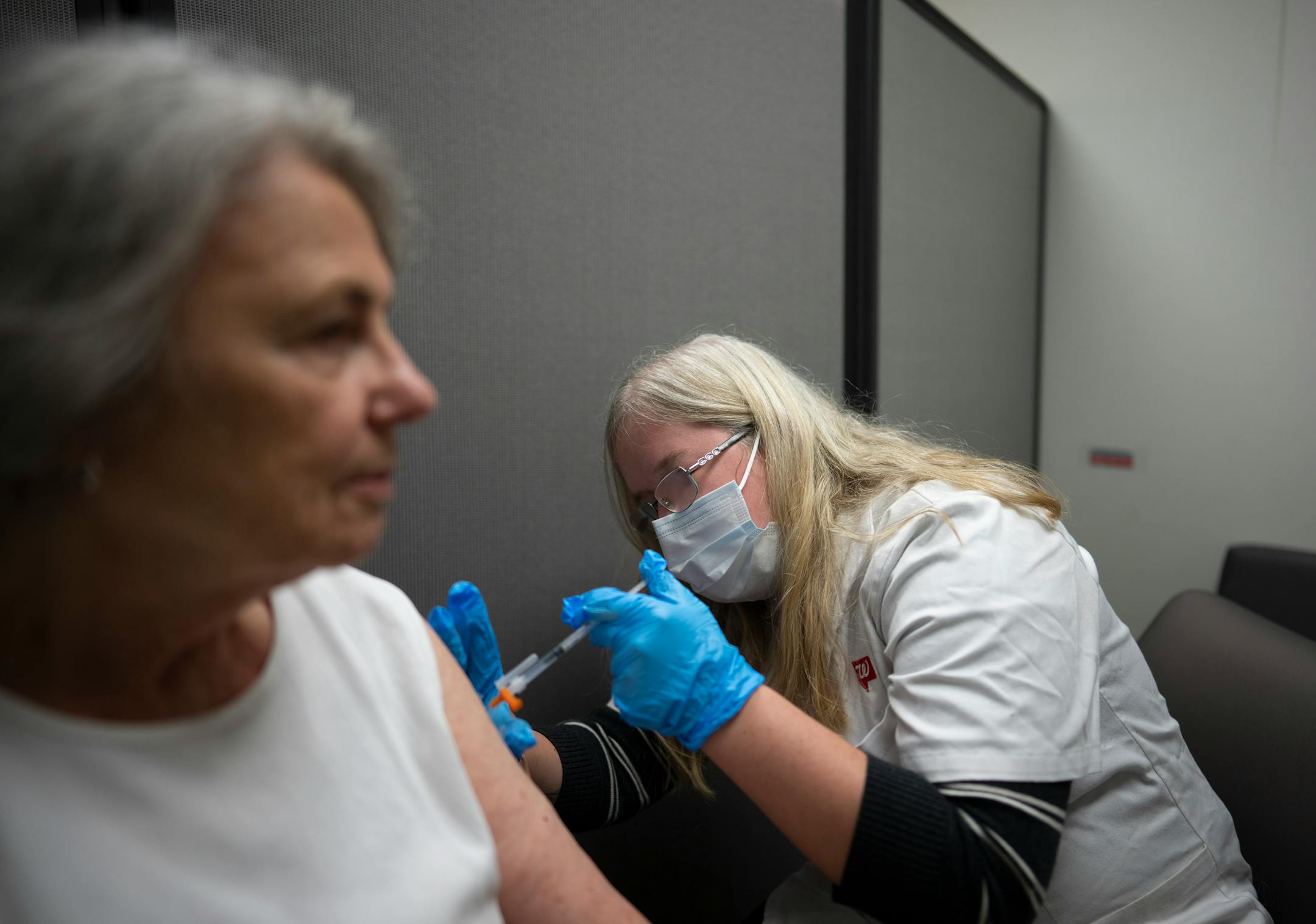
New COVID-19 vaccine boosters are now widely available in the Twin Cities this week, amid low but persistent pandemic numbers in Minnesota and an uncertain fall and winter.
Pandemic trends in Thursday's weekly state report showed little change — with publicly reported coronavirus infections remaining at about 1,400 per day and Minnesota seeing some four to six COVID-19 deaths per day. The state's death toll is 13,153 since the start of the pandemic in March 2020.
Linda Boss was motivated Tuesday as she became one of the first Minnesotans to receive a new COVID-19 booster, which increases protection against original strains of the coronavirus and also the BA.5 and BA.4 variants that are causing almost all infections right now. The 79-year-old Roseville woman wanted the added protection ahead of a church group trip to Ireland this month to learn about Celtic culture.
"I didn't happen to have any reaction at all, but sometimes there is a reaction and I wanted to get that over with before I was ready to take off," she said.
Booster appointments were available at many retail pharmacies on Tuesday and at the state's Mall of America vaccination site Thursday. The state's Duluth site will provide the boosters when it opens as scheduled Sunday. All booster shots for people 12 and older involve the new formulation.
Infectious disease experts are perplexed by the COVID-19 numbers this summer that haven't increased but haven't declined either. COVID-19 patients filled 425 inpatient beds in Minnesota hospitals on Tuesday, including 40 people in intensive care. That is well below the peak of 1,680 hospitalizations during last winter's pandemic wave, but it leaves Minnesota in a rut between 200 and 600 hospitalizations since early March.
Those flat-line trends have inspired public confidence, though. Last week's traffic at retail and entertainment destinations in Minnesota was 5% above average for the first time since Labor Day weekend 2021, according to Google, which uses aggregate cell phone usage to assess mobility. Retail traffic was 20% below normal in late January during the omicron COVID-19 wave.
Mobility levels in workplaces have remained 20% below typical in Minnesota all summer, but levels in bus and train stations have steadily increased. Buoyed by State Fair traffic, transit mobility levels were only 5% below normal last week, an improvement from 13% below normal at the same time last year and 33% below normal the year before that.


