

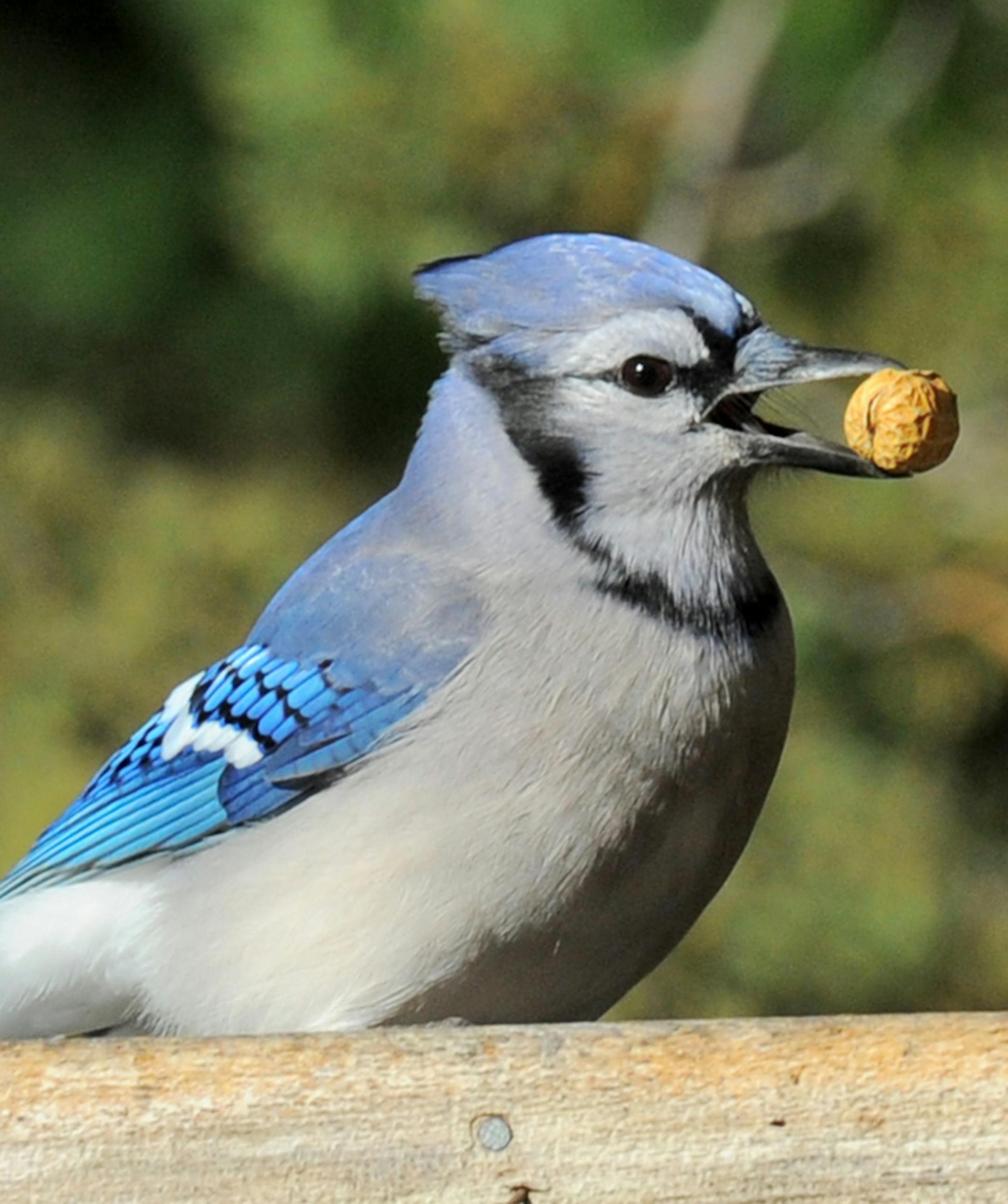
One winter morning I wrote in my journal that 15 minutes after sunrise about 25 blue jays arrived at our feeding station. The flock was a welcome sight on a cold, sunny, 16-below day.
Although many people have told me they don't like blue jays, I don't share the feeling. Their alarm calls are often helpful in saving the lives of other creatures, and they are also among the most active, amazing, beautiful and clever of our native birds.
The large numbers of birds that share the same area with them indicates that any nest-robbing they might do can only be seen as another natural control of numbers. My observations show blue jays are no more dominant than other birds of the same size, and they make no effort to keep away other birds. Their activities at feeding stations, if anything, cause passing birds to inspect an area, discover food that has been put out, and become regular visitors, too. It's interesting that rarely does the jay actually eat at a feeder. Rather food is crammed into a throat pouch until there isn't room. One may fly away with a dozen sunflower seeds at a time. Some food is eaten in a quiet spot and other food is cached.
At feeders they relish sunflower seeds and peanut parts, plus cracked corn scattered on the ground. Blue jays lower their crests when feeding peacefully. Natural food consists of insects, fruit, seeds and carrion.
The range for the blue jay is the eastern United States, and much of far southern Canada. A permanent resident throughout Minnesota, some are present throughout winter in all parts of their range. Again this fall we observed flocks heading south throughout most of the state, and thousands were seen migrating along the North Shore of Lake Superior. Studies reveal that young jays may be more likely to migrate than adults, but many adults still do. Some individual blue jays might migrate south one year, stay north the next winter, and then migrate south again the next year. No one has worked out why they migrate as they do. One blue jay banded in autumn at Lowry Nature Center, near Victoria, ended up in Texas a couple weeks later. The oldest known banded blue jay was at least 26 years and 11 months old when it was found dead. It was banded in Newfoundland in 1989 and found there in 2016.
Jim Gilbert taught and worked as a naturalist for 50 years.


