
Bloomington’s K-5 computer science immersion program builds future problem-solvers

At Indian Mounds Elementary, students are encouraged to incorporate computer science into every subject — boosting their tech skills and creativity along the way.

Sahan Journal
October 4, 2025 at 7:00PM
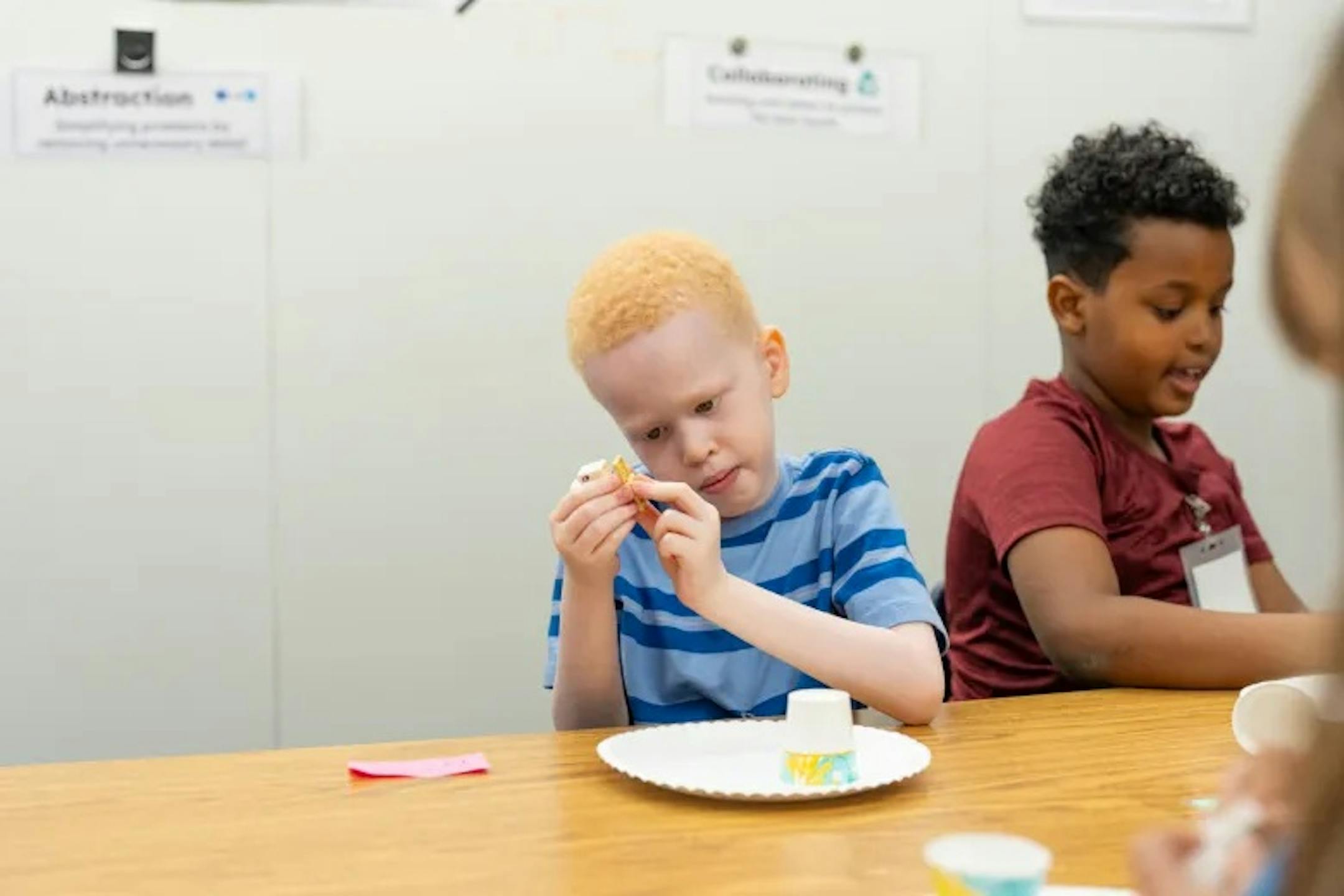
Third-grader Ismail tries to build a duck out of Legos during computer science class at Indian Mounds Elementary School in Bloomington on Sept. 11. (Aaron Nesheim/Sahan Journal)

A class of third-graders were given six Lego pieces. They had to make a duck out of their pieces. The duck could be sitting, swimming or flying. But no duck could look the same.

This is how the third-graders at Indian Mounds Elementary School in Bloomington started their first day of computer science lessons.

They went on to dismantle the ducks and were asked to create anything that is not a duck: a test of imagination, flexibility and creativity.

The students made polar bears, birds, dragons and even angel dogs (a dog, but with wings).

“Legos are a great way to think about computer science, and you can get really creative with them,” said computer science teacher Lee Nelson. “It’s a great way to get the creative juices flowing.”

Indian Mounds, part of Bloomington Public Schools, is a computer science immersion school, meaning K-5 students take dedicated computer science classes every week and are also encouraged to incorporate computer science lessons and skills into other subjects, too. A second Bloomington school, Poplar Bridge Elementary, also has a computer science immersion program.

Students at these schools learn computer science both on computers and also unplugged, that is, using their hands to get a sense of how the gadgets they use on a daily basis work.

The program, which was started in 2019, aims to prepare students not just to enter the computer science field, but also boost their problem-solving abilities, logic and creativity. That means that not only can their Lego ducks look different, they should.

The program not designed just for future computer scientists, the school administrators say.

“It’s more of a way of thinking than it is a set of specific skill sets,” Nelson said. “Like, ‘Do you understand how a machine gets directions from a human and then follows those directions?’, through a series of lessons that progressively get more interesting and more challenging through the grades.”

At the school, computer science immersion is designed to complement the standard Bloomington curriculum. Teachers still cover the same lessons taught across the district, but they also weave in computer science.

The goal, administrators said, is to make lessons more engaging for students while still meeting state standards.

Here’s an example of what that looks like at Indian Mounds: Third-graders combine their social studies lessons on Native American history and contemporary life with computer science instruction. Students prepared what they had learned and translated it into an interactive map of Minnesota.

The map was wired to connect with a programming platform called Scratch, where students uploaded photos or recorded their own voices to share information. The result was a digital map that blended storytelling with technology, allowing students to present historical and present-day perspectives on Native Americans in a hands-on way.

Alexandra Holter, computer science program coordinator at Bloomington Public Schools, says this helps students build confidence in all subjects.

“When we learn in silos, it’s hard to see the real world relevance. … In education, sometimes we get stuck in these antiquated ways and do these kinds of things that have just been done, and CS allows students to demonstrate what they know in unique and creative ways,” she said.

Jack Ell, a third-grader at Indian Mounds, is “mad about computer science,” said his mother Angie Hendrickson. Ell said he wants to be a video game developer when he grows up, and he is already on his way.

“For Christmas, he’s asking for circuit boards and coding games. He’s already developing his own servers on Roblox [an online game creation platform] and doing all sorts of things like that,” Hendrickson said. She added that Indian Mounds was the “logical option” for Jack “to be ahead of the game when it came to computers and technology.”

With 32% English language learners, the school took an approach to teaching computer science that doesn’t rely on English for instruction, Holter said. Educators like Nelson use visual cues and movements to explain and illustrate lessons.

Holter said Bloomington schools are trying to prepare students for growing tech opportunities, while also addressing demographic gaps in the industry, which remains dominated by white men.

“It was a very intentional equity move, that we want to bring this to all students so that they can take advantage of the tremendous opportunity that the field provides,” Holter said.

About the partnership

This story comes to you from Sahan Journal, a nonprofit newsroom dedicated to covering Minnesota’s immigrants and communities of color. Sign up for a free newsletter to receive Sahan’s stories in your inbox.

about the writer

about the writer

Shubhanjana Das

More from Twin Cities Suburbs

See More
card image
Shari L. Gross

Ortega, a commissioner since 1994, reversed course days after St. Paul City Council President Rebecca Noecker formally launched.

card image
card image