

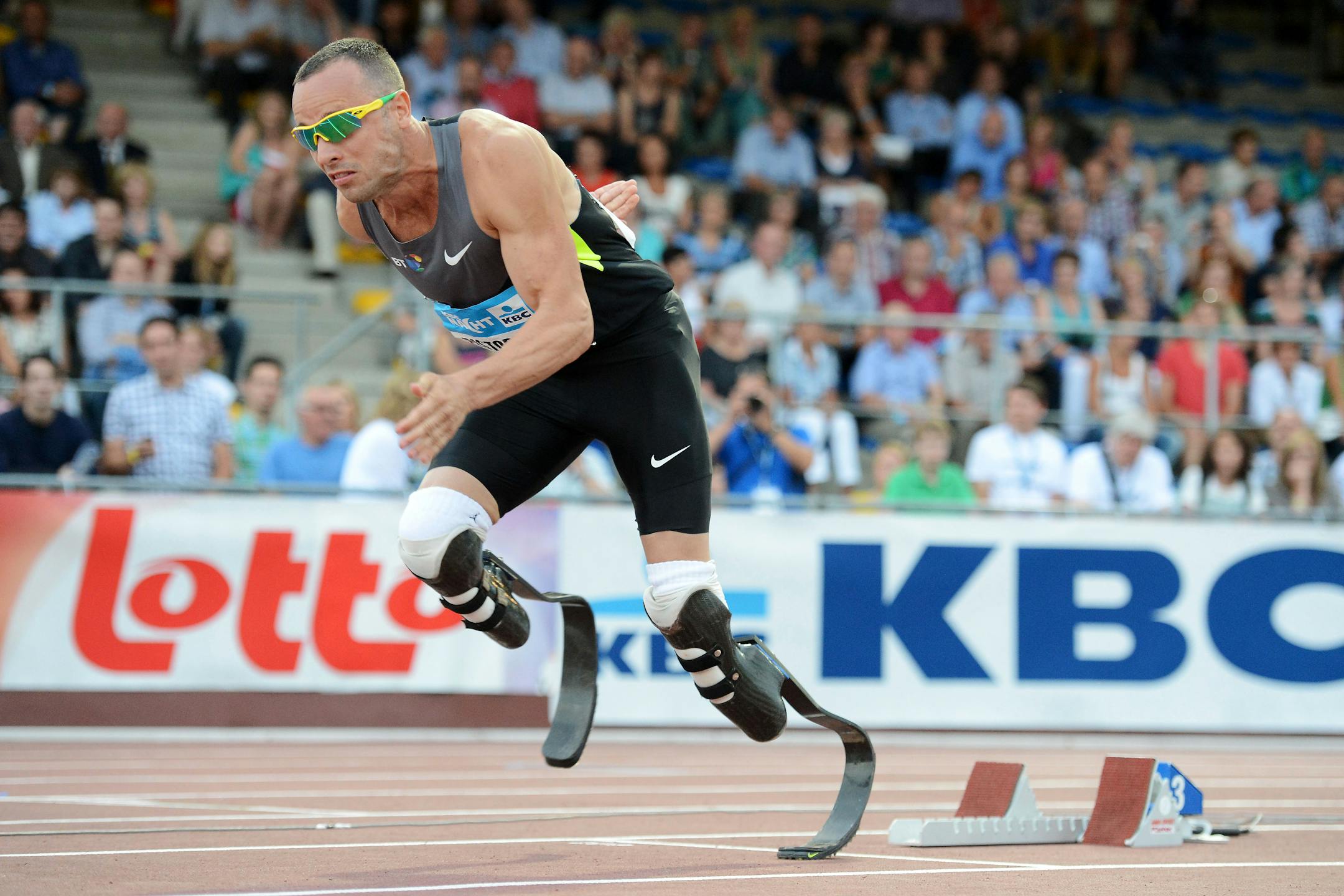
Oscar Pistorius, the double-amputee South African "Blade Runner," is set for an unprecedented Olympic debut today in the 400-meter qualifying heats. When the starter's gun goes off, it will be a shot heard throughout the sports world and a watershed event for legions of disabled athletes.
To get there, he ran a tortuous course of legal proceedings with the International Association of Athletic Federations.
Pistorius, a multiple Paralympic gold medalist, was forced to challenge a recent IAAF rule that forbids lower-extremity "spring" assist units. The IAFF required that he undergo scientific studies seeking to determine whether, wearing his carbon-fiber Cheetah prostheses, he should be permitted to challenge able-bodied competitors. The federation commissioned a sports physiologist to study Pistorius. That laboratory evaluation showed that his prosthetic legs gave him an advantage. He was prohibited from competing against non-handicapped athletes in further IAAF-sanctioned events.
Pistorius then assembled his own legal-scientific team, and successfully appealed to the Court of Arbitration in Sport by showing that part of the IAAF study was flawed. That study was designed to find out whether Pistorius' prostheses gave him an unfair advantage; his appeal team only had to cast doubt about the first study's findings. The court pointed out that the IAAF had trampled Pistorius' rights and broken its own rules, but its decision came down to assessing the science. The ruling was in favor of Pistorius.
Despite the years of contention and the court's decision, a crucial question remains unanswered: Can using "adaptive sports equipment" unfairly tilt the playing field? Is it, in other words, akin to doping?
Outside experts still debate the court's rendition of the data, and point out weaknesses and misinterpretations in both the IAAF's and Pistorius' studies. Good science is based on studying large numbers of cases and reproducing the results in different laboratories. With just Pistorius' performance to compare with those of a group of able-bodied runners, we are stuck with only one double-bladed study subject, who was also a stakeholder in the outcome.
Based on this limitation, most scientists would not attempt definitive conclusions. They would use their preliminary findings to better design and expand their investigations and, importantly, make them applicable to other uni- and bilateral prosthesis-equipped athletes.
In the end, the court merely kicked the can down the road. It passed up the opportunity to push sports' ruling bodies to develop fact-based regulations concerning adaptive sports devices. And its determination applies only to Pistorius, equipped with his current model of Cheetah blades. It does not speak to succeeding disabled athletes, using other devices. Instead, the lawyers suggested case-by-case evaluations, essentially shifting the burden of proof to individual athletes. This approach will create an untenable choke point in processing a flood of eager young war amputees wanting to compete at all levels, and it does nothing to assure athletes and fans of a level playing field.


