

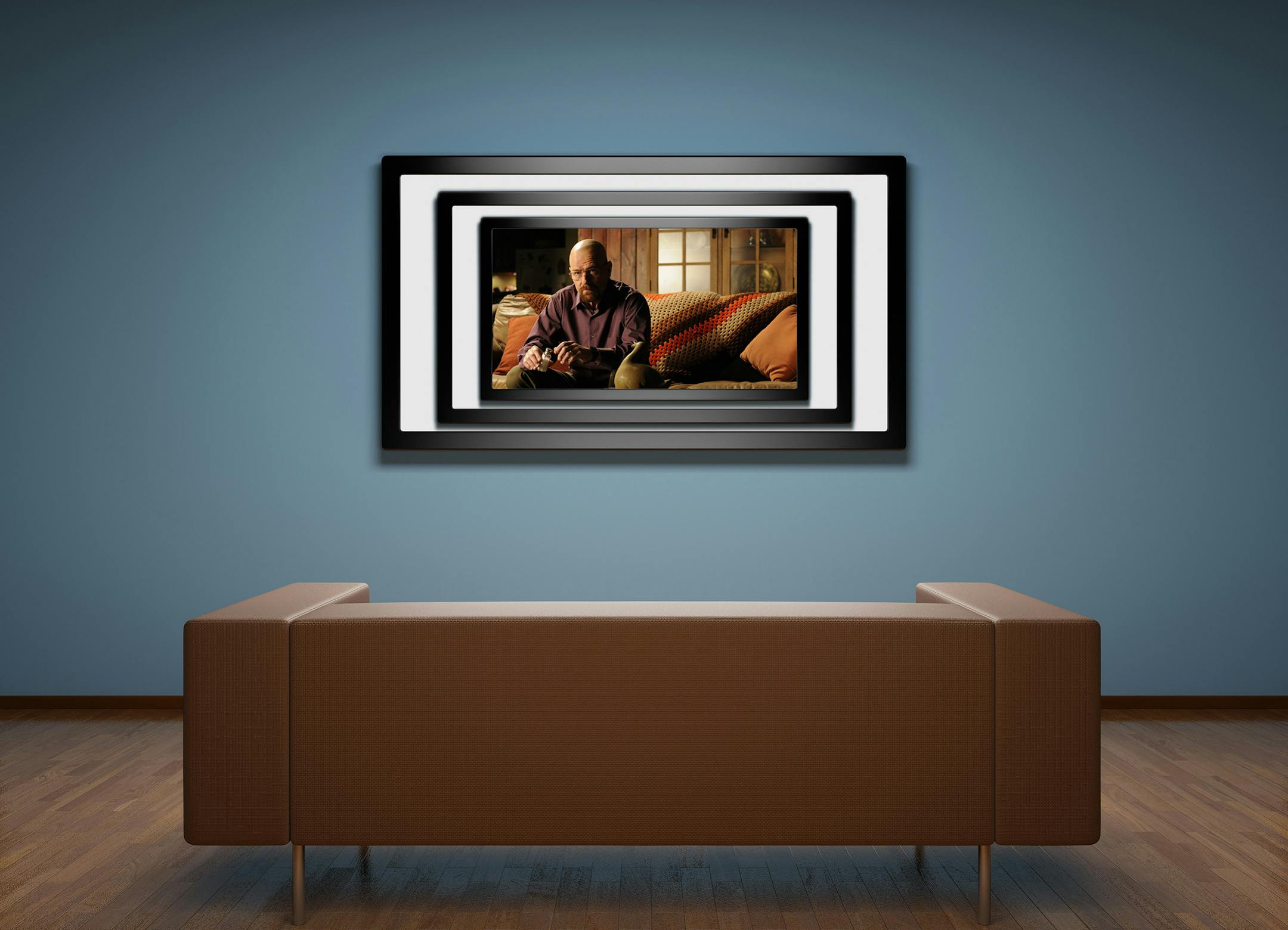
It can only be fate that has caused the new Golden Age of Television to coincide so exactly with my retirement, creating the new pastime of binge-watching to reinforce so strongly my habit of overdoing whatever is worth doing.
Actually, the new Golden Age began some time ago, while I was still laboring in the salt mines of academia. At that time, I taught (and occasionally wrote, and very occasionally published) fiction, literature. I was not just a reader, but a reader of Good Stuff: Twain and James and Austen and Dickens; Homer, Aeschylus, Sophocles. Shakespeare! Dante! Milton! I was far too high-minded to waste any part of my one and only life on television, except for the occasional PBS documentary or "Masterpiece Theatre" dramatization.
The problem with television, to my mind, was that it left too little for us viewers to do. One-dimensional characters, predictable story lines, complete and often cheesy visual settings that left nothing to the imagination, even a laugh track to tell us when to chuckle — all made for passive viewers and for a medium that was, at best, merely entertaining, a pastime, usually a time-waster. I watched Mary Tyler Moore and Bob Newhart during my family's Friday night television time, but these were the best of a bad lot, oases in the wasteland of television.
Yet change was coming to the tube. "Roots," the first miniseries, somehow passed me by back in the 1970s, probably because of its popularity and my resistance to enthusiastic recommendations, but "Lonesome Dove," first aired in 1989, and which I started watching almost by accident, drew me into the world of the frontier West, and I followed the adventures of Gus and Woodrow, their cowhands, and "the herd" with an interest that surprised me — this was only television, after all.
I discovered that LD's long "character arcs," as they're called, allowed for a greater variety of incidents and far more character development than were possible in a 90-minute movie. When the series was finally over, with Gus buried back in Lonesome Dove and Blue Duck getting his just deserts, I felt that I'd actually learned something about friendship, about the western frontier, about human nature and even about myself.
Yet this first viewing was not a binge, as there was a whole week of impatient waiting between episodes. (I've since watched a Blu-Ray reissue of "Lonesome Dove," all 375 minutes, in two sittings, a true binge.)
And these were network series, still subject to censorship, though even network television was becoming more permissive, particularly in language (as I discovered while on my way around the dial to Channel 2). Cable channels were less inhibited. I remember attempting to watch an episode of "The Sopranos" with my daughters and walking out embarrassed by the language; had I stayed around, I might have discovered what was happening on cable TV in the violence and nudity departments.
Then, when I was several months into retirement, a friend recommended "Breaking Bad." Ridiculous premise, thought I: underinsured high school chemistry teacher diagnosed with terminal cancer starts making methamphetamine in order to provide for his family after his death. I started watching to please my friend, and within two or three episodes I was totally hooked on the adventures and misadventures of Walter White and his family; his neighbor Hank, a narc married to Walt's sister-in-law; Jesse Pinkman, his sidekick; and the many mostly dark characters they all encounter in the course of marketing this evil drug and amassing a pile of ill-gotten gains.


