
Advertisement

Bill Marchel: Talkin' turkey tactics as winter lingers

Hunters in the early season should consider a strategy more about feeding than breeding.

For the Minnesota Star Tribune
April 3, 2011 at 6:09AM
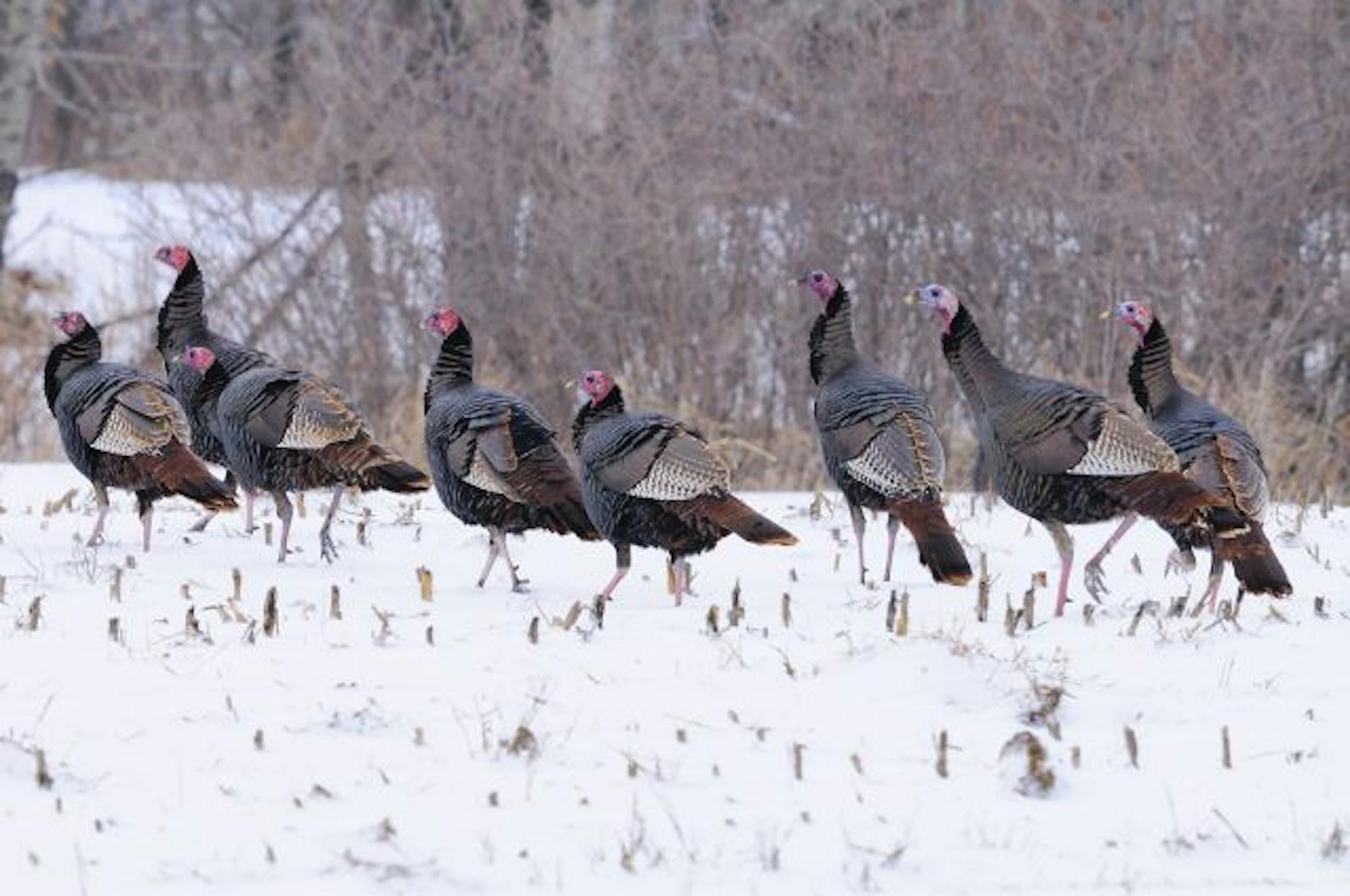
As of last week wild turkeys like this flock of toms were generally still in a feeding mode after a prolonged winter. Hunting tactics for the April 13 turkey opener may have to modified.
As of last week wild turkeys like this flock of toms were generally still in a feeding mode after a prolonged winter. Hunting tactics for the April 13 turkey opener may have to modified. (Photo By Bill Marchel/The Minnesota Star Tribune)
Advertisement

BRAINERD — Old Man Winter still has a grip on much of Minnesota. As of late last week, here in the central part of the state, a blanket of snow covered the ground in all but a few windblown fields and south-facing woodland edges. More snow is forecast.

What impact the late spring will have on the April 13 Minnesota turkey hunting opener is dependent partially on the weather between now and then. For those who drew a tag for the first season -- I'm among them -- a change of hunting tactics is likely in order.

It is generally agreed upon that the breeding season for most wildlife species is set by the seasonal changes in the amount of daylight, or photoperiodism. This winter, though, has been particularly harsh and long-lived.

Last week I observed very little turkey breeding activity. For the most part turkey flocks were still segregated, the hens and toms occupying different areas. In fact one large flock of adult toms was busy feeding around and between farm buildings, practically in the farmer's yard.

A lot can happen between now and the April 13 opener, but suffice to say the turkey breeding season is a week or two behind normal.

"A change of hunting tactics will be necessary if the cold weather continues," said Mart Strand, president and founder of the School of Outdoor Sports.

Strand, of Woodbury, is a turkey hunting fanatic. He first pursued the big birds in 1979. He has hunted turkeys in about half the states. "I'm gone basically all of April and May," Strand said. "If I'm not hunting, I'm shooting video of turkey hunts."

According to Strand, a study done in Missouri indicated that hen turkeys delayed breeding behavior and nesting following a long winter.

Advertisement

"The toms are ready for breeding way before the hens and well after the hens are done," Strand said.

Strand suggested the prolonged winter might actually benefit the early-season hunter. The delay in the hens' nesting might make fewer hens available and willing to breed. Thus more toms are "hen-less" and eager to respond to our calling.

"The key to drawing in a flock of turkeys that are neutral or in a feeding mode is to find one turkey, hen or tom, which is willing to talk," Strand said. "Call specifically to that turkey to see if you can draw it into gun range. The entire flock, including the toms, is likely to follow.

"If a hen is calling back to you, imitate her to try to get her upset and excited to come and investigate. Get aggressive with yelps and cuts."

Strand believes an underutilized turkey hunting method is gobbler yelping.

"A gobbler yelp is slower than a hen yelp," he said. "It's not necessarily raspier, just slower. And gobblers cut, too. The gobblers come to the call because they want to see who the new boy in town is."

Advertisement

Strand emphasized that bad weather on the day of a hunt can shut down breeding behavior "right now." He has seen gobblers gather together during spells of dreadful weather. During those times, hen calls won't work.

"Gobbler yelps might," Strand said, "for the same reason a hen may respond to the call of another hen. The gobblers are curious about the new guy."

Few absolute rules apply when dealing with nature. But given the unforgiving winter and late arrival of spring, it is relatively safe to assume turkeys -- come opening day -- will be more interested in putting on a pound or two than they would be following a less severe winter coupled with an earlier snowmelt.

A wise early-season turkey hunter should consider hunting near food sources.

And brush up on his gobbler yelping.

Bill Marchel, an outdoors photographer and columnist, lives near Brainerd.

Advertisement
about the writer

about the writer

BILL MARCHEL

Advertisement