
Bill Marchel: For falconers and raptors, it's work to sink your talons into

Using trained hawks brings a new feel to the hunt and a different look at the prey.

For the Minnesota Star Tribune
January 25, 2010 at 10:27PM
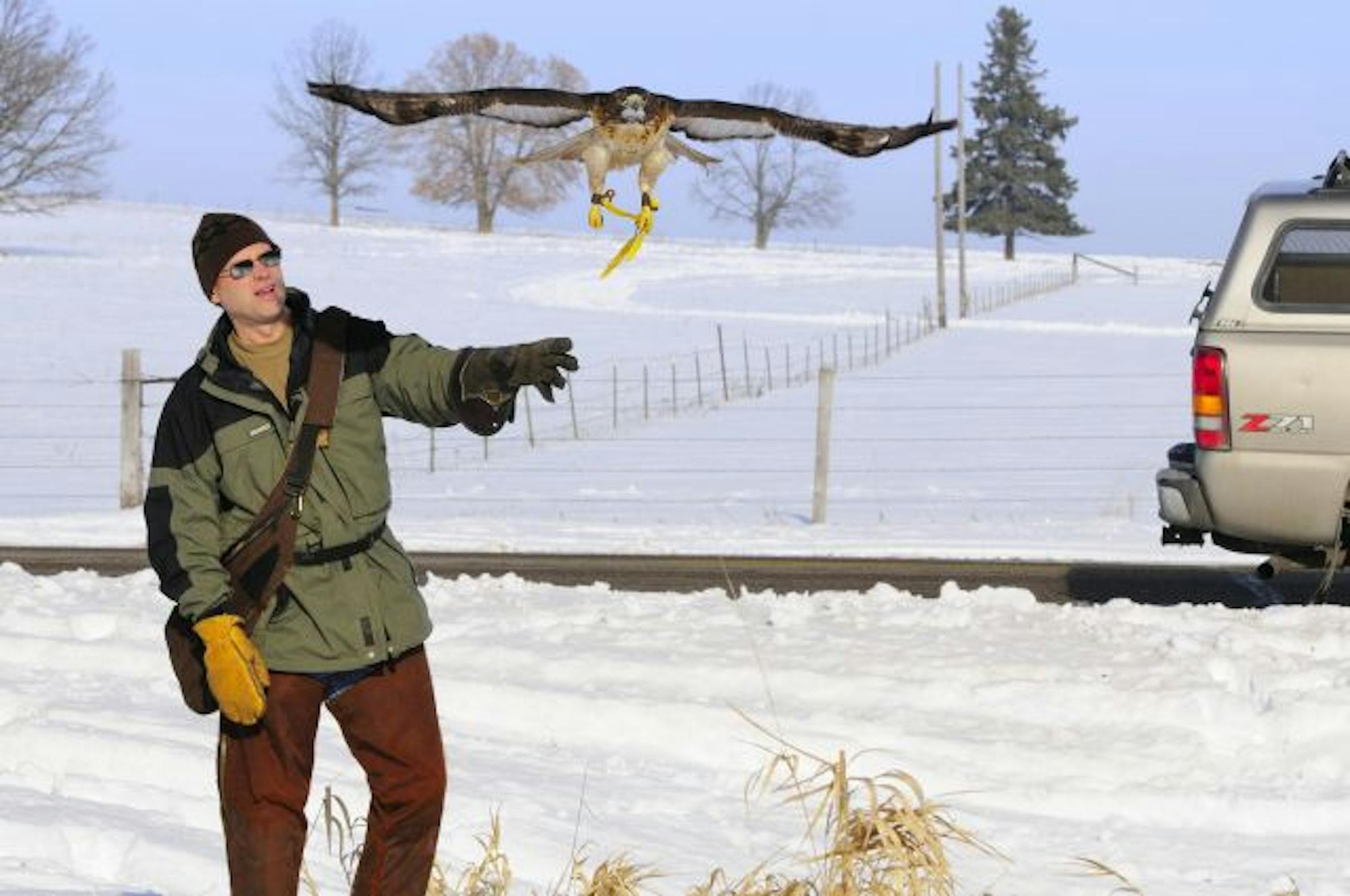
Falconer Grant Anderson cast his red-tailed hawk Abbey during a recent for snowshoe hares.
Falconer Grant Anderson of East Bethel cast his redtail hawk, Abbey, during a recent Up North hunt for snowshoe hares. (Photo By Bill Marchel/The Minnesota Star Tribune)

BRAINERD — Nothing strikes fear into the souls of prey animals like the sight of a raptor.

I thought about this last week as I watched falconer Grant Anderson of East Bethel prepare Abbey, his redtail hawk, for a hunt while the big bird of prey stood atop his heavily gloved fist.

Abbey's long, needle-sharp talons affixed to powerful yellow toes gripped the thick leather that protected Grant's hand. Her impressive hooked beak uttered authority. The extended brows that give all hawks a fierce demeanor erased the calmness I saw in the redtail's striking hazel eyes.

Abbey shifted her weight from one foot to the other as she gazed into the woodland beyond. She was anxious to hunt.

Grant and two falconer friends had driven north from the metro area hoping to fly their birds in pursuit of snowshoe hares. Joining Grant and me was Geoff DouVille of Brooklyn Center and his redtail hawk, Kyra, and Ben Ohlander of Eagan and his goshawk, Eva. Also along were Jared Boldt of Hewitt and his two sons, Albert, 12, and Eddie, 9. Albert is interested in becoming a falconer, and Eddie was doing a school project about the sport of falconry.

We began our hunt in a chunk of state property that had been logged a decade or so ago. A few years ago Abbey caught her first snowshoe hare in this woodland. Once Grant had Abbey fully outfitted with leg bells and telemetry, he raised his fist high and Abbey took flight, broad wings pumping hard, rusty red tail spread wide. She flew a short distance and then alighted in the upper branches of a nearby bur oak.

Grant instructed his human comrades to form a rough line, each about 20 yards apart. With Abbey watching from her high perch the line advanced through the forest, kicking brush piles here, jumping on downed trees there, all in an effort to drive a snowshoe hare from its daytime hideout. As the line proceeded, Abbey followed, always perching in a location with a commanding view. It was a well-orchestrated hunting effort.

Without warning a snowshoe hare bolted from its lair. Abbey immediately took flight. Nothing escapes the sharp eyes of a raptor, not even a white hare in snowy surroundings fleeing through thick cover. While the falconers yelled "ho, ho, ho" to urge Abbey on, she, like a guided missile, shot toward earth, wings tight to her body, tail twisting to alter her course around various obstacles.

Ultimately, Abbey caught only fistfuls of snow. Although several of us were mere yards away from the event, none of us saw where the hare took refuge. We kicked the snow and stomped each likely spot where the hare could have found refuge, but the animal had seemingly disappeared.

As mentioned earlier, noting strikes fear into prey like a hunting raptor. During past hunts we have seen hares simply dive under the snow to escape the talons of a diving bird of prey, a maneuver hares never perform when pursued by human hunters. Falconers have countless stories of what most of us would consider odd behavior displayed by prey when death by talons is close at hand.

The next stop was Geoff's turn to fly his Kyra. She hunted hard and cooperatively. Kyra, like Abbey, missed on her only opportunity to capture a hare.

Snowshoe hares are cyclic animals, meaning populations rise and fall for reasons mostly unknown. Right now the forest hares are at a low in their cycle and rather difficult to find. The lack of fresh snow and current crusted conditions made finding the animals even more difficult.

With that in mind Ben decided to fly Eva -- a young bird artificially bred in captivity -- on cottontail rabbits instead of hares. It was a wise choice. Just moments into the hunt, I flushed a cottontail out of a brush pile and Eva flew from Ben's gloved fist in hot pursuit of the retreating rabbit. After a short flight, the immature goshawk had caught its prey.

"I hoped for a more difficult and challenging hunt," Ben said. "But Eva is a young bird, and every kill is a learning experience."

Falconry is a demanding exercise practiced by few in Minnesota. The sport is highly regulated by the DNR. A would-be falconer must undergo an apprenticeship and adhere to stringent regulations regarding the care and training of birds of prey before obtaining a raptor.

To a falconer the sport is less a hobby than a way of life.

Bill Marchel, an outdoors columnist and photographer, lives near Brainerd.

about the writer

about the writer

BILL MARCHEL