
Bill Marchel: Following a snowy trail reveals circle of life

A bobcat sighting by day began a mission to learn about predators and their prey.

For the Minnesota Star Tribune
February 7, 2010 at 5:38AM
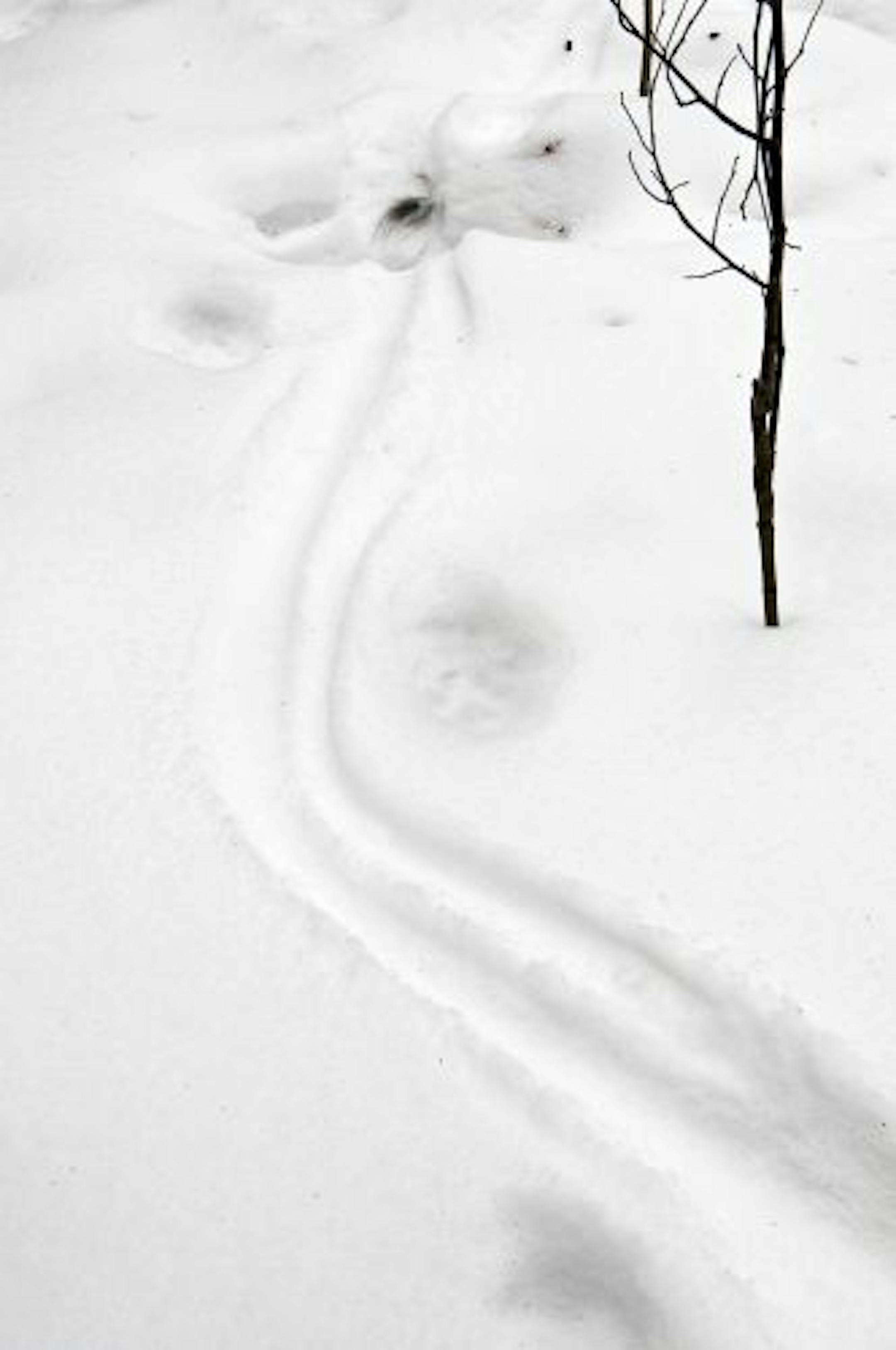
The footprints of a bobcat straddle drag marks left by a cottontail rabbit the bobcat had killed and carried away.
The footprints of a bobcat straddled drag marks left by a cottontail rabbit the bobcat had killed and carried away. (Photo By Bill Marchel/The Minnesota Star Tribune)

BRAINERD - It was late afternoon when Axel, my Deutsch Drahthaar, let out vicious bark, his focus riveted out the back patio door.

The dog is 9 years old, and I know most of his barks. It wasn't his UPS man bark, nor was it his deer bark. It was more.

"Come and look at this, quick" Janis said as she peered from the kitchen window, her gaze following Axel's.

I immediately spotted a bobcat crouched low in the snow across a backyard pond.

"It's a bobcat," I said as I grabbed for a pair of binoculars on the kitchen counter.

As I spun the focus wheel the animal came into clear view. The bobcat obviously could hear Axel's loud bark and was staring in the direction of the house.

Moments later the wild feline trotted off, stepping carefully as to not break through the crusted surface of the snow. We watched it angle across an opening and then disappear into a stand of cattails.

"I'm surprised to see a bobcat out during the daylight," I said.

Last winter Janis and I implemented a wildlife habitat project by cutting a stand of nearly mature aspen growing close to the house. We had stacked the tree tops into a half-dozen huge piles. Cottontail rabbits had since adopted the stacks of limbs. I figured the bobcat was out looking for a rabbit dinner.

The next morning I hiked the area checking for bobcat tracks, curious to see if my assumption was correct. A short distance from the house I found the sign of a bobcat. Drag marks in the snow indicated the cat was towing something, an unfortunate cottontail, I assumed. I backtracked until I found the kill site.

Sure enough, the bobcat had captured a cottontail. Several gobs of fur and just a bit of blood marked the location of the kill.

Carefully I unraveled the chase, a predator/prey confrontation written in the snow. I've seen roughly 20 bobcats in my life, but never have I been an eyewitness to one taking prey. I understand bobcats hunt primarily by stalking close to their quarry and then lunge at it using teeth and claws to secure the victim.

I studied the scene, and that's exactly what appeared to have happened. The bobcat had captured the rabbit in a short chase of about 10 yards.

I followed the cat's tracks forward, curious to see how far the feline had traveled before consuming the rabbit. Initially the cat stayed within heavy cover, its tracks and the unmistakable drag marks meandering among aspen and hazel. Occasionally I stopped to photograph the tracks, cursing the gray light and lack of contrast.

The bobcat entered an oak savanna before crossing a grassy lowland meadow. Mostly the predator was able to tread atop the crusted snow, but occasionally a paw broke the crust. When the tracks penetrated a thick lowland of alder and willow, I figured it wouldn't be long before the bobcat would stop and eat its meal.

A short distance into the thicket I found where the cat had consumed the rabbit. I crouched in the snow and examined the remains. Little remained of the carcass; mostly just fur, two feet, part of the head and the stomach. Evidence in the snow indicated the bobcat made a feeble attempt to cover the rabbit's remains by pawing the snow.

I now had a complete picture of the bobcat's hunting process. The overall distance from kill to consumption was about a third of a mile. I stood alone and contemplated the scene. In nature, one dies so that another can live.

According to the DNR, about 2,000 bobcats inhabit Minnesota. Their primary range is the northeastern third of the state. In late fall and early winter there is a limited hunting and trapping season in a zone north of I-94 and Hwy. 10. The season limit is five bobcats by hunting and trapping combined. About 200 bobcats are taken each year in Minnesota.

Bobcats eat a variety of prey, from birds and mice to snowshoe hares and squirrels. Despite their relatively small size (males weigh about 30 pounds, females about 20 pounds) they have been known to haul down adult deer. The wild felines hunt mostly at night and so are seldom seen.

Axel has now added a bobcat bark to his repertoire.

Bill Marchel, an outdoors photographer and columnist, lives near Brainerd.

about the writer

about the writer

BILL MARCHEL