
Bill Marchel: Anyone home? Not in the Badlands

Fields were scarce of mule deer during a bow hunting excursion in western North Dakota.

For the Minnesota Star Tribune
November 15, 2009 at 5:10AM
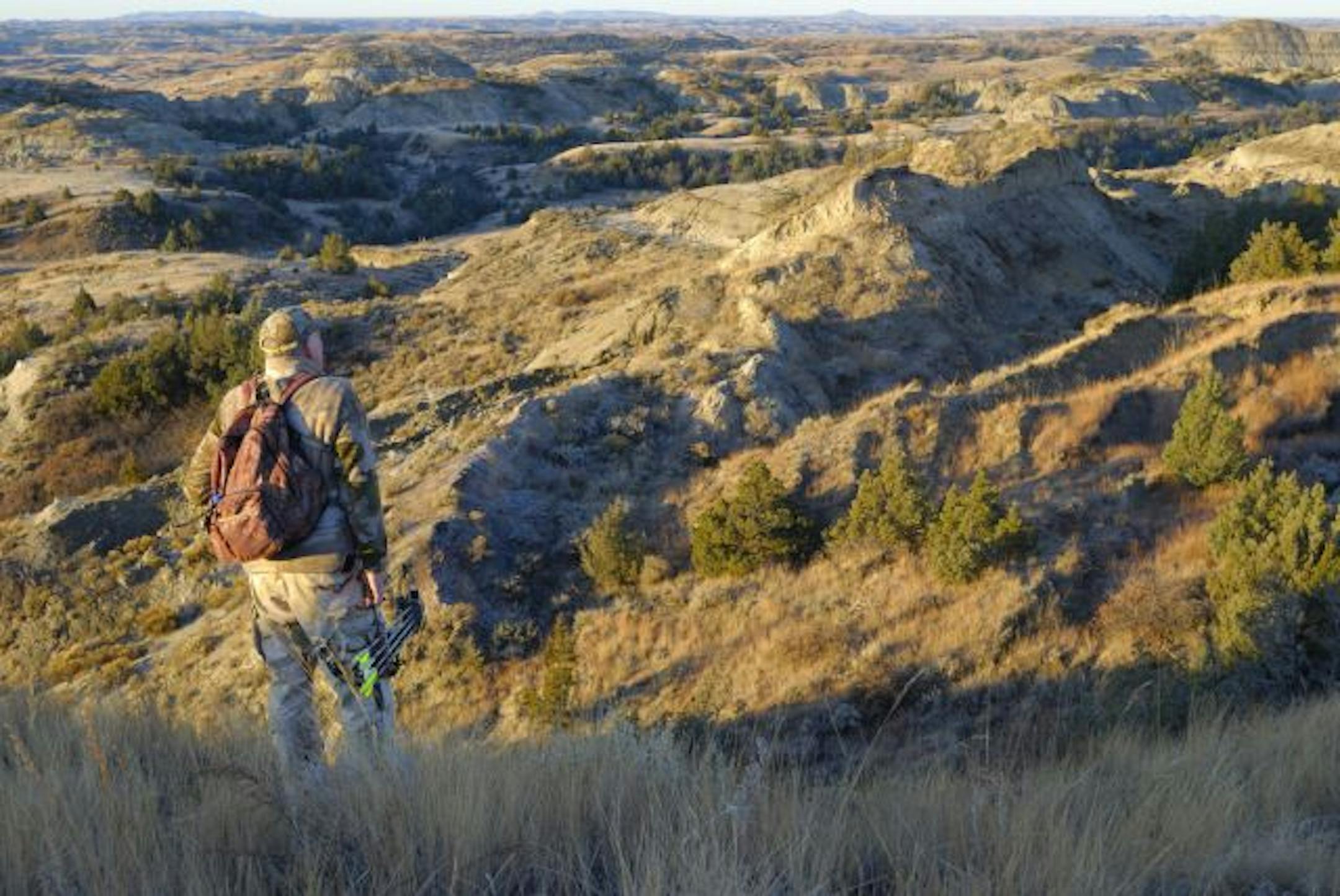
Leo Marchel of Grand Forks, NoDak watches for mule deer during a recent bow hunt in the Badlands.
Leo Marchel of Grand Forks, N.D., watched for mule deer during a recent bow hunt in the Badlands. (Photo By Bill Marchel/The Minnesota Star Tribune)

THE BADLANDS, N.D. — For five years running, my brother Leo Marchel of Grand Forks and I have rendezvoused in Fargo during early November and traveled across the prairie via I-94 to the Badlands in western North Dakota.

There we've descended into deep coulees and climbed over and around towering clay buttes, all while toting bows and arrows in an attempt to waylay a mule deer buck.

Earlier this month we again headed west.

This year was different, though. Following a tough winter, Leo and I knew our hunt would be even more difficult, primarily because of the reduced deer herd but also because we choose to hunt mulies with the spot-and-stalk (sometimes we employ stalk-and-spot).

"Last winter the weather here was comparable to what the winter of '96-'97 was in the eastern part of the state," said a Badlands-area man who was also a bow hunter. "A lot of the mule deer left the Badlands and ended up wintering in ranchers' yards. Some of them didn't make it back." Another local reported some parts of the Badlands were buried under 12 feet of snow.

It was obvious to Leo and me from the first day of our hunt that mule deer numbers were down. In years past, while en route to and from our hotel in the predawn or after dusk, we spotted deer in several fields, sometimes gathered by the tens and twenties. This year nearly all of those fields were barren of mulies. The most we saw in any one field was about a dozen.

Leo and I noted, too, a lack of mature bucks. When we Easterners envision a mule deer buck, we picture it with antlers spreading high and wide, main beams forking, and then forking again. This year, we did not see a single dream buck.

On the second day of our hunt, I managed to slip to within 20 or so yards of a decent-sized mulie that sported medium-sized 4-by-4 antlers. Leo had spotted the buck just as we topped a butte several hundred yards away. The buck stood among a thick clump of low-growing cedar trees. Leo gave me a nod and I began my stalk.

At the time, the weather was clear and calm, not your ideal stalking conditions. Mule deer rely heavily on their radarlike ears to locate predators. The only reason I got as close as I did was because I was able to complete the stalk along a south facing slope that consisted of baked clay free of noisy dry grass and brush. It was like stalking along a sidewalk.

I closed the distance, careful step by careful step, arrow nocked. When I knew I was within bow range, I attempted to stare through the thick cedar branches, but I was unable to spot the buck that I knew was so close. Finally I heard the telltale thump, thump, thump of a mule deer bounding away in the typical pogo stick fashion. I realized the jig was up.

Apparently mule deer were not the only wildlife that suffered from Old Man Winter's onslaught. We saw only two cottontail rabbits in the same areas where we saw dozens on previous trips. Notable, too, was the lack of sharp-tailed grouse and wild turkeys.

Usually predators prosper when other wildlife succumbs to the weather, but we saw only one coyote and it was obviously suffering from mange, it's rump and tail barren of hair.

Oddly, we spotted more pronghorns than usual. Perhaps the prairie goats found winter refuge on some barren ridge tops where the everpresent wind had swept away the snow, thus exposing meager prairie grasses to the hungry animals.

In nature, there are very few givens. One thing is for sure, though: Every now and then Old Man Winter will flex his muscles, and wildlife will suffer.

Another given is that mature mule deer bucks never bed down in locations that allow human hunters to stalk within bow range. Six trips to the Badlands seem to prove such.

Bill Marchel, an outdoors photographer and columnist, lives near Brainerd.

about the writer

about the writer

BILL MARCHEL