

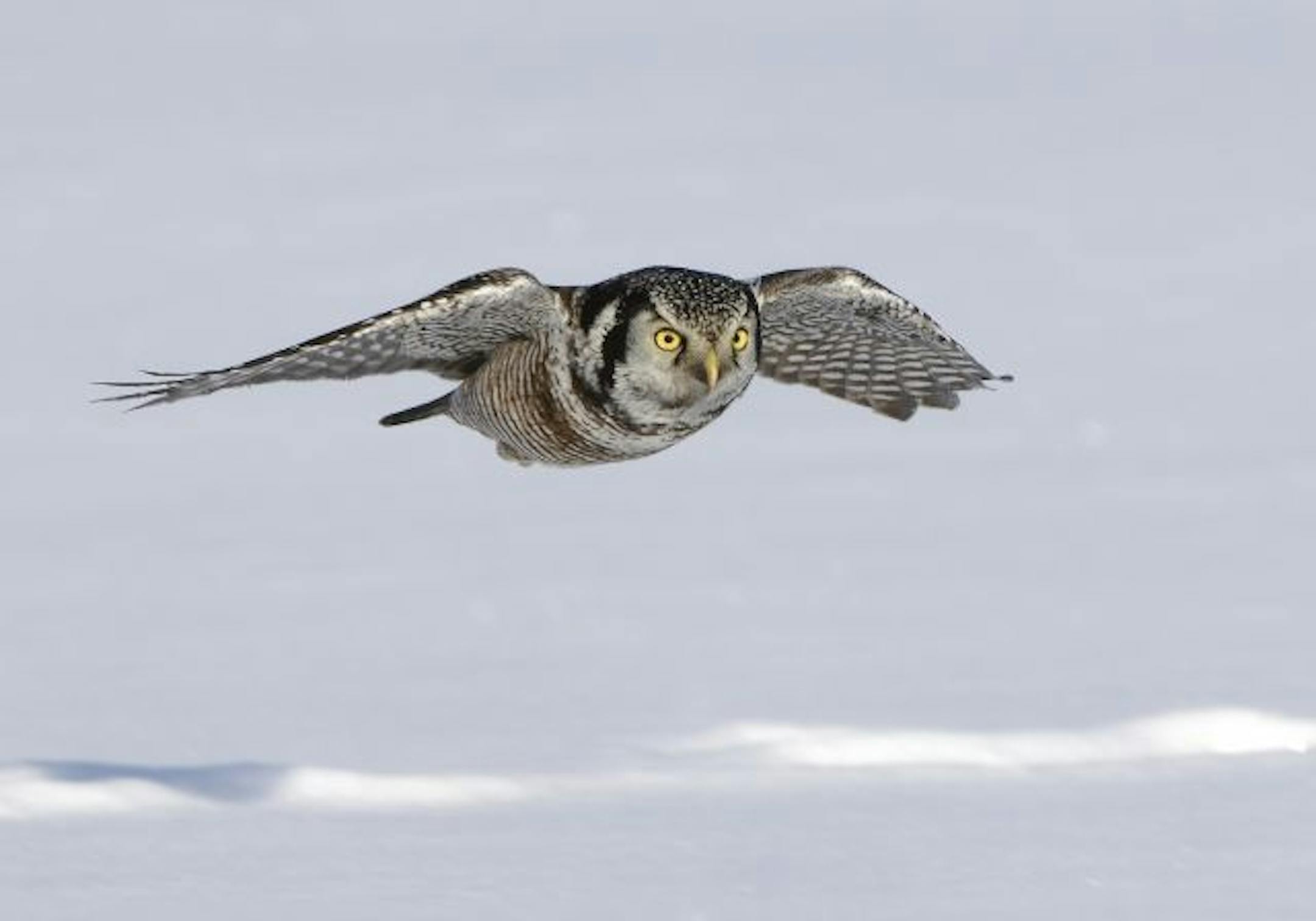
BRAINERD - When food is scarce in the Canadian north, those who can wing southward do. Included are several sorts of birds, but of particular interest to birders are four species generally referred to as northern owls. Some are already being spotted in Minnesota.
The four northern owls species are great grey, boreal, snowy and northern hawk. Some great greys and boreals nest in a few Minnesota locations, but when an owl "invasion" occurs, the birds have generally arrived from Canada.
What drives owls southward is not the cold. They possess thick layers of insulating feathers and are capable of withstanding the most bitter winter weather. That is if they are well fed. It is believed that a shortage of prey, particularly voles (small mouse-like rodents), is what causes them to relocate.
It's true Minnesota has thus far been spared deep snow and bitter cold. Nonetheless, northern owls have already arrived in notable numbers, particularly in the northeast, and birders are taking advantage of the early influx.
Northern hawk owls have been the most observed species. Nearly three dozen have been reported, most in the bog country west and north of Duluth but some as far south as Aitkin County. That's a significant number since the winterlong average is fewer than 10.
A few great greys have been spotted, but some are likely resident birds. Snowy owls have also showed up.
Why do northern owls generate so much interest? Unlike resident owls -- among them the barred and the great horned owls -- northern owls often hunt during the day and out in the open. They are also very tolerant of humans. They watch us with their piercing yellow eyes, a stare that suggests the wilderness from which they have come.
Great grey and northern hawk owls prefer to hunt along roadsides, field edges or boundaries of meadows and bogs. A snow-covered field close to an expansive bog is especially attractive. Hawk owls in particular like a commanding view while hunting, so watch for them to be perched high atop a tree or electrical wire. Snowy owls also like open terrain and can often be spotted in farm country. Boreals are more secretive. These tiny owls tend to stick to heavy cover and are less likely to be active during daylight.

