
Bill Marchel: A fish house built by his own hand

A swipe of plastic will get an angler a satisfactory fish house. Or nine months of work will produce much greater satisfaction.

For the Minnesota Star Tribune
December 19, 2010 at 6:29AM
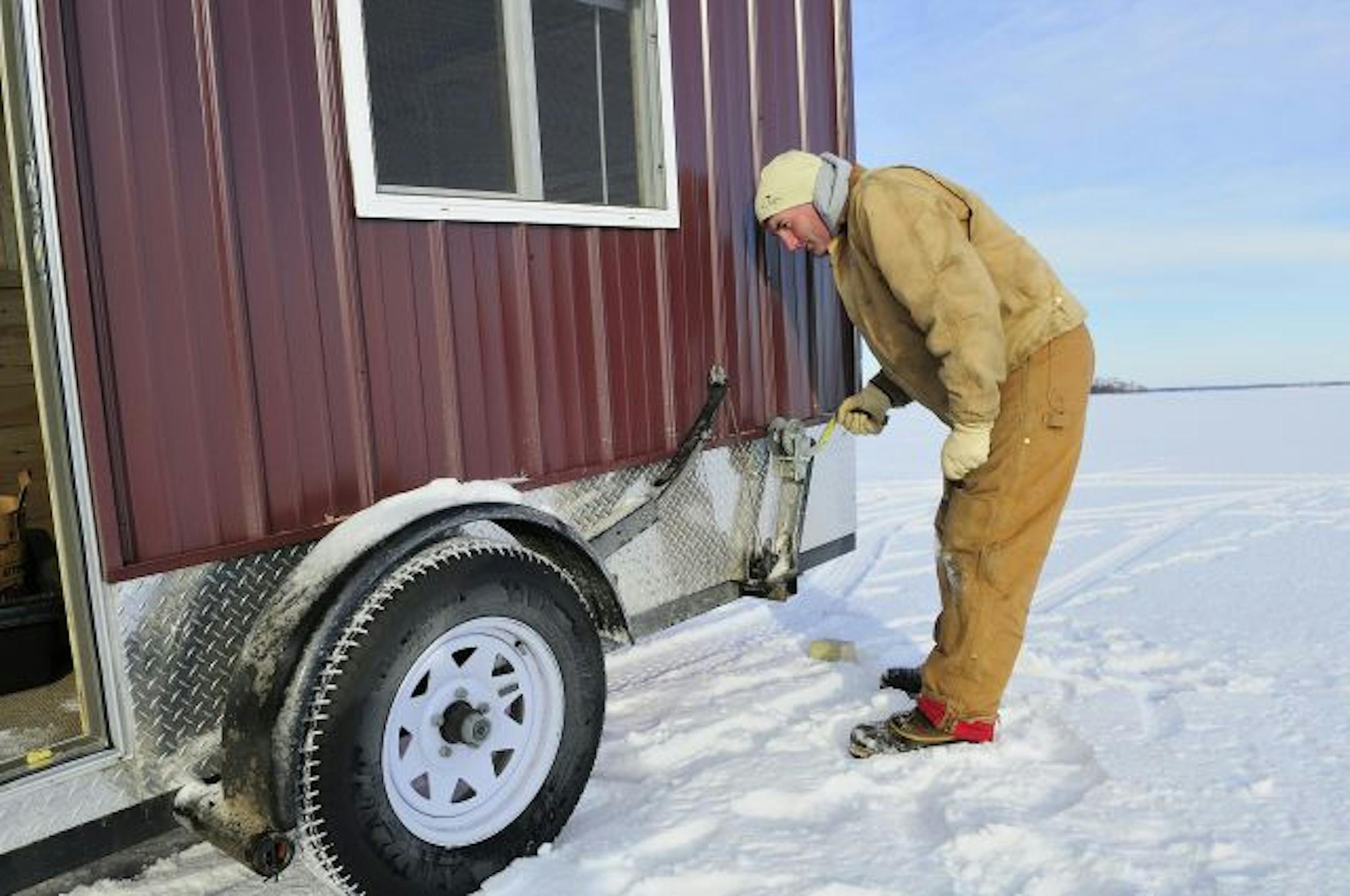
Lindy Frasl of Fort Ripley cranked one of three winches used to lower his home-built ice fishing house during its maiden ice fishing voyage.
Lindy Frasl of Fort Ripley cranked one of three winches used to lower his home-built ice fishing house during its maiden voyage. (Photo By Bill Marchel/The Minnesota Star Tribune)

NISSWA - Atop a frozen lake not far from this central Minnesota town, Lindy Frasl of Fort Ripley and I towed his brand spankin' new home-built ice-fishing-house-on-wheels on its maiden voyage.

This occurred midafternoon on the eve of the big snowstorm that dumped enough snow on the Twin Cities to collapse the Metrodome. As it turned out, the December blizzard only dusted this area. Nine inches of ice supported us as Lindy hauled his creation behind his ATV while I relaxed inside the nifty shelter. Our destination was a rock pile about a half-mile from shore. Lindy used his GPS to guide us to the location.

The odyssey for Lindy began nine months earlier, when he purchased the trailer upon which he built the fish house. These fish houses on wheels are available commercially, but Lindy chose to build one himself. Over the summer Lindy, a tinkerer when not driving a dairy truck full-time, worked on his dream ice fishing shelter when the occasion arose. He is handy with tools and is "a good fixer," according to his young granddaughter.

"I didn't have a blueprint, but I pretty much knew what I wanted," Lindy said.

The shelter measures 15 feet from the tip of its V-shaped front to the back, and is 6 1/2 feet wide. Three hand winches -- one on the trailer's tongue and one behind each wheel -- allow Lindy to lower the fish house to the ice without unhooking it from the trailer hitch.

Once we arrived at the proper GPS coordinates we drilled a few holes and took depth readings to fine-tune our location.

"Twenty-four feet, that's about right," Lindy said.

In short order we had the house lowered to the ice and ready to go. Lindy drilled five holes, two for each of us to fish through and one for his underwater camera. The sixth hole was left capped. Each floor opening is outfitted with hole liners that keep any drafts from entering and also aid in the cleanup of ice chips from drilling.
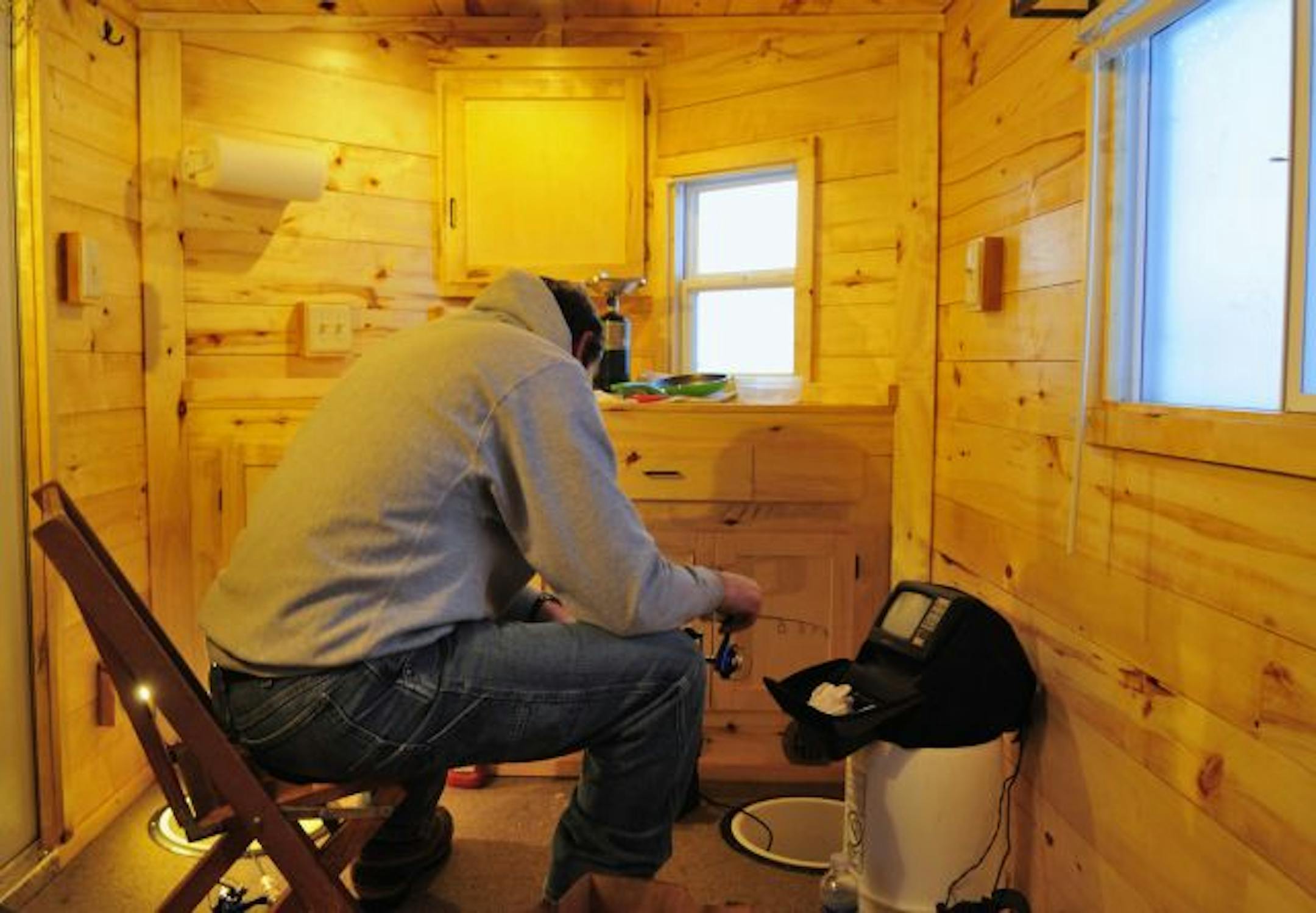
The shelter is heated by a propane furnace like those used in campers. With a flick of a finger Lindy set the thermostat to the desired temperature, and the furnace started.

In the meantime I affixed a shiner minnow to a bare hook and lowered it into one hole. I impaled the head of a crappie minnow onto a jigging spoon and dropped that down the other hole. By then the interior of the fish house was toasty warm.

The floor and roof of the shelter are insulated with 2 inches of pink foam. Lindy used 1 1/2 inches of foam in the walls. Outside, the upper walls are sided with steel, and the lower portion is covered by metal stone guard. Lindy used reclaimed poplar siding to panel the interior, giving it a cabin-like feel. The floor is carpeted. There is, of course, a carbon monoxide detector aboard.

Lindy wired his fish house for both 12 volt and 110 volt, so the accessories can run on battery power, a generator or household current. There are upper and lower folding bunk beds at the rear of house. The V-shaped front has cabinet storage above and a countertop below. Lindy elected not to install a cook stove.

"I'll use my Coleman stove when I want to cook," he said.

Lindy's fish house on wheels also makes a nifty hunting camper or, during the offseason, a playhouse for kids.

We hadn't been fishing long before Lindy spotted a walleye on the underwater camera. Lindy teased the fish with his jigging spoon, but it was lethargic and refused to bite. So were the next few walleyes that showed up on the screen.

As the sun approached the southwestern horizon, Lindy flicked a switch and on popped the lights. Rustic metal lampshades with moose-shaped cutouts surrounded the bulbs and lighted the interior with a warm, cozy glow. What was really clever was that each of the six holes in the ice was illuminated by its own light mounted about 10 inches above the floor.

Suddenly I watched the bobber -- below which hung a shiner minnow -- bob once and then slowly sink into the depths. When I set the hook my ice rod bent into a graceful arc. After a short battle I guided a walleye into the hole and hoisted it out of the water. My first walleye of the winter season also christened Lindy's new ice house.

An hour later three walleyes lay in the bucket. The action had slowed down so we reeled up our lines.

Lindy figures he spent about $3,500 on his fish house. That's roughly half of what a comparable commercial rig would have cost.

"I'll probably fine-tune a few things," Lindy said as we gathered our gear. "I might add a shelf here or there. I don't know yet."

Perhaps framed wildlife prints for the wall?

Bill Marchel is an outdoors photographer and columnist. He lives near Brainerd.

Lindy Frasl jigged for walleys in his home-built fish house on wheels. The fancy shelter affords all the comforts of home.
Lindy Frasl jigged for walleyes in his fish house. The shelter affords all the comforts of home, including bunk beds and counter and cabinet space. (Photo By Bill Marchel/The Minnesota Star Tribune)
about the writer

about the writer

BILL MARCHEL