

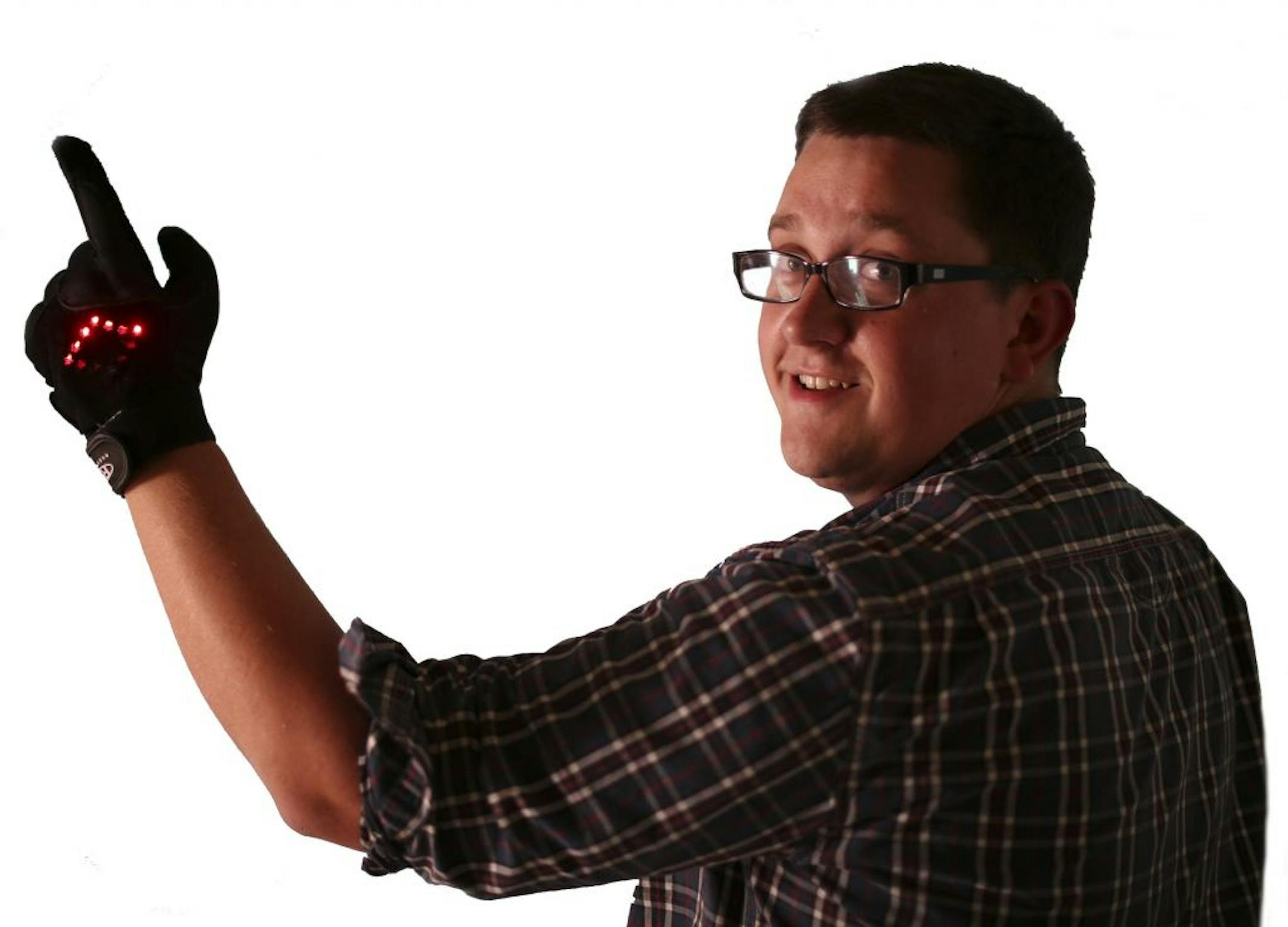
Anthony Carton is getting a lot of attention these days, and with his help, soon so might people on bicycles, scooters and motorcycles.
Carton, a graduate student at the University of Minnesota, created a glove outfitted with sensors that translate hand turn signals into lighted directional indicators. It won Most Innovative Design Concept at the International Symposium of Wearable Computing, held this past June in England.
Not a bad finish for something that began as a quick project for a spring semester seminar.
"I'm really surprised at how much attention this is getting," said Carton, 29, who lives in Robbinsdale and is pursuing a master of fine arts degree in graphic design from the College of Design. "The whole thing took only two weeks" from concept to finished prototype.
Carton, a frequent scooter user, realized that many automobile drivers either don't pay attention to bikers when they signal turns or no longer recognize the meanings of the hand signals, which were widely used until electronic turn signals became standard vehicle equipment following World War II. He decided to tackle both problems at once with gloves that light up to get drivers' attention and show the direction the biker is going.
"The main point of the project was to enable people to communicate visually with another person," he said.
He assigned the project a caveat: It had to work without the bikers thinking about it. Because the ultimate goal is to improve safety, he was adamant that the glove not distract riders by requiring them to activate it.
"People don't need a new gadget," he said. "The bikers do what they always do, and the glove recognizes the gesture and reacts with the appropriate signal."


