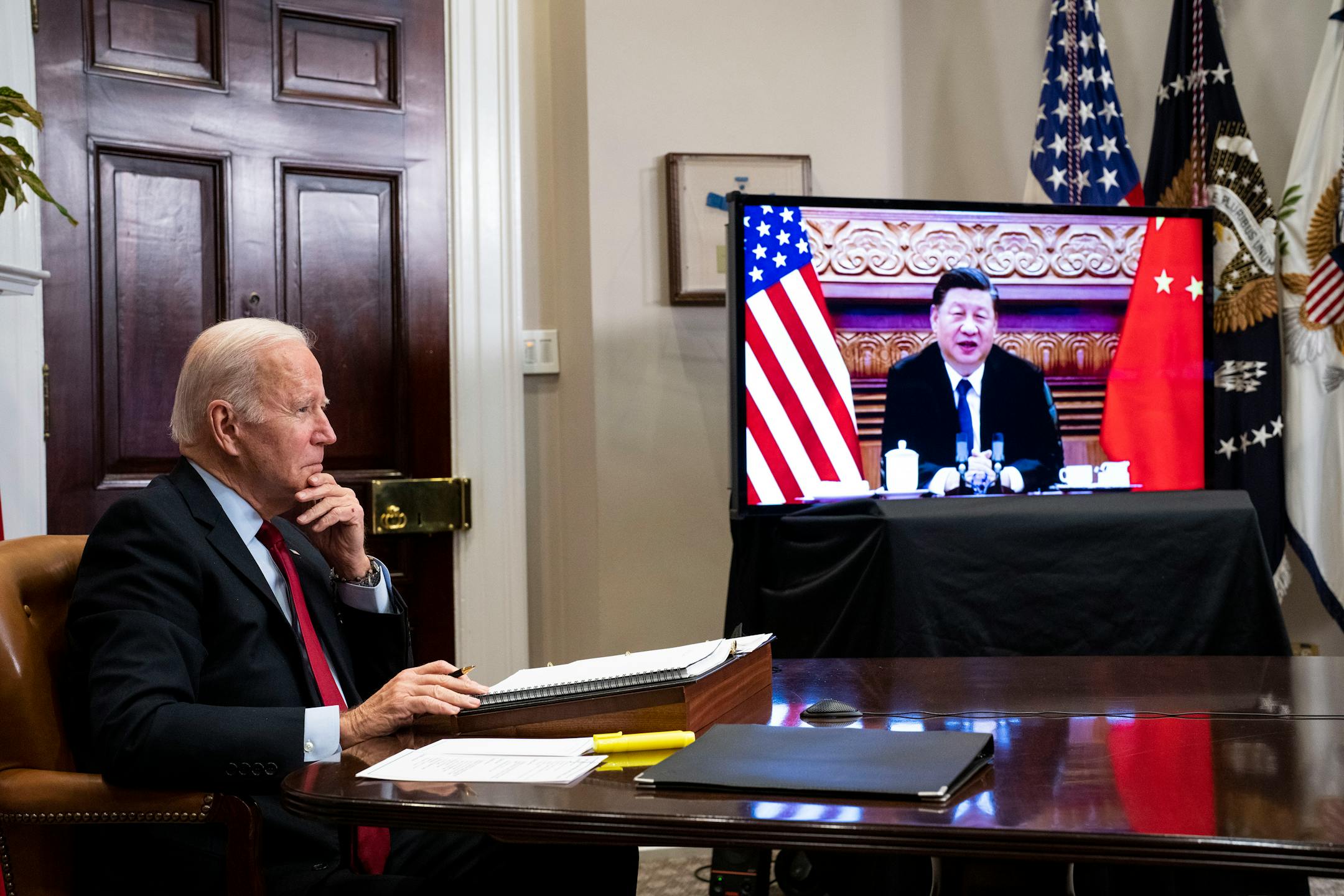
On cue, his staff cautioned that the president was not proclaiming a shift in U.S. policy.
The president also said that whether Taiwan should pursue independence is "their decision." Here again, Biden was departing from long-established policy. Succeeding American presidents since Richard Nixon have hewed to the line carved out by the Shanghai Communique in 1972, and restated in various forms since then: There is but one China, and Taiwan is part of it. U.S. policy, on which decades of peaceful relations with China were founded, explicitly does not support Taiwan's independence.
U.S. policy does, however, oblige the United States to furnish Taiwan with weapons for self-defense. Accordingly, sales of U.S. weapons to Taiwan are picking up, with the avowed intention of making the island a "porcupine" — that is, so lavishly supplied with things that hurt that any predator thinks twice before an attack. (Real porcupines, however, do not have to put up with lagging deliveries. Taiwan is reportedly waiting for weapons that have been purchased but not delivered, perhaps because Ukraine has priority.)
The longstanding practice of strategic ambiguity cuts both ways. It's intended to keep not only Beijing but also Taipei guessing about what the United States might do in a crisis. Chinese leaders couldn't be sure the Americans would stay out of a fight; Taiwan's leaders couldn't be sure the Americans would lend a hand. Thanks to strategic ambiguity, China might be constrained from launching an attack, and Taiwan might be deterred from overconfidently provoking one.
A confrontation with China entails considerable risk. Few countries have such a highly developed sense of national pride, or so acute a sensitivity toward perceived interference in their affairs. China's huge military is often cloaked in secrecy, but it is believed to be pursuing an aggressive modernization effort. Its navy reportedly has more ships than any other, and it recently tested a hypersonic missile capable of carrying nuclear payloads.
Simply, to threaten an armed response, putting U.S. troops on the line to defend Taiwan, seems counterproductive. A better strategy is maintaining the tried and trustworthy practice of strategic ambiguity. China must be persuaded that its interests are served by moving gradually toward closer ties and cooperation. For that approach to work, though, the U.S. must commit to steadfast patience and a steady cooling of tempers — hardly the tone Biden has been setting.