

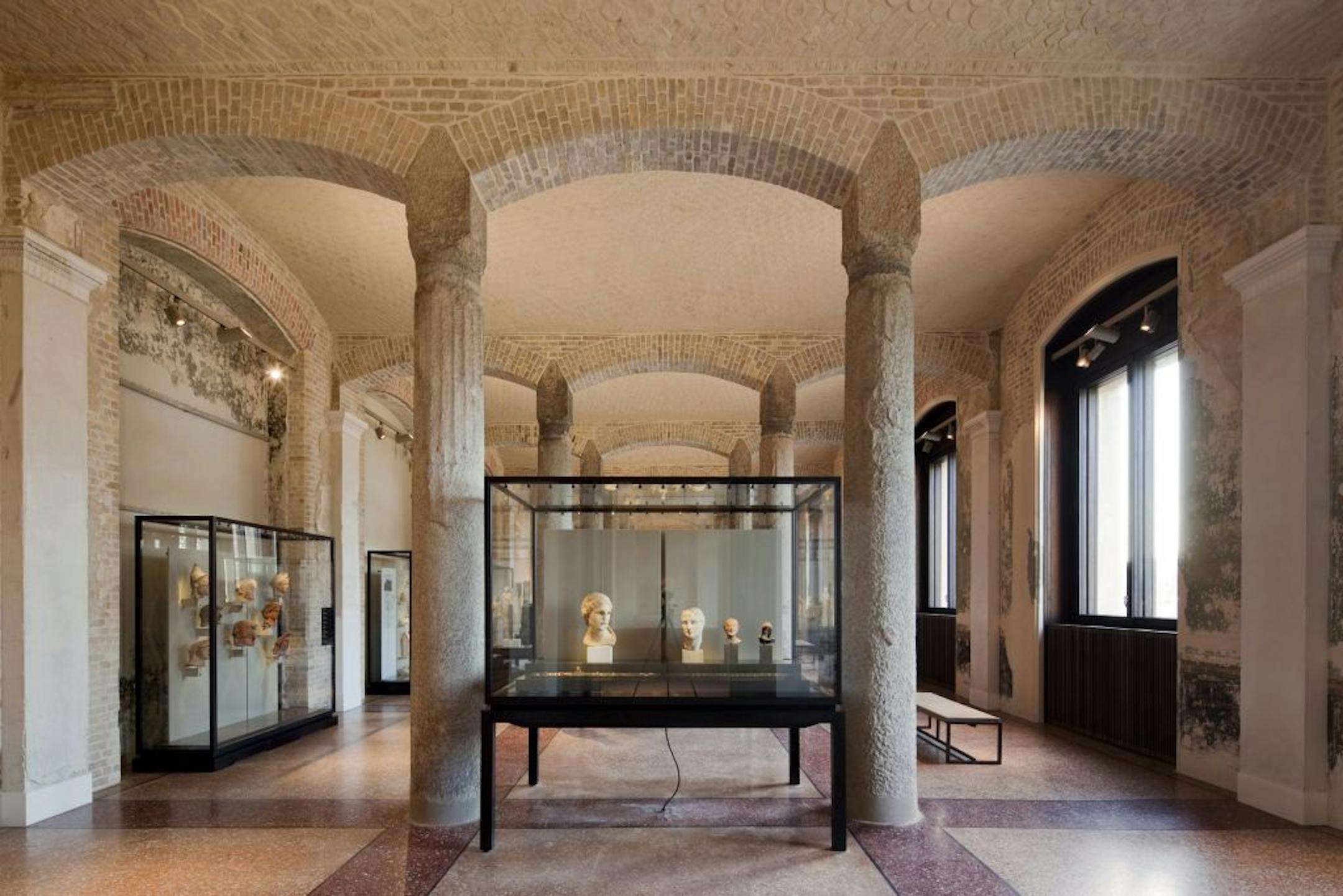
I was perusing a gallery of art from ancient Cyprus when I first saw the bomb blasts. Even the lovely stone figure of Aphrodite, an impressive 2,000 years my senior, was no match for this, a room filled with weathered columns, vestiges of decorative plaster and shell-torn holes that once exploded through the room's southwest wall. I could clearly see the damage because it had been plastered over and covered with slightly lighter paint.
I'd never heard of this place -- the remarkable Neues Museum, a World War II ruin brought back to life -- until my boyfriend returned from Berlin with a book detailing its recent 10-year, $300 million restoration. As I flipped the book's pages, oohing and ahhing over its luminous images of crumbling stonework and decaying friezes, I became fascinated by the peculiar past of this history museum.
Built between 1843 and 1855 on orders of a Prussian king, the Neoclassical Neues Museum (named "new" because it followed the nearby Altes Museum, or "old" museum, by about 30 years) was lushly appointed with Greek mythology-themed frescos and hieroglyphic ceiling paintings, designed to complement the king's growing collection of ancient Grecian treasures and classical antiquities.
Years later, the Neues became a casualty of Allied bombing during World War II. In another stroke of bad luck, it was parceled to the government of East Germany. For the much of the next 60 years, its crumbling chambers were left exposed to the elements.
Sturdier sections served as storage facilities for the city's other museums, especially the other four museums on Berlin's Museumsinsel, or Museum Island.
Walking through the exhibit space 12 months after I first saw that book, I witnessed firsthand how the decaying building has been imaginatively restored. Between 2003 and 2009, the British modernist David Chipperfield undertook the task of rebuilding this broken museum. He never endeavored a copy of the original. Rather, he sought to preserve the building's checkered history, the original opulence as well as the wreckage.
The result? Architectural accolades (the building most recently claimed the 2011 European Union Prize for Contemporary Architecture/Mies van der Rohe Award in April) -- and a building with better stories than many of the objects it holds.
Nefertiti's domed showroom


