
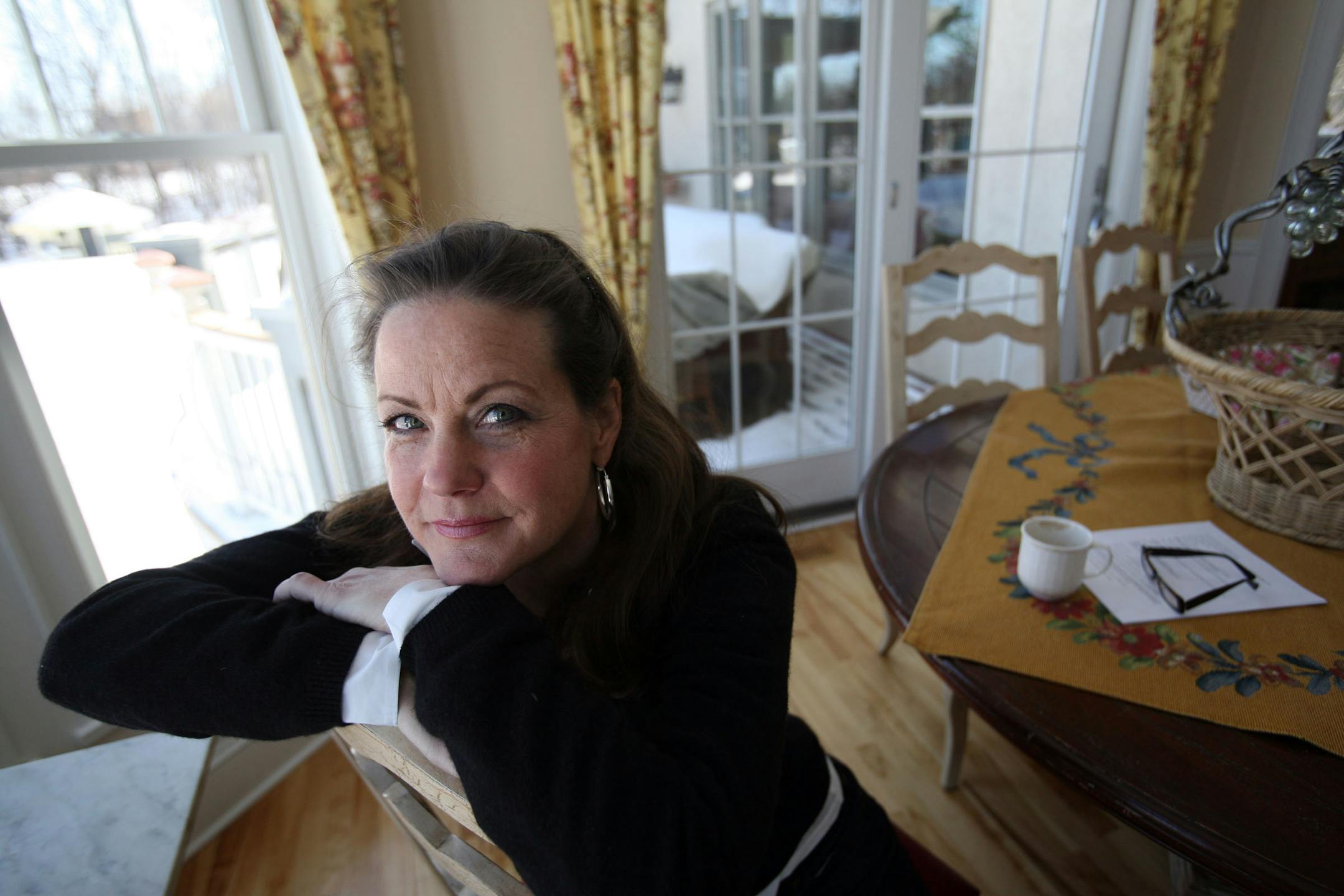
Berit Francis: The road to normal

After she was sexually assaulted, Berit Francis shut down. Her journey back was long, sad and angry -- until she learned how to unlock the silence.

March 14, 2008 at 9:57PM
Berit Francis was the target of a brutal rape while living in California in 1991. Now she's speaking out for RAINN, Rape Abuse, Incest National Network.
Berit Francis was the target of a brutal rape while living in California in 1991. Now she's speaking out for RAINN, Rape Abuse, Incest National Network. (Star Tribune/The Minnesota Star Tribune)

She'd worked late -- it had been one of those days at the hospital -- so Berit Francis closed the apartment door behind her with exhausted relief. Then she heard a stranger's voice.

"I was about to give up on you. I didn't think you were coming home tonight."

The next hour and 15 minutes of violent humiliation happened to someone else, not her, couldn't be. At some point, she decided never to tell anyone, then feared she may have made her last decision. Only after he assured her that the phone cord with which he'd hog-tied her wasn't that tight, that she'd be able to free herself once he climbed out the window, did she know that she wasn't going to die that night.

• • •

The sun gleams off the rolling snow-covered acreage in Orono, 2,000 miles, 17 years and a psychological chasm away from that night in Berkeley, Calif. Francis now is a mother of four and a national spokeswoman against sexual violence. She's successfully lobbied Congress to fund the DNA testing of backlogged rape kits. The 30-year-old nurse who came home to heal in Minneapolis, only to sleep hours into the afternoon and chain-smoke the moment she awoke, seems like another woman in the face of this striking, articulate survivor.

And there's the rub. We prefer our tales of tragedy and triumph to cleave neatly into "before" and "after," as if danger somehow is contagious. Francis, however, makes no bones about that young woman being every inch the person she is today. Francis will speak Thursday at the Women of Influence luncheon series, and again April 26 as cochair of a benefit for RAINN, the Rape, Abuse & Incest National Network, at the Depot in Minneapolis.

Francis doesn't relish telling her story, and wouldn't, frankly, if it weren't for remembering her own long search for a sign that she still was a normal girl from Wayzata. Here's the deal: If she talks, maybe someone who has been assaulted will remember the woman who came to her class or her group and remember how she actually seemed OK. They might find comfort in learning that "OK" didn't come quickly or easily -- but that it eventually arrived.

Who can handle me?

Intuition is a powerful force. After the rapist left, she wriggled free, grabbed a bathrobe and went to a neighbor, who called the police. She needed a friend, but wondered, "Who can handle me?" she said. "I knew I couldn't call any of my kind of screwed-up friends." She settled on a co-worker who had been divorced twice and lost a child to cancer. Perseverance personified.

Briefly, here's why Francis knew she needed someone strong. She'd been raped, but also sodomized with objects, bound and urinated upon over the course of the attack. With horrific irony, that level of violence is what eventually may lead to her experiencing some sense of delayed justice. More on that later.

Francis never again entered that apartment; her sister arrived to move her things. Her personality shriveled. No longer the busy-busy "supernurse," she feared being alone. After several months of living with friends, she decided to return to Minnesota. Her therapist warned that she was making a mistake, and Francis wavered -- she loved California -- but ultimately decided "to crawl back into the womb."

It was a mistake. "It was my lowest low," she said, describing a routine of sleeping and chain-smoking. "I was paralyzed. You can't make a decision to save your soul." She joined a survivors group through the Sexual Violence Center, hoping to find some semblance of normalcy in their shared experience. "I mean, I was a girl from St. Olaf and Wayzata, where no one ever gets raped."

They do, of course.

Every two minutes, someone in the United States is sexually assaulted. She's the one woman in every half-dozen. He's the one man among 33 (a statistic likely underreported). Add them up, and there are an average of 232,000 victims of rape, attempted rape or sexual assault nationwide every year. That's the Metrodome, sold out five times. Close to half of those attacked are under age 18, and 80 percent are under age 30.

Now for better news: Since 1993, the incidence of rape or sexual assault has fallen by two-thirds, a decline mirrored in crime across the board, while the percentage of reported attacks has risen. That's probably the result of a greater willingness to prosecute, but also shows a shift in public awareness, with fewer people downplaying it out of shame or misplaced blame.

In 1991, there were almost three times as many rapes in the United States as there were in 2006. Berit Francis was the one in 78 raped each hour.

Easier to be dead

Back in Minnesota, her smoldering depression ignited in anger. The day she had a fender bender, well, it seemed the last straw. She told her mom it would be easier to be dead. Recounting this, she recalled her mother's stunned sense of helplessness. How can you say that? It was the only time in a two-hour interview that Francis teared up.

But every day, there she was, still alive. She kept going to therapy, trying to find normal. A friend urged her to go out with a guy in her office who'd recently transferred to Minnesota. Her therapist supported the idea, but cautioned against unloading her story on him.

Which is what happened, of course. They bonded over complaining about Minneapolis. He still loved Chicago; she missed California. Then she decided to cut to the chase and told him everything. To her astonishment, Michael Francis asked to see her again.

"You know how you always hear that you meet your mate when you're at your personal best?" she said, with a wry smile just this side of sad.

Life continued to improve. She got a job as a nursing supervisor at Hennepin County Medical Center. She moved into an apartment, unpacking boxes that had lain untouched for a year. "It was a joyful moment, seeing all of my things again."

Eventually, she and Michael Francis married and started a family. She kept working until pregnant with their third child, then began volunteering with the Sexual Assault Resource Service with other nonprofits. A fourth child arrived.

The detective never quit

For years, on and off, the lead detective in her case kept in touch. Larry Lindenau was one of the first authorities with whom Francis dealt at the hospital. She remembers the moment because she was lying on a gurney when he walked up, said "Nice to meet you," and held out his hand. "That little gesture of humanity and respect meant so much," she said.

She wasn't of much help because she'd determinedly avoided looking at her attacker, fearing that he'd kill her if she could identify him. The case went nowhere.

Then, in 2003, Lindenau called. He'd retired by now, but had always played his hunches, in this case, having had her DNA rape kit sent to a private lab in addition to the state lab. The state's samples had long been destroyed, but now the private lab had retested its samples to compare with others in the National Center for Combined DNA Index System (CODIS) database.

Several other matches came up, Francis' among them. That told them that whoever attacked her had attacked others. But it couldn't tell them who he was. A few months later came stunning news: The samples matched the DNA of a 45-year-old man currently serving a 15-year prison sentence for attacking a 30-year-old woman and raping her teenage daughter in Santa Monica, Calif.

It was March 2006. His release date was Dec. 31.

The statute of limitations on rape had expired, so no additional charges could be filed on behalf of Francis or the other women. But the violence of the attacks, terrifying in each case, was especially so for a then-13-year-old girl who had been thrown into a van and assaulted -- so much so that the county filed charges of torture, for which there is no statute of limitations. If found guilty, he could be sentenced to life in prison.

Last July, Francis and her husband flew to California for the preliminary hearing. For the first time, she really looked at the man, but as if from a great distance. She was far more interested in meeting the other women, who may be recalled to make statements during the sentencing phase, should he be convicted of the torture charge. A trial date has yet to be announced.

Talking not easy, but crucial

On that terrible night, Francis thought she'd never, ever talk about this. But that decision quickly fell by the wayside as she had to talk with investigators and nurses, then with co-workers, finally with family members. She learned that she could talk. Then later, that it's important.

Michael Francis said he's been amazed by how many families have come forward to say how much her willingness to talk about her experience helped them. "It's not an easy thing for her to do," he said. "She knows it's something that people would rather not hear about, but she's very committed to saying, 'I'm not going to let silence be a way that women, and men, are re-victimized.'"

Toward that end, she and others, including actress Christina Ricci, who volunteered her services out of the blue, have successfully lobbied members of Congress to fund the testing of backlogged DNA samples from rape kits. Francis became supportive of RAINN -- as is Target, where her husband is executive vice president of marketing -- because it's an umbrella over the range of violence from rape to abuse to incest. She regards her own attack -- only once, by a stranger -- as pale in comparison to a siege of abuse by a family member. But that's also the reason that she can better lend her voice to the issue, talking for those who can't yet speak, unlocking the silence for those who'd rather not hear.

Kim Ode • 612-673-7185

about the writer

about the writer

Kim Ode

Reporter

See Moreicon