

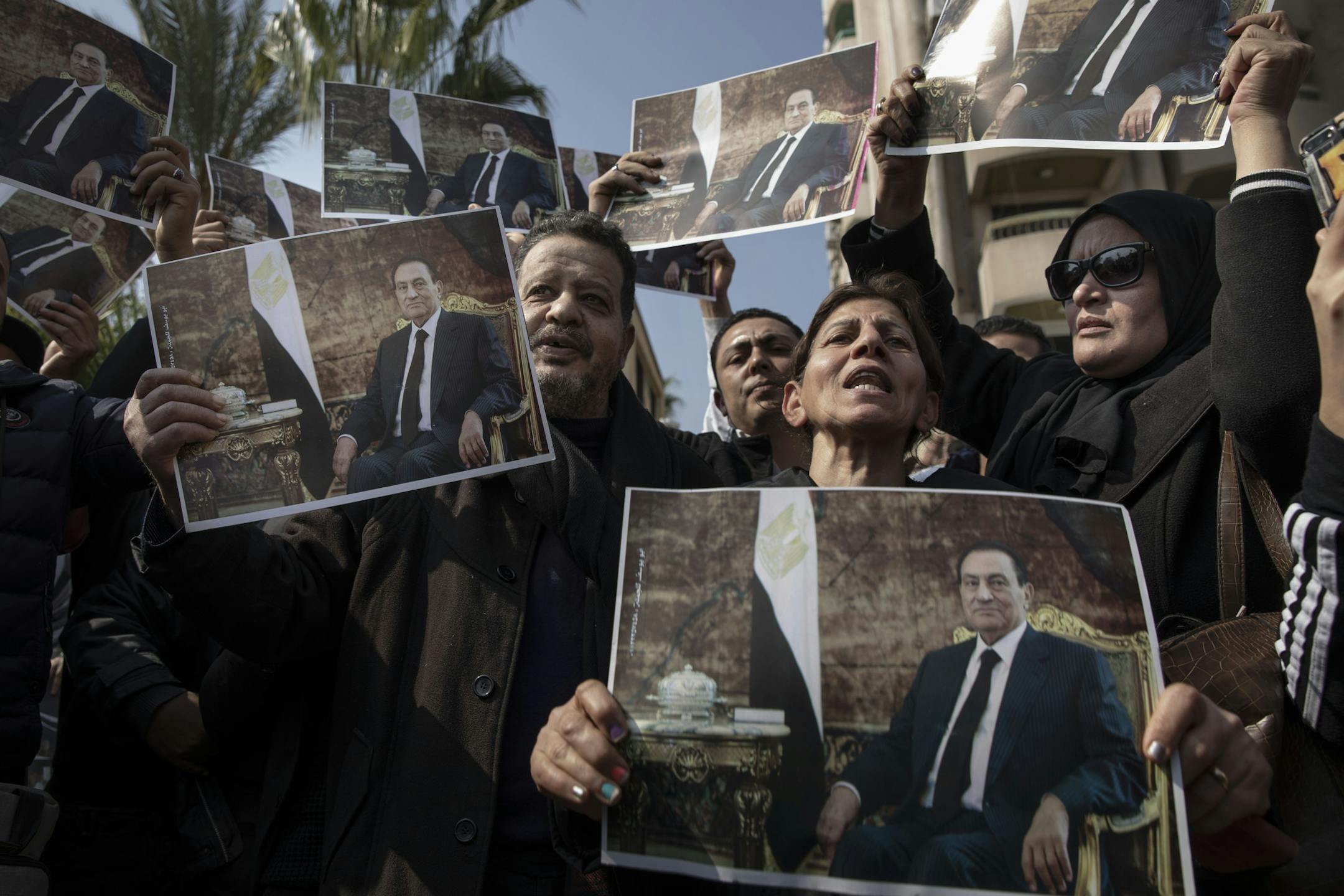
"I have never wished a man dead, but I have read some obituaries with pleasure."
There is a lot of debate about the origin of this quote and variations of it. Most agree it has a Mark Twain flavor. Regardless, it is the sentiment I had when I learned of ousted Egyptian dictator Hosni Mubarak's death this week. At 91, Mubarak finally tested positive for mortality.
Like all Egyptian military dictators before him, Mubarak came from a humble background. He was born in a village in Monufiya called Kafr al-Meselha, on May 4, 1928. His father, Ibrahim Mubarak, was a courthouse janitor and his mother, Naeema, was a traditional woman, an illiterate housewife.
However, Mubarak ruled Egypt for 30 years; he was called modern Egypt's Pharaoh. His legacy is a mixed bag, to say the least. He became an accidental leader of Egypt by being in the right place at the right time, sitting next to another military dictator, then-president Anwar Sadat, when Sadat was assassinated during a military parade. Mubarak then was appointed to run Egypt, where proximity is a political virtue.
During his 30-year tenure, Mubarak changed the course of Egypt for the worse, taking it from a country leading the Arab world economically and politically to a country that is irrelevant historically and strategically. His regime, fraught with corruption and cronyism, resulted in destroying Egyptian economy, education and culture.
Israel became Egypt's friend and partner in "peace" and Egypt got billions for it. Palestine became Egypt's enemy. Mubarak sent troops to help Bush invade Iraq and opened prisons for his own opposition. He used Islamists as a bogeyman card to scare the West and get the support he needed, including looking the other way when it came to human rights violations.
Mubarak realized that he couldn't live forever and started grooming his son Gamal to take the helm after him. But the military was alerted and used the Jan. 25 popular "Arab Spring" revolt to oust the dictator.
He was accused of killing protesters and of corruption, and was put on trial in a kangaroo court and sentenced to three years in prison. But he never spent a day in jail. During the trial, he used a Harvey Weinstein-like strategy, a hospital bed instead of a walker. He divided his time between his luxury residence and a luxury hospital.


