

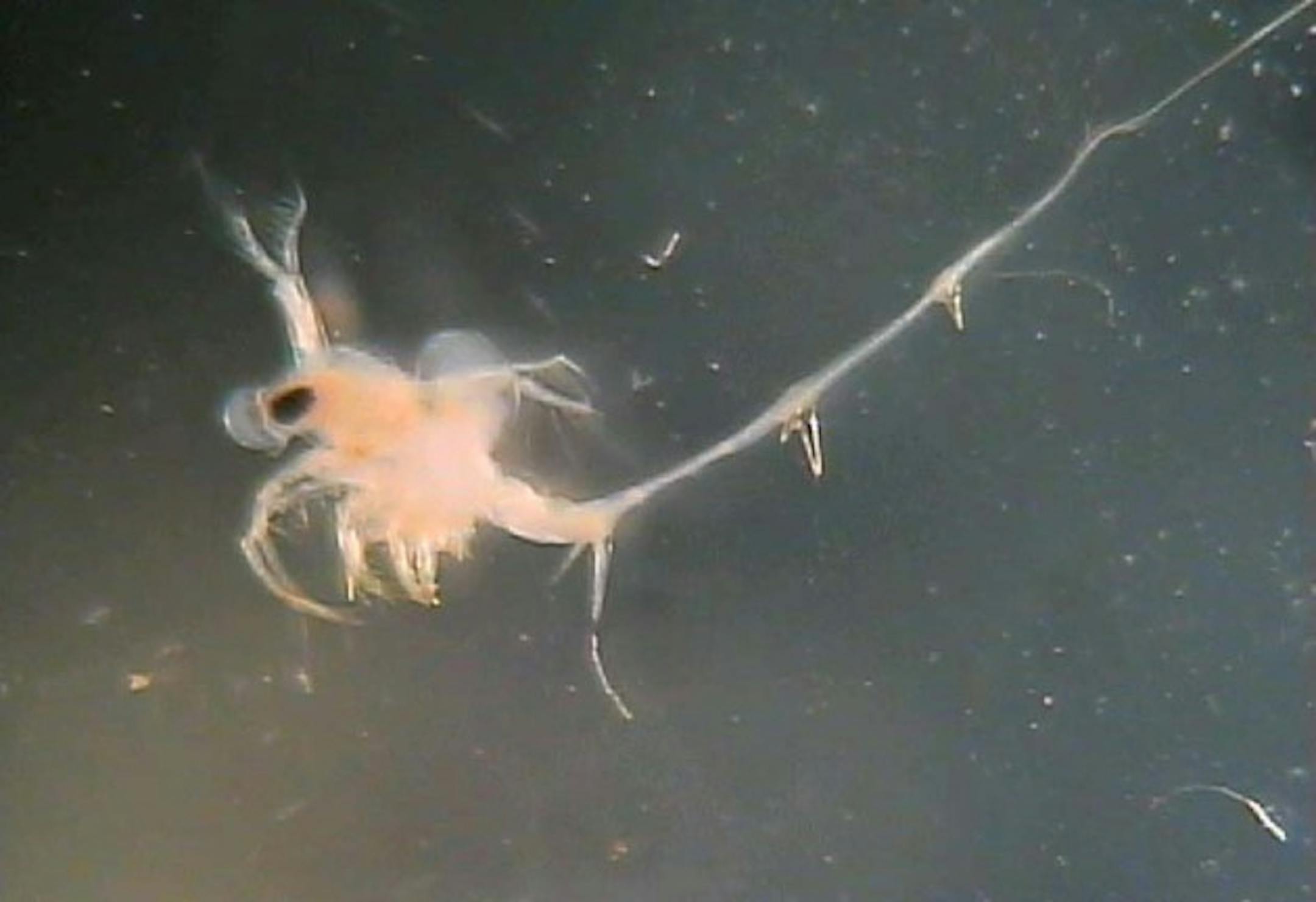
Spiny waterflea, an invasive species accidentally imported from Europe and Asia, continues to spread in the Boundary Waters Canoe Area Wilderness.
Officials Thursday confirmed its presence in Basswood Lake, which straddles the Minnesota-Ontario border near Ely.
The discovery was confirmed in zooplankton samples taken by the University of St. Thomas in partnership with the Minnesota Department of Natural Resources fisheries staff. In addition, DNR fisheries staff found spiny waterflea in the stomach contents of Basswood Lake cisco.
The lake will be added to the list of infested waters, along Crooked Lake, Iron Lake and Bottle Lake, which are downstream. The Basswood and Bottle rivers will also be designated as infested waters due to connectivity and the likelihood of infestation spread.
Lac La Croix, which also straddles the Minnesota-Ontario border, was designated as infested when spiny waterflea was discovered there in 2008.
"The DNR is coordinating with Canadian officials at the Ontario Ministry of Natural Resources to alert boaters and other recreationists about the risk of spreading the invasive species," said Rich Rezanka, DNR aquatic biologist.
Spiny waterflea is a small planktonic crustacean that disrupts the food web and competes with small fish as it forages on microscopic animal plankton such as daphnia. Because of its long tail spike, the spiny waterflea is not eaten by small fish.
Their impact on fisheries is uncertain. But when populations are high, anglers can experience frustration with masses of spiny waterfleas clogging fishing and downrigging lines, and other water equipment.


