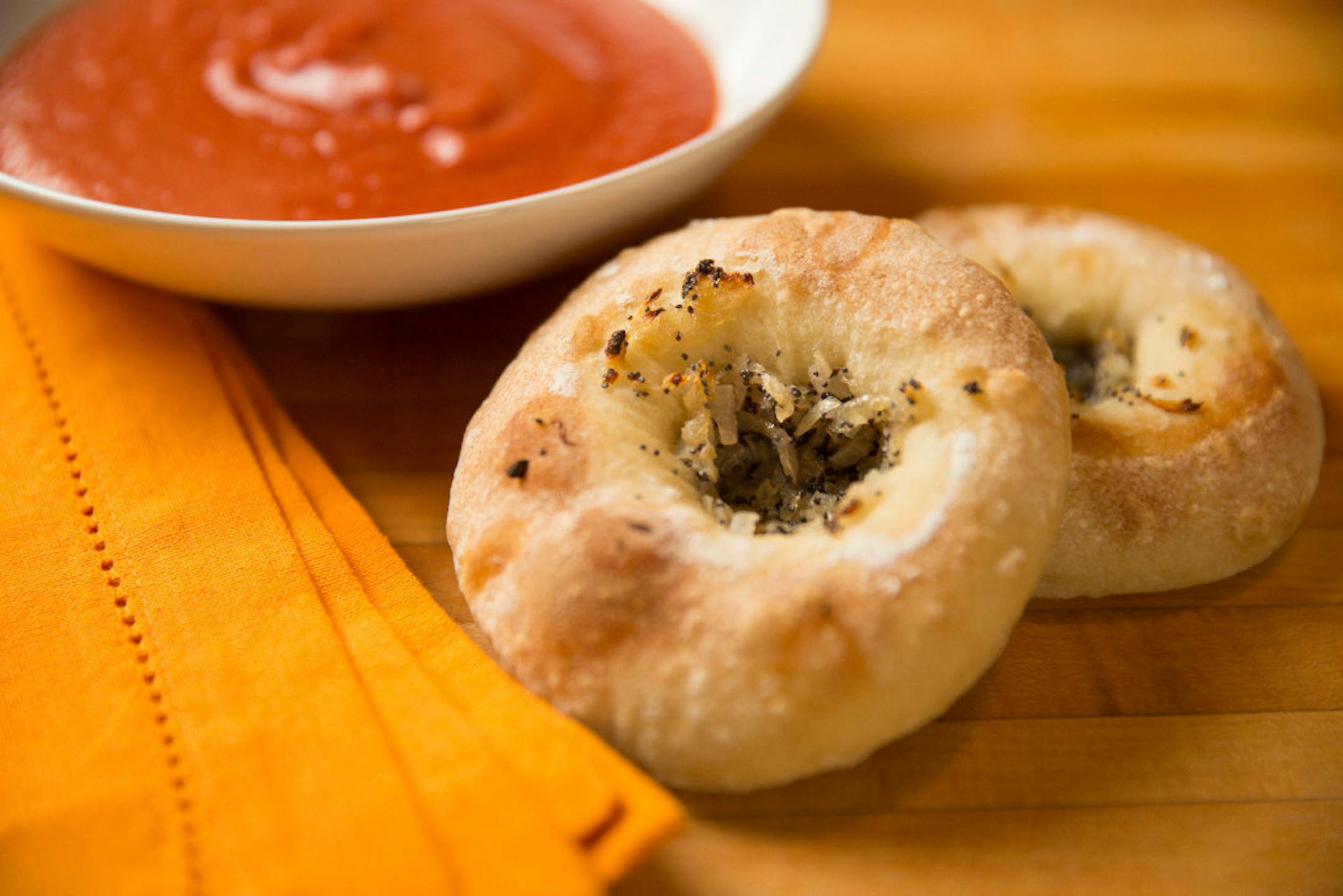
Bialys may not be well known here in the North, better known for its lefse, potica, kolache and limpa. Yet it's familiar in that way that so many cultures share a common bond when it comes to carbohydrates.
A bialy is a bit like a bagel, in that it's round and chewy, and yet it's not. It's a bit like a kolache, in that its central divot sports a filling, and yet it's not.
Bialys are filled with a mixture of sautéed onions and poppy seed, and the dough tips toward the salty side, which brings them into the realm of a perfect bread for upcoming evenings of soup suppers.
Dunkable? Absolutely. And if some of the onion bits tumble into the soup, that's a win.
Bialys have their roots in Eastern Europe and Jewish culture, originating in the small city of Bialystok in northeastern Poland.
The town gained a tragic history during World War II, when Nazis burned down the central synagogue, trapping many Jews inside. Others fell victim to the Holocaust. Immigrants who fled to New York established a strong Jewish community on the Lower East Side, complete with bakeries.
Lore holds that a baker, in the midst of harried work, dropped a round of dough on the floor.
We'll let Mimi Sheraton, grande dame of New York food writing, take it: "Someone else, not seeing it, came over and stepped on it. The baker, not wanting to waste it, picked up, smeared on poppy seed and onion, baked it, tasted it, and declared a eureka moment in bread history."