
Setting up a backyard buffet for birds

Well-stocked feeders provide a feast for the birds, and a feast for the eyes for bird-watchers.

For the Minnesota Star Tribune
November 23, 2023 at 1:35PM
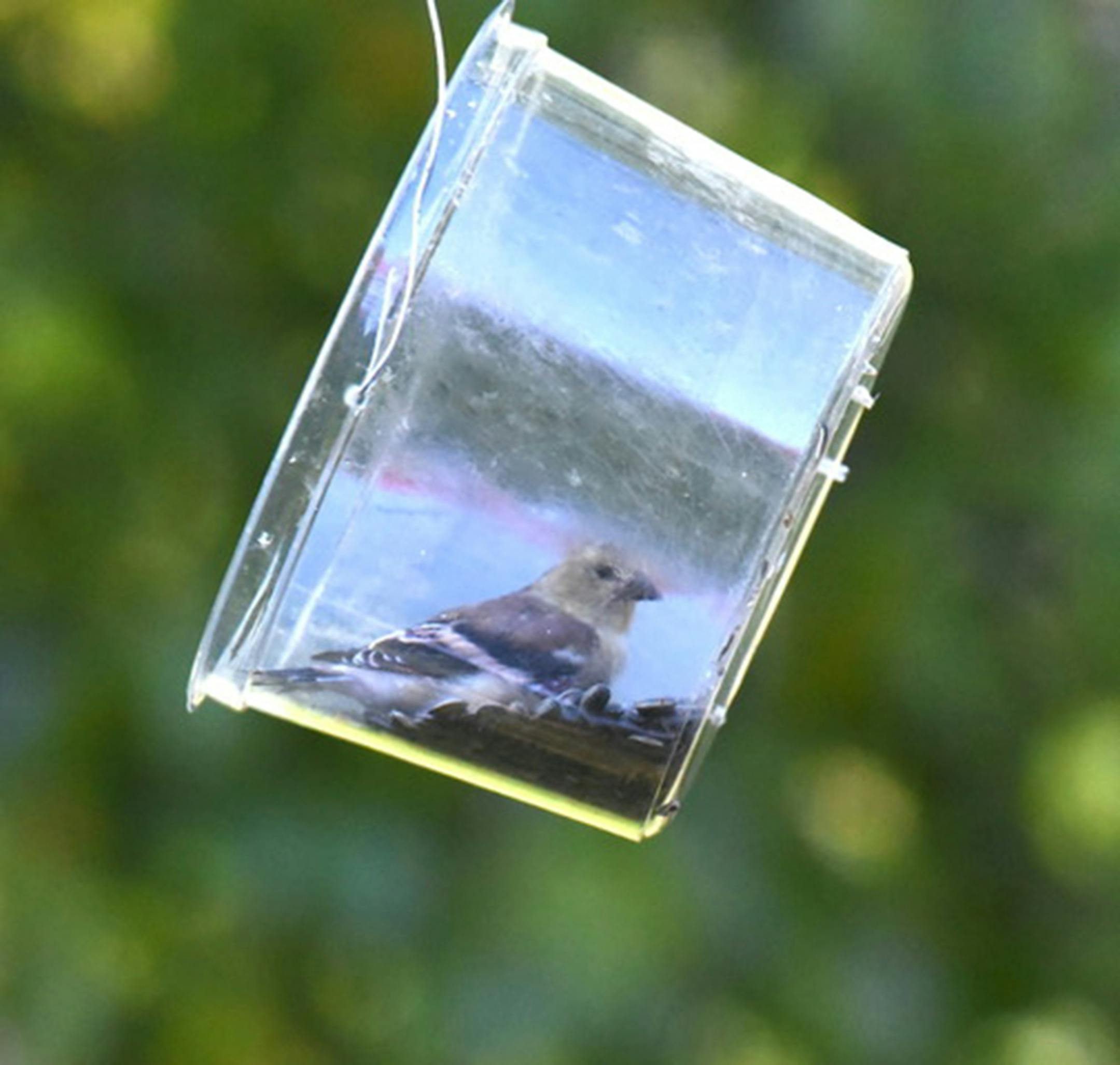
Jim Williams photo: We toss a handful of seeds into this deli container, wired to hang. Like this American goldfinch, the birds are happy with an improvised feeder.
We toss a handful of seeds into this deli container, wired to hang. Like this American goldfinch, the birds are happy with an improvised feeder. (Jim Williams/The Minnesota Star Tribune)

We've reworked our feeder setup again, taking down the now out-of-season hummingbird feeder, and hanging two new tube feeders, one for more sunflower seeds, the other for suet kibbles.

When we moved to this house 22 years ago we hung four tube feeders from a feeder tree made of plumbing pipe. It worked, and it was squirrel-proof.

It was at the far end of the backyard, though, out in our wilderness (trees, bushes, swamp and pond edges). To see the birds well, binoculars were required.

Seed was kept in small garbage cans in our walkout basement. Going to the basement, loading a pail with seed, tromping through snow in season, well, it became a bit of a chore. I am not getting younger.

The walkout feature gives us a deck on what is, in the rear of the house, the second level, our living level.

The feeders now hang from shepherd poles fastened to the deck rail. Seed is kept out there in an old chest cooler. Squirrels are trying to gnaw their way in. I think they smell the seed, so I am smearing lid edges with peppermint oil to mask the scent. We will see.

Suet is offered in holes drilled in two 6-foot-long heavy branches stacked against the rail.

There are three pairs of patio doors leading onto the deck, glass stretching 6 by 24 feet if you include the framing. All that glass could be a huge problem for the birds. We've tried several ways to mark the windows, to warn birds away.
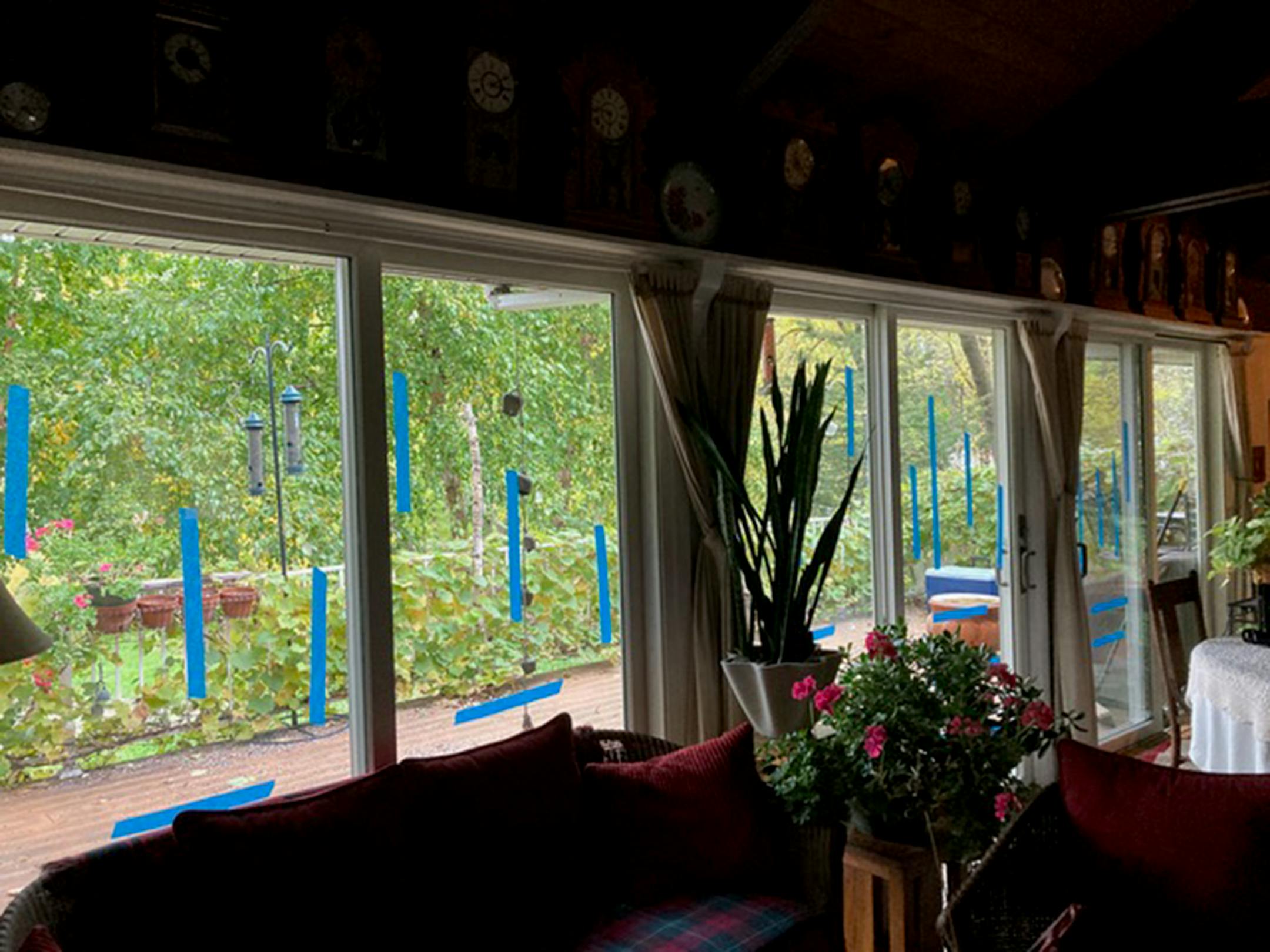
We've settled on 1.5-inch blue masking tape in strips 1 to 3 feet long, four to six strips per window. We are not aesthetically prepared for a Home & Gardens house-of-the-month feature, but the birds are safer.

Jim Williams photo: Blue masking tape, 1.5 inches wide, in strips one to three feet long, warn birds of those large sheets of glass.
Blue masking tape, 1.5 inches wide, in strips 1 to 3 feet long, warn birds of those large sheets of glass. (Jim Williams/The Minnesota Star Tribune)

Light through the glass doors illuminates our dining room and an area convenient to the kitchen where we have two chairs, a small table, and a settee on which I can stretch out to read or watch birds.

This is where we unfold our paper version of the StarTrib and have breakfast, birds sharing our morning, or the other way round.

In mid-October we had visits from a purple finch, previewing a good finch winter, hopefully, and a hermit thrush, a rare sighting here, particularly on our deck. Perhaps it saw the bird bath there (heated for winter use).

We sprinkle sparrow seed (millet, thistle, sunflowers crumbs) on the deck for birds that often forage on the ground — white-throated sparrows and juncoes this fall.

The deck rail is blanketed by an old grape vine, its various stringers 60 feet or more in length now. A flicker has come by to pick grapes. Cautious birds hide in the vine's shadow.

The birds are eager visitors in the morning. At a point, all at once, they disappear. I wonder who gives the time-to-go signal?

The birds drift back in an hour or so or more. Feeding bouts through the day are less group events than the early one. Cardinals close the store.

We've always fed birds, never tiring of the same ones, always hoping for a visitor like the thrush — or the Bullock's oriole that took some pokes at an orange half last summer.

Where did it come from? Where did it go? What will we see next?

Lifelong birder Jim Williams can be reached at woodduck38@gmail.com.

about the writer

about the writer

Jim Williams

See Moreicon