

Much like the schizophrenic reality of the annual meeting of the United Nations General Assembly itself, this week's conclave of world leaders in New York has presented two contrasting narratives for the Syria-Iraq war and the current moment of upheaval in the Middle East. One, the polished speeches of leaders before the cameras, follows a script, presents its best face, and plays to the hopes of constituents back home. The other, like the snarling traffic jams, the curt, hurried back hall of conversations of the senior officials straining to do the diplomatic heavy lifting, and the late-night critiques offered up in hotel bars, is more ragged, grounded in the truth, and therefore unsettling.
The first, more polished, view is the story you would get if you listened only to presidents and foreign ministers speaking of clear goals, coalitions knit together by common ideals, and, ultimately, a remade, safer, more stable world. While the other view, the story you only hear in conversations that take place on background or off the record, reveals that even behind well-intentioned initiatives there can be the kind of delusions, dubious motivations, divisions, and duplicity that seem likely to make bad situations worse. The question now is what factors will tip the balance so that the story told (and sold) in press releases and talking points comes to pass — rather than the one that led a former cabinet official from U.S. President Barack Obama's own party to say to me this week with regard to the White House's recent conduct of foreign policy in the war-torn region, "Things are bad, very bad."
The duality of this particular moment, the tension between the good and the terrible, is so stark it evokes the light-versus-darkness heart of the Zoroastrian philosophy of the Yazidi people who, once upon a time, so long ago it seems hard to remember, helped usher in this latest chapter of Mideast war. (Their crisis atop Mount Sinjar was only a month ago, in case you had forgotten.)
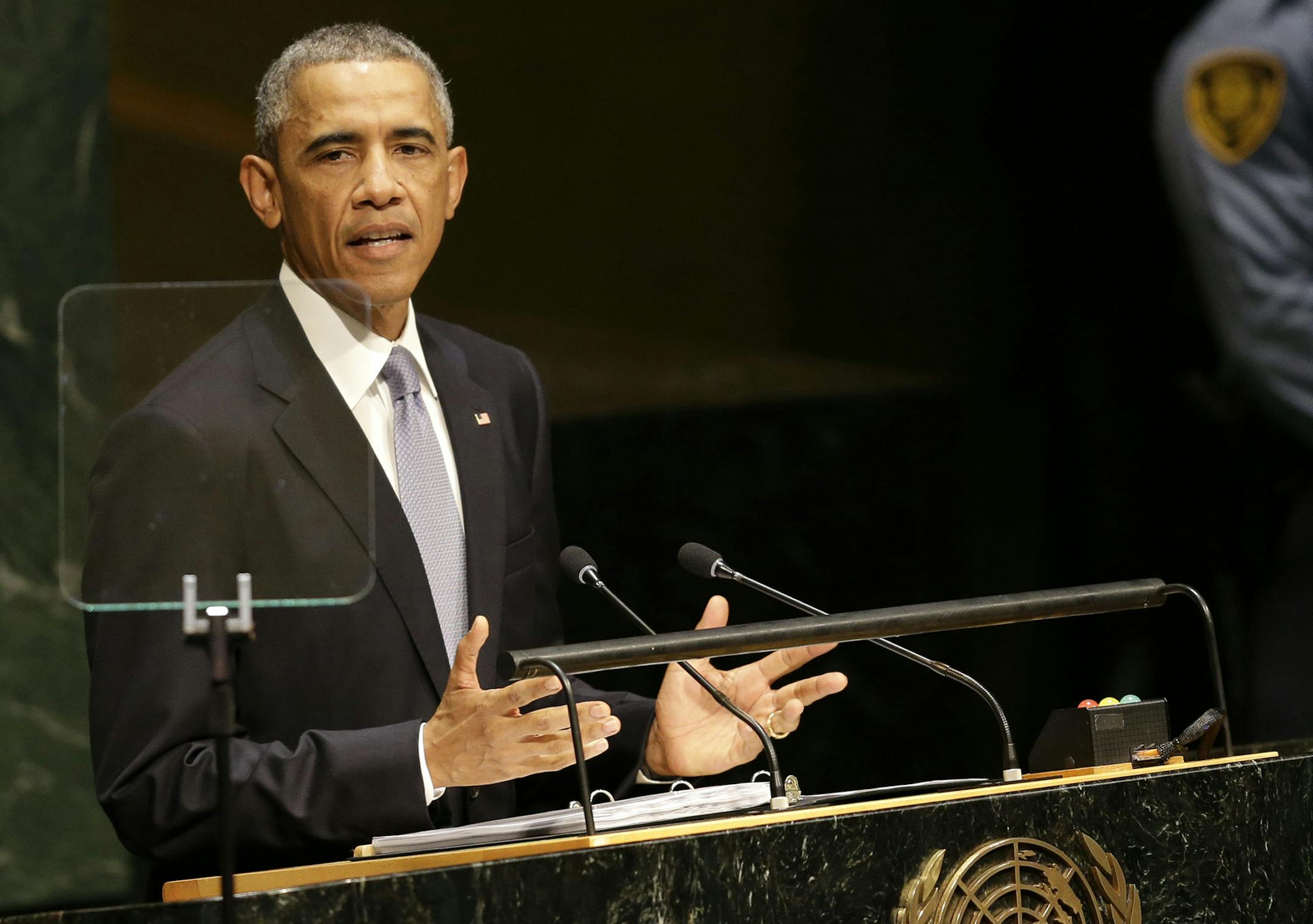
This tension was reflected in Obama's remarks to the General Assembly when he said, "We come together at a crossroads between war and peace; between disorder and integration; between fear and hope." As one of my colleagues, Elias Groll, indicated during his live-blogging of the speech for Foreign Policy, it's a perspective that is far removed from Obama's assertion of just 12 months earlier when he said, "The world is more stable than it was five years ago."
What shocks and spasms we have seen in this past year or so: a United States that is about to take action in Syria, then one that could not without congressional approval and then later said maybe it didn't need that approval after all; an administration arguing for the elimination of the standing authorization to use military force in Iraq and then just months later using it to justify an action it vowed it would never take; the United States hemming and hawing and disappointing allies from Eastern Europe to the Persian Gulf and then one acting boldly and celebrating the coalition with which it went to war. Who knew that the pivot the Obama administration would be remembered for was swiveling back to policies it opposed, rejected, and had turned away from just months or years before?
But if you listened to Obama's passionate and well-delivered speech (and those of other leaders), you certainly could not help it if a bit of optimism brightened up your worldview. The president was powerful and clear about issues on which in the past he had been accused of hesitancy and vagueness. He was tough on IS and extremism, saying, "No God condones this terror. No grievance justifies these actions. There can be no reasoning, no negotiation, with this brand of evil." He took on Russian President Vladimir Putin, promised aid to combat Ebola, and to fight climate change. He was encouraging on the Iran nuclear talks and even took a moment to reflect on America's own flaws as manifest in the shooting and subsequent unrest in Ferguson, Missouri. In closing, he offered a resoluteness many have long hoped for from this administration: "At this crossroads, I can promise you that the United States of America will not be distracted or deterred from what must be done. We are heirs to a proud legacy of freedom, and we're prepared to do what is necessary to secure that legacy for generations to come."
Obama was not the only one promising a more positive view and hinting at a different shape of things to come. At a small breakfast for journalists, Iranian President Hassan Rouhani openly and deftly fielded questions on a wide range of subjects. While reports of the meeting emphasized his critique of the U.S. attacks on Syria as illegal, the real headline of the meeting was how little he mentioned those attacks. He commented on them pro forma, for a split second, then moved on to describe his hopes for U.S.-Iran nuclear talks. He said this week would be pivotal in those talks and that he hoped for a final deal before the current round's deadline, which is approaching in just two months. He mentioned that a year ago in his phone conversation with Obama the two discussed how such a deal could usher in new communication and cooperation between the United States and Iran. He talked of rapprochement with regional neighbors despite enduring differences. He refused to be baited into focusing on U.S.-Iranian tensions on key issues.
On Syria, Rouhani said the focus should be on "time-management skills," meaning first defeating terrorists and then addressing a political solution — and when he mentioned the political solution he didn't mention Syria's president and erstwhile ally Bashar Assad by name. The vibe he gave off was that Iran might be open to a deal that saw Assad depart, provided all the people of Syria had a say (meaning that non-Sunni minorities might be able to form a coalition to keep the government out of Sunni hands). He even said that even if the deal he hoped for did not materialize there would be other ways to carry the dialogue forward. And this, too, was a far cry from a year earlier, when the big story was whether or not there would be the possibility of a handshake or a photo op between U.S. and Iranian leaders. Now there was an emphasis on a possible sea change, on the common goal of fighting terror.


