

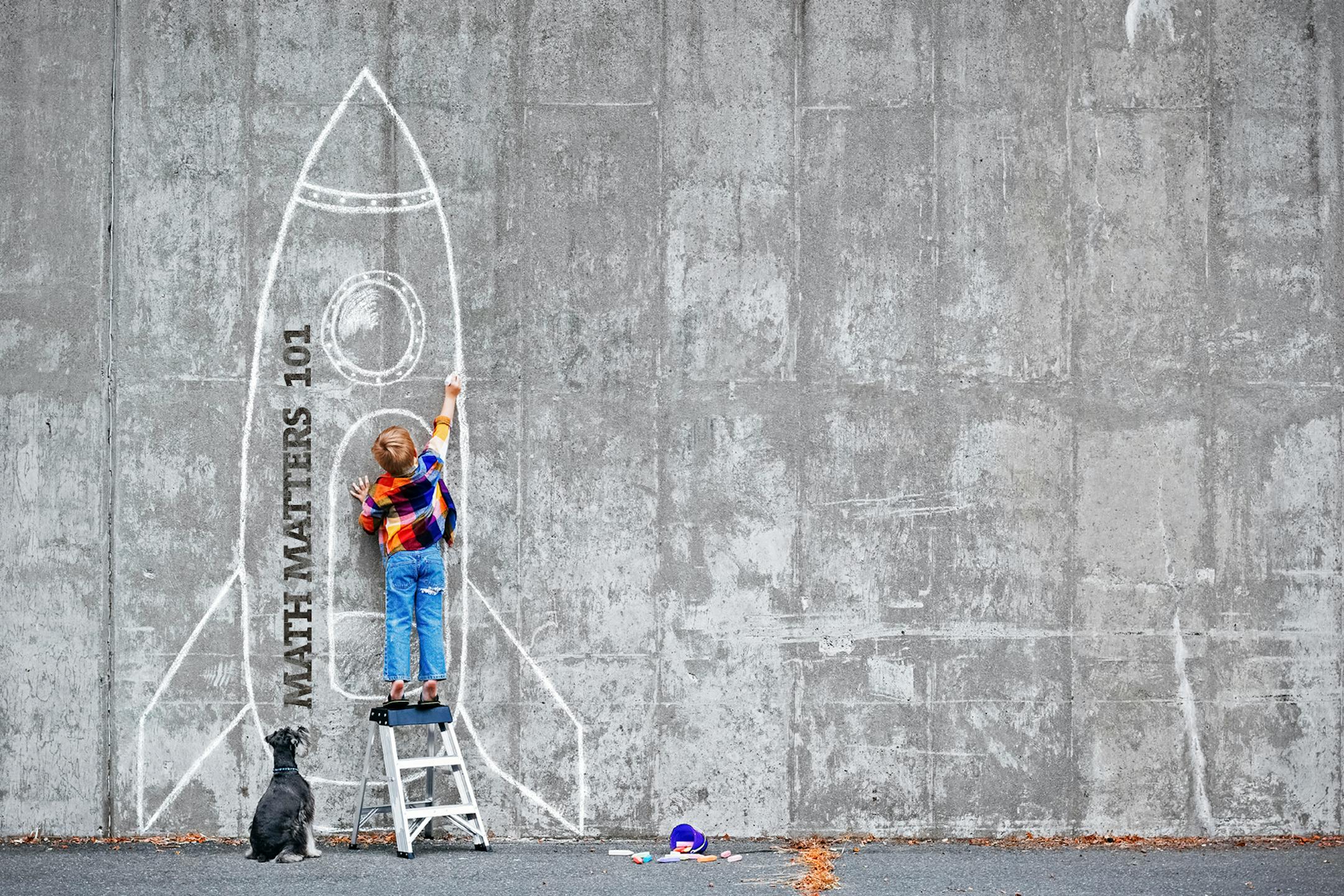
The imminent return to school has been magnified by the uncertainty of a COVID future and painful memories of the COVID past. As if the increased levels of anxiety and depression were not enough, new reports show our children are behind in mathematics, compared with where they would be after a normal year, with the sharpest declines experienced by the most vulnerable ones.
Math induces anxiety in kids, many lasting far into adulthood. As a mathematician, I constantly sense shame when people discover my profession. Pleasant introductions are followed by confession: "Forgive me, father, for I did not understand algebra."
With parents having been responsible for a good amount of their children's education last year, the thought of helping their kids struggle through another year seems overwhelming. This is compounded by the added pressure of knowing that math is the gatekeeper to science and technology that drive much of our society. After all, the power of mathematics has helped a rover to land on Mars, a computer to outthink chess masters and a phone to navigate us around the world. And mathematicians have done a good job of showcasing these successes.
Ironically, this very feature of mathematics is its greatest weakness.
When our kids ask why they need to know algebra or trigonometry, we promise them that these tools will be useful. So, students hold their noses and drink math medicine that may help in their technological futures. Not only is this not true (I've never used algebra, much less trigonometry, in my daily life), it makes math dreary. Touting the usefulness of math for building spaceships makes one excited about the spaceships, not the math.
Do we listen to Coltrane because jazz is useful? Or immerse ourselves in a Rothko painting because of its practicality? The joy of food comes not from amino acids and proteins, but its look and smell and taste. Humans relish the practical, but we also know that there is much more to life. As Aristotle said, knowledge begins with wonder, but what wonder is there in algebra or trigonometry or calculus?
Happily, unlocking the pleasure of math is simple: Do what mathematicians do and seek out unexplored, unknown, undiscovered math.
Regrettably, the mathematical journey is imagined as a formidable mountain: The wide base is arithmetic, the skills of adding and multiplying, accessible to everyone. Climbing higher brings us to algebra, geometry, trigonometry and eventually calculus and beyond. We believe that new math ideas have been all but exhausted, with a few remaining challenges tucked away in the highest peak.


