

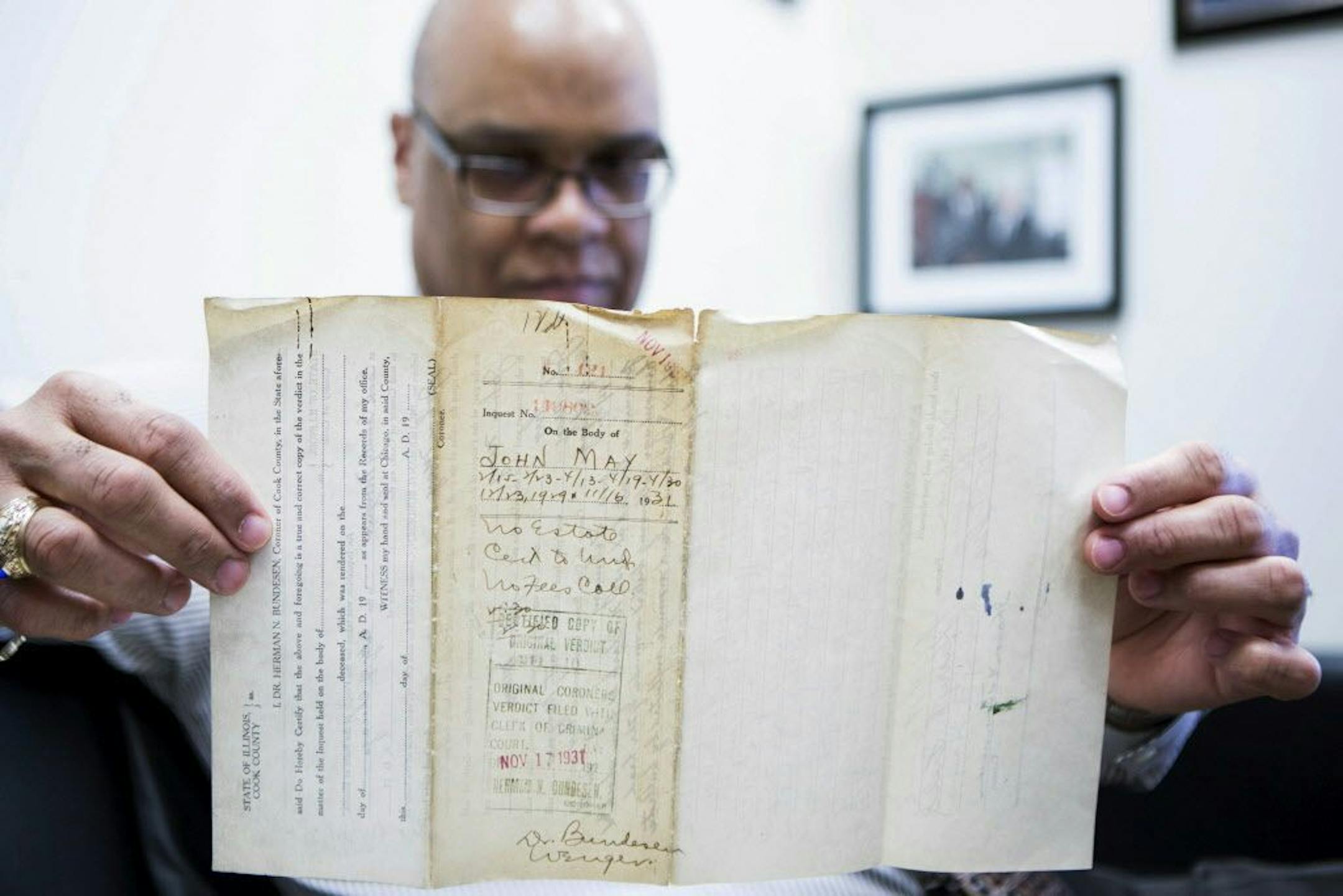
CHICAGO — Written by hand, the autopsies on the seven bullet-riddled bodies vividly describe why the Valentine's Day massacre of 1929 is still considered Chicago's most infamous gangland killing.
The reports were recently unearthed with inquest transcripts from a warehouse after eight decades, and the Cook County medical examiner's office is now considering how best to preserve and display them.
Executive officer James Sledge, a local history fan and a Chicago native, said he felt a chill down his back when he first read the documents outlining the attack at a Lincoln Park garage that left seven men dead and more than 160 machine gun casings littering the scene.
The attack, carried out by men dressed as city police officers, is widely believed to have been ordered by famed Prohibition-era gangster Al Capone. The crime was never solved.
Shortly after Sledge joined the medical examiner's office in 2014, he asked for permission to look at the autopsy records. His staff took multiple trips to a Cook County government warehouse to find the reports, which were tucked away in a metal file cabinet.
Sledge is weighing where the documents should be stored and how accessible they should be, he told the Chicago Sun-Times (http://bit.ly/1XnGk5E ) in a story published Thursday.
"On the one hand, we want to have them readily available," Sledge said. "But we don't want them so accessible that we in some way anger some part of the population who feel we are not paying proper respect to the deceased."
The victims of the Feb. 14, 1929 massacre were five men who were known gangsters working for Capone rival George "Bugs" Moran, an optometrist who was friends with Moran's crew and a mechanic at the garage that served as Moran's headquarters. They were gunned down by four men, two of whom were wearing police uniforms. Since there was no evidence of a struggle, it's believed that Moran's men thought it was a police raid.


