

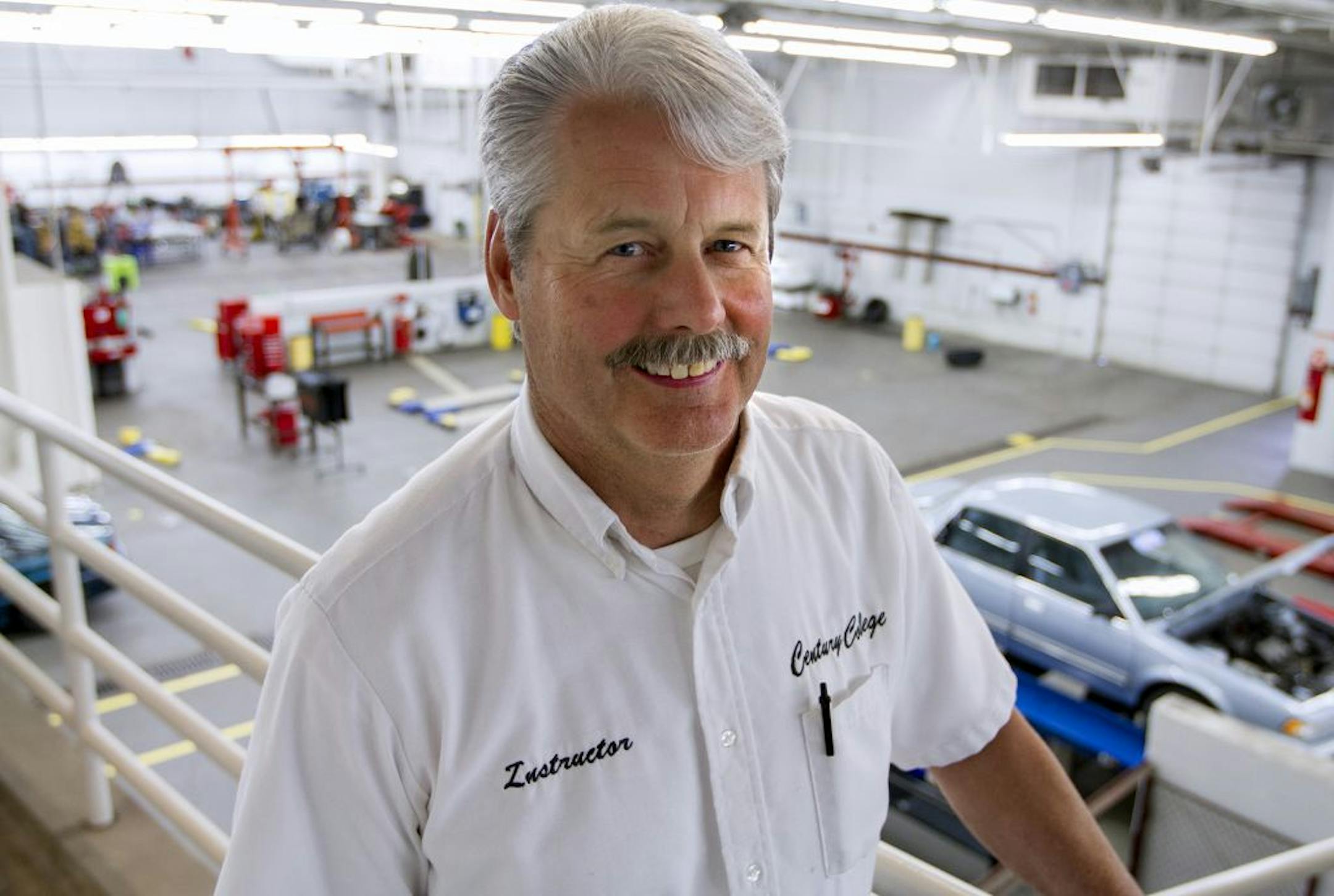
Tom Chall was there when the automotive program began at Century College in White Bear Lake. He was the one who started it.
Now, 41 years and countless students-turned-mechanics later, he's retiring. In his time at Century, Chall has seen some major changes, not only at the two-year college but in the automotive industry as a whole. He's also been a keen observer of student behavior. With his wealth of experience, we asked him to take a look back on his tenure.
What was the price of gas when you started teaching? Twenty-five cents a gallon. I had a '72 Vega, and when I would drive from Milwaukee, $3 would fill the tank. I could always fill the tank for under $4. The students think it's unfathomable.
The biggest change in cars through the years? When I started, the car was like a big go-cart. It had seven more pistons than a go-cart, and seven more spark plugs. There was nothing electronic about it. Today's automobile has more technology than the first lunar landing to the moon! It's just amazing. ... Every part of the vehicle is computer-controlled. It has changed so that the computer senses every function of the car. You could go into a slide, and it will start to correct it to take you out of the slide. The automobiles today are superior, cleaner and more efficient.
Common problems, then and now? Common problems are always the brakes, steering suspension, spark plugs. You don't have to worry about a distributor cap -- we don't even have a distributor anymore. ... Today, you get the "check engine" light that signals there's a failure in one of the computer systems. You have to diagnose and know it, and be able to fix that in today's cars. ... The hardest thing to teach is diagnosing. Fixing is the easy part. ... Only half of the students make it to the second year [of the program], and the reason is they have to score well in electrical. We can start out with 500 and end up with 75 students. Every one of my students said they never realized how complicated an automobile really was.
Accomplishment you're most proud of? We [Century College] have the best program in the state. Our students are the proof of the pudding. When students head to a manufacturer's training session they come back and say "wow, thanks for teaching me so well." ... My teaching colleagues are a big part of the success of the program. And they're both former students, too!
Biggest challenge? The biggest challenge is trying to teach someone who doesn't really want to learn. You just can't do it. The good news is, the number of students who want to learn far outweigh the ones that don't. It's very satisfying to have a student who wants to work very hard, and does very well because they're doing something they're passionate about. If you're passionate, you'll be successful in life.
Philosophy on teaching? You have to know your subject matter inside and out. It's the rubber-to-the-road reality; you just need to know your subject matter well, and share that passion. ... You also have to have the ability to get complicated concepts across to people. I have 25 different ways to explain something. If you don't get it across one way, try another way. I once had a student who would sit in the front row, and I could read his face like a sign. When he got it, his face lit up like a light bulb. You have to find a different approach until that light goes on.


