

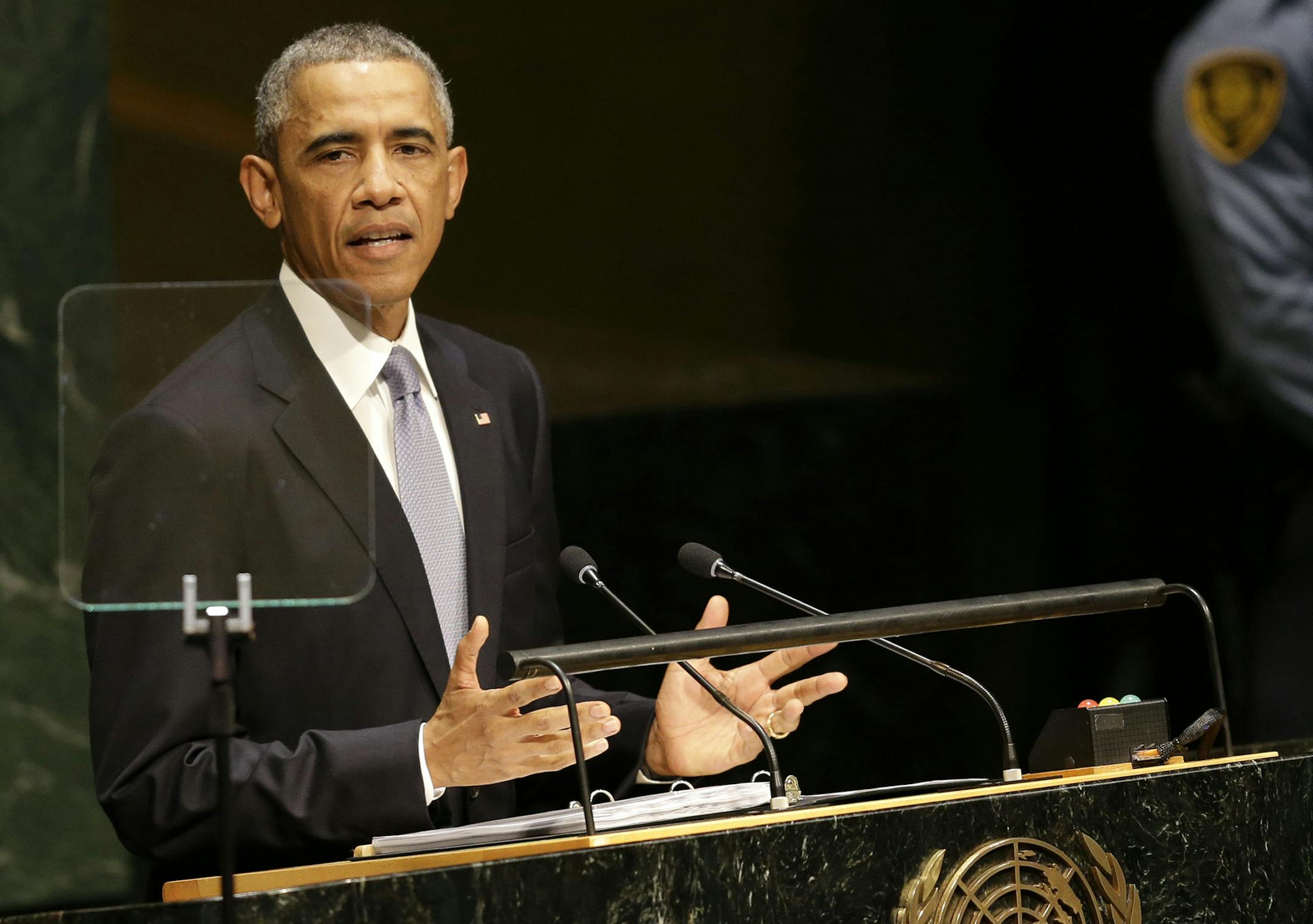
Addressing leaders of a world widely seen to be moving from crisis to crisis, President Obama told the United Nations General Assembly on Wednesday that a collective response is imperative. Although the United States can and should take a leadership role, long-lasting solutions ultimately must come from those nations with the most at stake.
Obama pointed to several global challenges, including the spread of Ebola in West Africa, Russian aggression in Eastern Europe, Iran's potential nuclear weapons program, and ongoing military efforts to thwart the Islamic State in Iraq and the Levant (ISIL) and other terror groups.
To his credit, Obama didn't flinch from describing the illegal and immoral moves by Russia — its annexation of Crimea, its efforts to cleave Ukraine, and its complicity in the downing of a Malaysian jet — that he said challenge post-World War II order.
He also rightly called for a diplomatic, not military, solution to Iran's potential nuclear weapons program.
Obama challenged the delegates to reinvigorate the United Nations itself — an institution too often neutered by China and Russia coddling dictatorships with vetoes of Security Council measures. "We gain more from cooperation than conquest," Obama accurately observed.
Diplomacy will also be a requisite element to responding to terrorism, be it from Al-Qaida, ISIL or Khorasan, the more obscure but equally dangerous offshoot of Al-Qaida that was also targeted in Monday airstrikes in Syria. But the diplomacy will likely be applied to recognized Mideast governments, not groups like the depraved ISIL. "There can be no reasoning — no negotiation — with this brand of evil. The only language understood by killers like this is the language of force," Obama said.
The U.S. president was quick to point out that the language of force is shared by the more than 40 nations that have offered to join an anti-ISIL coalition. Already, five nations — Saudi Arabia, Qatar, Jordan, Bahrain, and the United Arab Emirates — took part in the initial airstrikes.
ISIL's nihilism may indeed require a martial response. But equally important, Obama called on Muslim communities to "explicitly, forcefully, and consistently reject the ideology of Al-Qaida and ISIL" by cutting off funding, "contesting" the space they have online and in social media, and countering intolerance taught in schools.


