

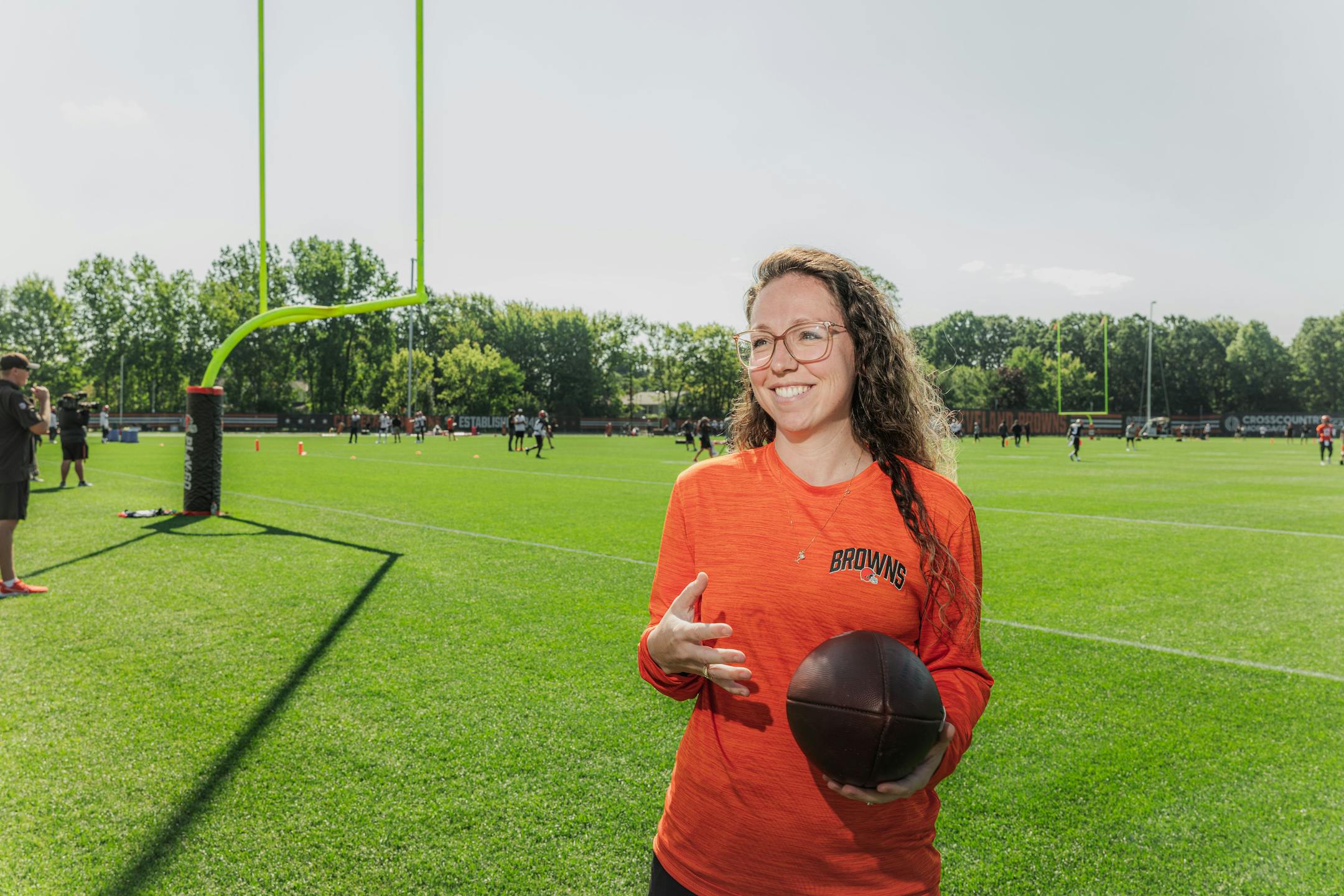
A decade before Catherine Raîche became the current highest-ranking female team personnel executive in the NFL, she was a scout for the Canadian Football League.
Back then, it was still uncommon for a woman to hold a job evaluating football players, a role that required Raîche to travel the country looking for talent. In a few instances, she said, when she arrived at a college or a training camp, football staff members there would ask for her business card to confirm her identity.
"When I was asked, 'Where is the scout?'" Raîche, 34, said in a phone interview, "I would be like, 'Well, it's me.'"
Raîche, now the Cleveland Browns' assistant general manager and vice president of football operations, is part of an influx of women who have permeated pro football in a relatively short span, taking on the kinds of inside-the-game but outside-an-office roles that had been reserved for men. As their numbers increase, the women have formed their own support systems to navigate a culture that has historically excluded them.
After Jen Welter became the first woman to coach in the NFL in 2015, Katie Sowers made history by becoming the first to coach in a Super Bowl in 2020, and Sarah Thomas in 2021 became the first woman to officiate the title game. Nearly 70 women, according to league statistics, are in scouting and personnel roles, positions critical to the selection and development of players, and 10 female assistant coaches are in the league.
"I think it's great and there's just so much interest now," said Connie Carberg, 72, who was hired by the New York Jets in 1974 as a secretary and was later promoted to become the first female scout in league history. "Back then, there just weren't any other women doing it. Now they're really enjoying it and learning it."
Scouting and assistant coaching jobs have typically been the entry point for those with dreams of running a team or becoming a head coach. Nearly 75% of current NFL general managers — a role that typically oversees player contracts, draft picks, trades and other major roster decisions — got their start as scouts evaluating collegiate and professional players through film study, attending games and practices and interviewing coaches about an athlete's character.
Scott Pioli, the former general manager of the Kansas City Chiefs and a former personnel executive for the New England Patriots and Atlanta Falcons, said hiring for those entry positions had traditionally been marked by racial and gender discrimination as well as nepotism. Coaches and front office executives tended to stock the jobs with their sons, their friends' sons or former NFL players.

