

 2:13
2:13Declaring that better learning opportunities can help erase America's growing gap between rich and poor, Gov. Mark Dayton started his second term Monday with a vow to deliver "an excellent education" to every single Minnesotan.
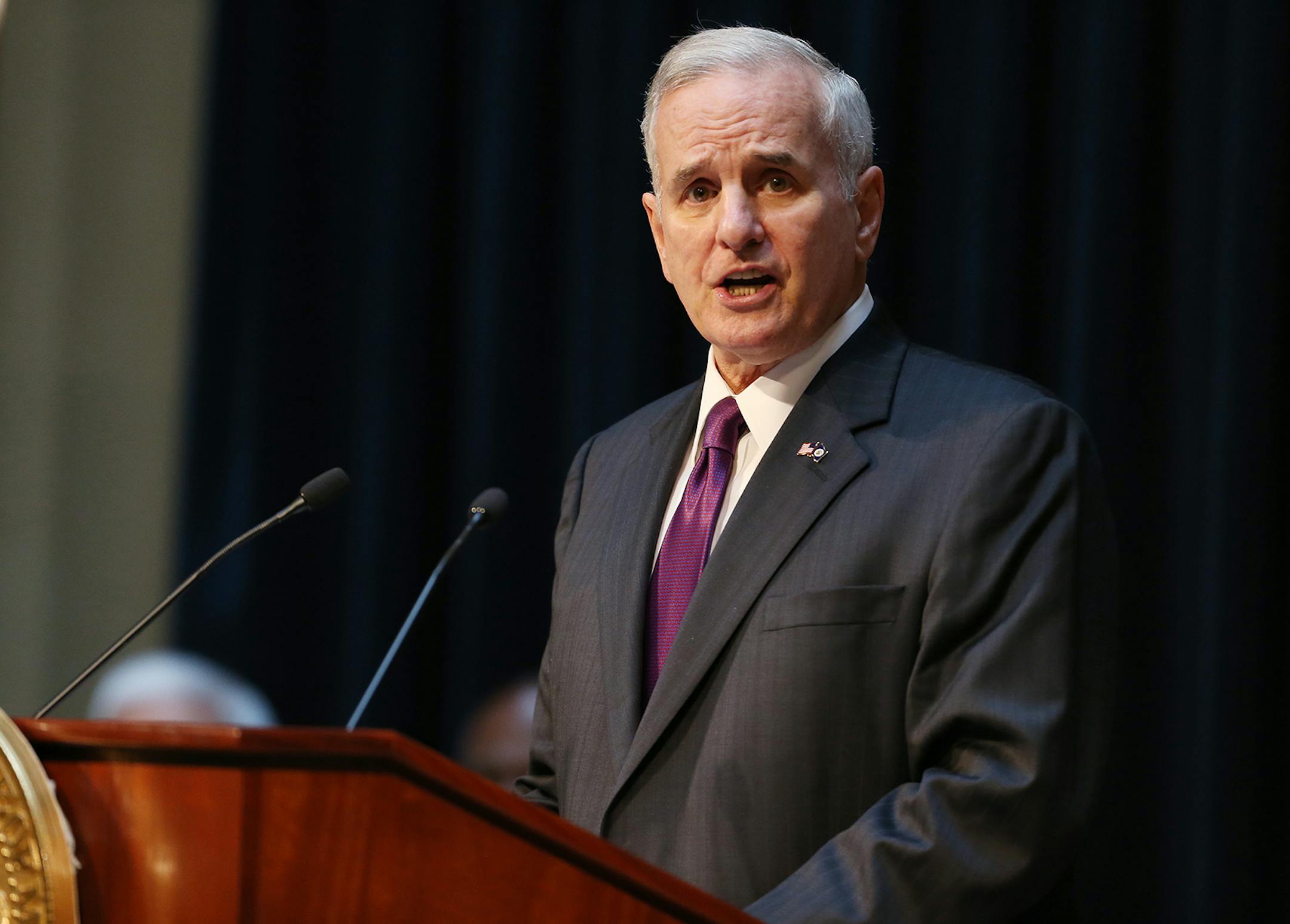
"Our citizens have long known that a good education is the key to our success. Now, we need to realize that a good education is the key to our survival," Dayton said in an inaugural speech that doubled as a road map to his goals for a legislative session that starts Tuesday.
Re-elected in November by a healthy margin, Dayton took his oath of office from Minnesota Chief Justice Lorie Skjerven Gildea before a crowd of several hundred people at the Landmark Center in downtown St. Paul. In between rousing performances by a gospel choir and a color guard presentation, Attorney General Lori Swanson and State Auditor Rebecca Otto also were sworn in for new terms, and two new executive branch officers began theirs: Lt. Gov. Tina Flint Smith and Secretary of State Steve Simon, all DFLers.
The 67-year-old Dayton is now underway with what he promises will be his political swan song, after four decades in and out of politics. As the governor took his oath Monday, his son Eric stood by his side, holding Dayton's only grandchild, 21-month-old Hugo. Dayton thanked his 96-year-old father, Bruce Dayton, also in the audience, and pointed out there were "four generations of Dayton here today."
Dayton started his 17-minute speech by tallying the economic successes of his first term. "We gather today at a much better time," he said, noting the state unemployment rate was 6.8 percent when he took office and now sits at 3.7 percent.
"We have added over 191,000 jobs during the past four years — and we're not done yet," Dayton said. He cited predictions by economists that the U.S. is poised to enter a period of even more robust economic growth.
But Dayton quickly pivoted away from overt optimism, raising alarm about an issue that Democrats both nationally and in Minnesota have emphasized with increasing frequency in recent years: income inequality.
Dayton said inequities in wealth and income between the wealthiest Americans and everyone else "explains the large divide between the new optimism on Wall Street and the persistent pessimism on Main Street, where real wages and median family incomes have continued to fall, even during this recovery."
![Governor Mark Dayton is sworn in greeted grandson Hugo held by Dayton's son Eric. ] GLEN STUBBE * gstubbe@startribune.com Monday January 5, 2015 Next Monday, January 5, Governor Mark Dayton and Lt. Governor-Elect Tina Smith will take the oath of office at an official inauguration ceremony beginning at 12:00pm at the Landmark Center in St. Paul. 138026](https://arc.stimg.co/startribunemedia/H3LNGA7J42AHC7QFI63KGWF4QE.jpg?&w=1080)
![Lt. Governor Tina Smith is sworn in. ] GLEN STUBBE * gstubbe@startribune.com Monday January 5, 2015 Next Monday, January 5, Governor Mark Dayton and Lt. Governor-Elect Tina Smith will take the oath of office at an official inauguration ceremony beginning at 12:00pm at the Landmark Center in St. Paul. 138026](https://arc.stimg.co/startribunemedia/TL77NXH7NACFISHQG4K25JOT5M.jpg?&w=1080)
![Gov. Mark Dayton poses for photos with the Greater Mount Vernon Baptist Church Choir after the Inauguration Ceremony at Landmark Center in St. Paul on Monday, January 5, 2015. ] LEILA NAVIDI leila.navidi@startribune.com /](https://arc.stimg.co/startribunemedia/6KPQXUH5Q5DTNQKE2KQDR3K4KA.jpg?&w=1080)
![Former Governor Wendell Anderson, Senator Amy Klobuchar, Former Vice President Walter Mondale. ] GLEN STUBBE * gstubbe@startribune.com Monday January 5, 2015 Next Monday, January 5, Governor Mark Dayton and Lt. Governor-Elect Tina Smith will take the oath of office at an official inauguration ceremony beginning at 12:00pm at the Landmark Center in St. Paul. 138026](https://arc.stimg.co/startribunemedia/KAANLALU63HEDQGUN7COOSHXLQ.jpg?&w=1080)
![Greater Mount Vernon Baptist Church Choir. ] GLEN STUBBE * gstubbe@startribune.com Monday January 5, 2015 Next Monday, January 5, Governor Mark Dayton and Lt. Governor-Elect Tina Smith will take the oath of office at an official inauguration ceremony beginning at 12:00pm at the Landmark Center in St. Paul. 138026](https://arc.stimg.co/startribunemedia/NBUIXAIG6HW3W62GNZHYUSWZO4.jpg?&w=1080)


