

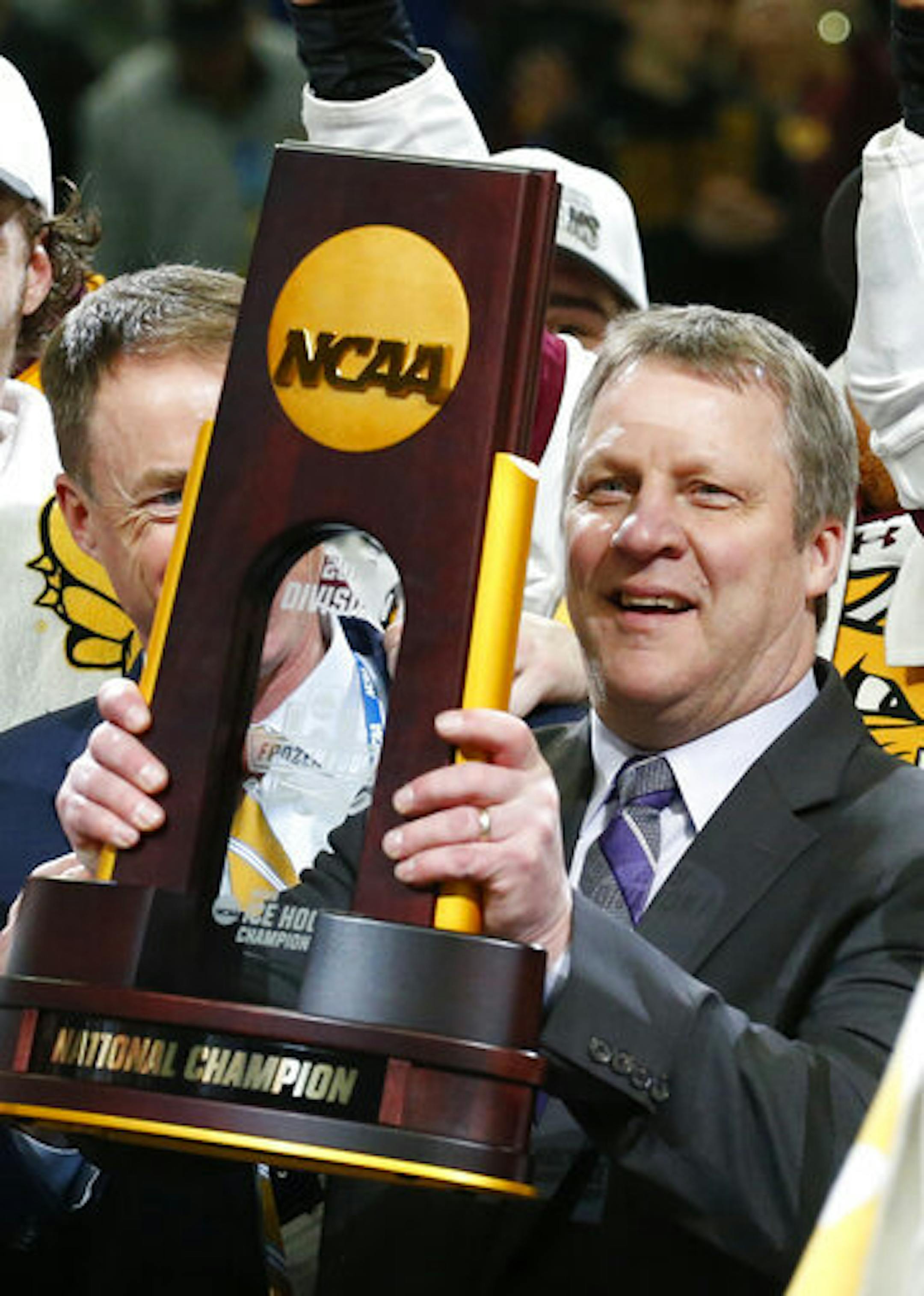
DULUTH — On April 9, 2011, in his 11th season at Minnesota Duluth, Scott Sandelin and his Bulldogs captured the program's first NCAA men's hockey championship, defeating Michigan 3-2 in overtime in a thrilling Frozen Four final at Xcel Energy Center.
"I remember telling my wife, 'We're going to enjoy this one because it might not ever happen again,' " Sandelin said.
History shows that Sandelin might have been selling himself and his program short when he made that declaration to his wife Wendy, but nobody can knock him for fully celebrating a title. Since then, the Bulldogs have captured two more NCAA championships (2018 and '19) and nearly won another (a one-goal loss in the 2017 final).
On Friday night, that third NCAA banner will reach the rafters in AMSOIL Arena before the Bulldogs open the 2019-20 season against Massachusetts Lowell. It's a coronation that Minnesota Duluth has a chance to three-repeat next fall. Only one team has won three consecutive NCAA men's titles. That was Michigan from 1951 through '53, and you're likely in your 70s if you remember those. The Bulldogs, flush with 20 returnees from last season's team, are embracing the challenge of history.
"There's no complacency," standout defenseman Scott Perunovich declared during the Duluth stop of Puck Drop's Tour of Minnesota. "Everyone wants a third in a row."
Sandelin won't pump the brakes on that optimism, though he knows hockey is a sport in which oddities occur, especially in a single-elimination situation.
"The most surprising one was '18," he said of his three national championship teams. "We had such a young team. Last year, I felt we had a better team to make a run at it, with those guys gaining experience. That's how it works sometimes. Talking with other coaches, it's amazing how many say their best teams haven't won it."
He pointed to a recent conversation with Brendan Morrison, captain of the 1996-97 Michigan team that entered the Frozen Four with a 35-3-4 record and designs on a second consecutive national championship only to fall 3-2 to Boston University in the semifinals. North Dakota, with Sandelin as an assistant, won the title that year.


